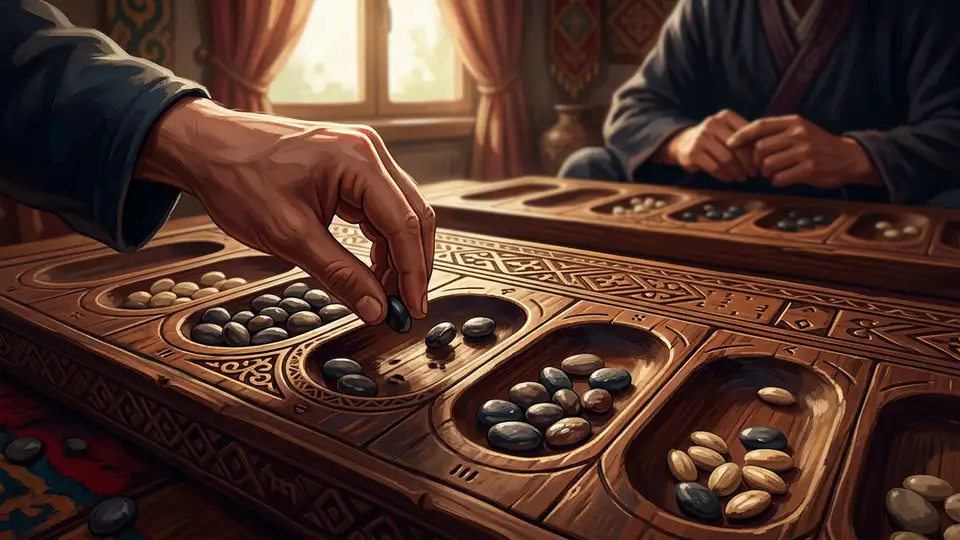
The rules create the strategic landscape. The modern game starts with nine stones in each of the nine holes on both sides, for 162 stones total. Since 82 stones are more than half, 82 is enough to win. Captures happen when your last stone lands in an opponent's hole and makes its count even. A tuzdik can be created when the last stone makes an opponent's hole contain exactly three stones, with important restrictions: only one tuzdik per player, not in the ninth hole, and not in the symmetrical hole to the opponent's tuzdik.
Use this page as a practical training checklist, not as an official ranking of champion secrets. The rules facts are checked against public sources; the strategy habits are Toguz Arena practice heuristics for deciding what to calculate after the rules are clear.
What makes champion strategy different
A casual player often asks, "How many stones can I take now?" A stronger player asks three questions before moving: what do I take, what do I leave, and what can the opponent take back? A useful beginner framework is to estimate both the stones you attack on the opponent's side and the stones you protect on your own side. The best move is often the one with the strongest combined attack-and-defense score, not the largest immediate capture.
That idea scales well. It is simple enough for a beginner, but it points toward champion thinking: every move has a visible result and a hidden cost.
Strategy 1: control the central holes
The central holes, especially the fourth, fifth, and sixth holes, are useful because stones from them often reach important targets without emptying your whole side too early. This is not a rigid rule. Sometimes an edge move is best. But central holes usually give more flexible routes for attack, defense, and tuzdik pressure.
When you study a position in Toguz Arena, look at the central zone first. Ask whether the center helps you reach a large odd hole on the opponent's side or whether moving from the center opens one of your own large holes to capture.
Strategy 2: count the last stone before looking at the prize
Every tactical idea starts with one concrete calculation: where does the last stone land? If it lands on your side, you may have changed structure but not captured. If it lands in an opponent's hole and makes that hole even, the stones move to your kazan. If it makes exactly three and the tuzdik restrictions allow it, the position may change for the rest of the game.
Champions train this until it becomes automatic. They do not stare at all nine holes equally. They first identify candidate holes whose last stone reaches an important target.
Strategy 3: protect parity on your own side
Parity is the heartbeat of Togyz Kumalak. A large odd hole on your side can be dangerous if the opponent can land one stone there and make it even. A defensive move often works by changing your valuable holes to even counts, so the opponent can no longer capture them with a simple last-stone landing.
| Pattern | Risk | Champion habit |
|---|---|---|
| Large odd hole on your side | Opponent may make it even and capture. | Check whether a quiet move protects it before attacking elsewhere. |
| Large odd hole on opponent's side | It can become your target. | Search for a route where your last stone lands there. |
| Several vulnerable holes at once | One attack may not solve the defensive problem. | Compare attack value with protected-stone value. |
Strategy 4: build tuzdik pressure, but do not rush it
A tuzdik is powerful because every later stone entering that hole is captured by its owner. But the strongest tuzdik is not always the first possible tuzdik. It should be in a hole that will receive stones often. The same practical idea applies to timing: choose a tuz/tuzdik where many stones are likely to pass, and avoid waiting so long that the board empties and the hole loses value.
In analysis, test both lines: one where you create the tuzdik now, and one where you keep the threat. A threat can be stronger than the immediate action if it forces the opponent into defensive moves.
Strategy 5: deny the opponent's best reply
A move is not good just because it wins stones. It is good if the opponent cannot answer more strongly. Before making an attractive capture, count the opponent's most natural reply. If your capture wins 8 but gives back 14, the move was not a champion attack. It was a tempo gift.
Use the AI review after the game to compare your move with the best defensive alternative. Often the engine's recommendation will be quieter than the human eye expects.
Strategy 6: keep flexible holes
Flexibility means having more than one useful candidate move. If all your threats depend on one overloaded hole, the opponent can often neutralize your plan by changing a single parity pattern. Good players keep several playable routes: one attacking route, one defensive route, and one route that improves future tuzdik pressure.
Strategy 7: do not empty your side without a plan
The game can end when a player has no legal moves, and the remaining stones are awarded according to the rules. That makes emptying your side a serious strategic decision. In some endgames it is correct. In the middlegame it can hand the opponent control over the timing of the next phase.
Strategy 8: recognize critical moments
Not every move deserves the same amount of calculation. Save deep thinking for moments where one of three things is true: a large capture is available, a tuzdik can be created or prevented, or one player may soon run out of moves. These are the positions where a single inaccurate move can decide the game.
Strategy 9: build a small variation tree
Full calculation is impossible for humans. The branching problem grows quickly: from the starting position there can be nine candidate moves, and after one capture the opponent may still have eight replies, producing 72 first-step continuations before deeper branches. Champions do not calculate everything. They calculate the most forcing branches first.
A practical tree is enough: my best attack, opponent's best capture, my best reply. Then compare that line with the best defensive move.
Strategy 10: review wins, not only losses
Many players analyze only painful defeats. Champions analyze wins too, because a bad move can be hidden by a later opponent mistake. In Toguz Arena, review three moments after every game: the biggest capture, the first tuzdik decision, and the move where the evaluation changed most sharply.
If you repeat this process, the ten strategies stop being a checklist and become one habit: count accurately, choose purposefully, and verify your assumptions after the game.
What to read next
For rule verification, start with the Toguz Arena wiki and the federation and source hub. For current competition context, use the events hub. For practice, open browser play, then review one critical moment in the AI Trainer and compare it with the move-counting guide.
Sources for factual checks
- PlayStrategy: Togyzqumalaq rules - starting setup, 162 stones, 82-stone win condition, captures, tuzdik and restrictions.
- Toguz Arena move-counting guide - internal practice model for last-stone counting, parity and forcing-line review; not an official federation source.
- UNESCO ICH: Togyzqumalaq, Toguz Korgool, Mangala/Göçürme - cultural context and strategic-thinking value of the game.