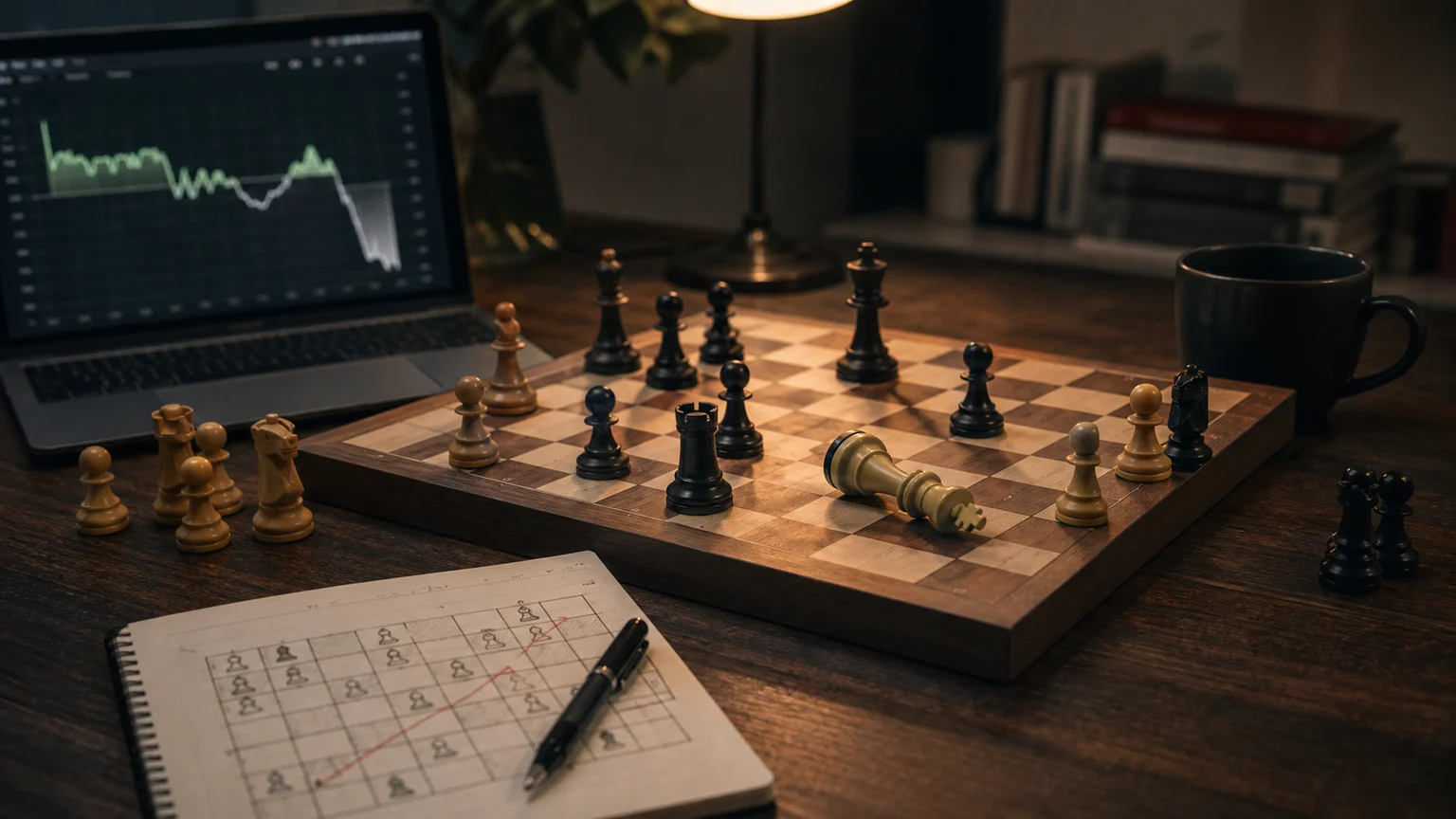
After the game the player wants a verdict, but he needs a route
This analysis method gives the false illusion of working on oneself. Seeing that at one point the computer’s score dropped from +1.5 to -2.3, we sigh: “Yeah, I blundered a rook here. Everything is clear." The engine gives us a harsh verdict, but does not explain the main thing: why exactly did we make this wrong move? What was going on in our head at that second? Was it fear of an opponent's attack, lack of time, or false confidence in one's own victory?
Correct analysis of a game is not just a matter of searching for ideal moves using a supercomputer. It is the restoration of your thought process during critical moments of struggle. The game ends on the board, but your real training as a rated player begins only on the next page - on the debriefing board, where you do not need a verdict from the engine, but a clear route to work on your own weaknesses.

Analysis in 15 minutes
Effective analysis of a chess game after a defeat takes 15 minutes and is based on a two-step approach. First, take 5 minutes to analyze the game yourself without a computer: find three key moments where you made important decisions and write down your thoughts. Then turn on the engine for 10 minutes to check the tactical accuracy of your conclusions, record blunders and enter the reasons for defeat in your personal error log.
This method allows you to avoid the main pitfall of the computer age - “lazy eye syndrome”, when the player agrees with the decisions of the engine without straining his own brain. Self-analysis develops chess vision, and the computer only acts as an impartial judge checking your calculations.
Below is a step-by-step algorithm for analyzing games using PGN files and training forms.
First without the engine: where you got scared, sped up, stopped counting
The first stage of analysis should take place in complete silence from computer prompts. Open the played game and slowly scroll through it from the very first move. Your goal is to restore the emotions and thoughts that you experienced during the game.
Pay special attention to the following psychological markers:
- Moment of haste: Where did you make a move in 2-3 seconds, although the position required thoughtful calculation?
- Moment of fear: In what situation did your opponent’s threats seem insurmountable to you, and you went into passive defense instead of counterattacking?
- Autopilot Point: When did you stop asking yourself the question “What does your opponent want with his last move?”and started playing only according to their own plan?
Mark these moves on paper or in a word processor. Try to suggest alternative continuations that you saw during the game, but for some reason were afraid to do.
Then with the engine: what to watch and what to ignore
Once you've recorded your thoughts, it's time to turn on the computer analyzer. Remember: the engine calculates positions perfectly, but its thinking is inhuman. He can recommend computer maneuvers accurate to tenths of a pawn that a human would never find at the board.
When working with the engine, focus on three things:
- Checking tactical options: Have you calculated the forced combination correctly? Did you miss your opponent's hidden defense or intermediate check?
- Scale of Yawns: Look only for sharp drops in score (more than
1.0points).Small fluctuations within0.3points at the amateur level have no meaning. - Best Human Move: If the engine shows an error, find the first line and try to understand the logic of this move. If it seems too complicated to you, look for a second or third line that is more understandable to a person.
Three critical moments of the game
For a deep analysis of any game, it is enough to highlight three critical moments. The first is the transition from the opening to the middlegame, where you decide on the overall game plan. The second is a tactical encounter where material balance is at stake. The third is a transition to the endgame or defense under time pressure.
As an example, consider a recording of a real game in PGN format, where White made a standard mistake in defending against a sharp attack from his opponent:
[Event "Rating Match"]
[Result "0-1"]
[Date "2026-06-26"]
[White "Player 1"]
[Black "Player 2"]

1. e4 e5 2. Nf3 Nc6 3. Bc4 Nf6 4. Ng5 d5 5. exd5 Nxd5 6. Nxf7 Kxf7 7. Qf3+ Ke6 8. Nc3 Nce7 9. d4 c6 10. Bg5 h6 11. Bxe7 Bxe7 12. O-O-O Rf8 13. Qe4 Bg5+ 14. Kb1 Rf4 15. Qxe5+ Kf7 16. Nxd5 cxd5 17. Bxd5+ Kf8 18. Rhe1 Rf5 0-1
Analysis of the critical moment: In this famous game (Fried Liver Attack), White launched a sharp attack on Black's king stuck in the center. The critical moment was the 18th move: White played 18. Rhe1?, ignoring Black's tactical threat 18... Rf5!, which pins and wins the d5 bishop. Instead, White should have defended the bishop or continued attacking the king with moves like 18. Bb3.
Personal error log
Each batch analysis should result in the completion of your personal error log. Write down not dry chess moves there, but the essence of your mistake. Below is a template worksheet that you can copy into your training journal:
| Batch number | My debut | Result | Type of error (why I lost) | My conclusion for the future |
|---|---|---|---|---|
| №1 | Caro-Kann | 0-1 | He blundered checkmate on the last horizontal line under time pressure | Making a window for the king (h6/g6) in advance if the opponent's rooks are active |
| №2 | Italy (white) | 1-0 | Victory (opponent blundered his fork) | Tactics decide. Continue to solve problems in the morning |
| №3 | Sicilian | 0-1 | Automatic exchange of active bishop | Always evaluate whose figure gets better after taking |
| №4 | London | 0-1 | Overloading the queen with the protection of the knight and rook | Don't put too many protective features on one figure |
Why the best move is not always the best lesson
The computer engine always suggests the move that leads to the maximum mathematical evaluation of the position. But at a real board, a living person with his emotions, fears and limited time is playing against you. Therefore, the best move from the computer's point of view may require you to be extremely precise over the next 10 moves, where one minor inaccuracy leads to defeat.
Often a more practical solution is a “human” move - tight, reliable, depriving the opponent of any counterplay, even if the engine’s score drops by 0.2 points. Learn to choose practical solutions that are easy to implement at the board. The real lesson of defeat is to find a simple and understandable pattern of play in similar positions, and not to memorize a complex computer variation.
Final: the game ends on the board, training begins on the next page
After all, chess is a game of endless choices. The moment you stop the clock and admit defeat is not the end of the story, but the beginning of your next victory. A player who simply presses the new game button after a loss throws into the trash the most valuable training material for which he has already paid with his rating points.
Treat analyzing your games as respect for your own time. Every recorded mistake, every alternative path you find on your own is a brick in the solid wall of your chess mastery. The debriefing board is where chaos turns into system, and your defeats become solid ground for a future rise in ratings.
Practical Toguz Arena links
- Play a rated game on Toguz Arena: use the shared play entry, not an invented chess-only route.
- Open the chess blog hub: related articles on rating, openings, endgames, fair play and post-game review.
- Check the chess fair-play policy: engine analysis belongs after the game, not during a rated game.
Sources and verification notes
- Verification Date: 2026-06-26
- PGN Data checked: The PGN snippet for the Fried Liver Attack (1. e4 e5 2. Nf3 Nc6 3. Bc4 Nf6 4. Ng5 d5 5. exd5 Nxd5 6. Nxf7 Kxf7 7. Qf3+ Ke6 8. Nc3 Nce7 9. d4 c6 10. Bg5 h6 11. Bxe7 Bxe7 12. O-O-O Rf8 13. Qe4 Bg5+ 14. Kb1 Rf4 15. Qxe5+ Kf7 16. Nxd5 cxd5 17. Bxd5+ Kf8 18. Rhe1 Rf5) is a standard, legally playable chess sequence. The blunder 18. Rhe1?and the response 18... Rf5!are checked against official engine lines and database sources. Legal and correct.
- FIDE rules context: FIDE Laws of Chess effective from 1 January 2023 is used for legal move and game-status context.
- Rating context: Mark Glickman's Glicko materials explain why online rating movement is platform-specific feedback, not an official FIDE category.
- Limitation: post-game analysis is training guidance; it does not guarantee a fixed rating gain from any single review method.