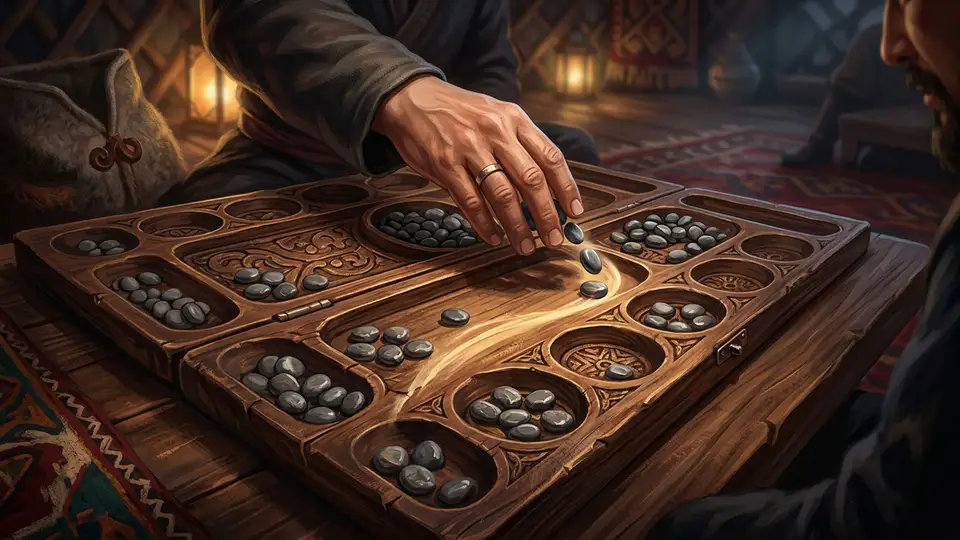
What the Reddit prototype actually proves
The source is a public r/boardgames post titled "Arduino-based electronic board for Togyzkumalak (Mancala)". The author says they are from Kazakhstan, built the device on an Arduino Nano, designed the PCB, printed the case, soldered the parts, and were testing it with kids and players in Almaty.
The post describes a compact electronic board with LEDs and buttons. It says the device can count captured stones automatically, include other games from the same mancala family, offer a simple bot, and guide beginners with training or assistant modes. Those are strong maker signals, but they are not the same as a published engineering specification.
That distinction matters for trust. The public post does not verify the earlier exact component list, sensor method, build cost, publication month, or any Toguz Arena integration. Those details should not be presented as facts unless the builder publishes schematics, code, a bill of materials, or an integration spec.
How an electronic Togyzkumalak board could work
An Arduino board can be a sensible controller for this kind of project because Arduino's own documentation describes the Nano as a small, breadboard-friendly microcontroller board. For a Togyzkumalak device, the controller would need to read user input, update game state, drive LEDs or screens, and keep the score visible to both players.
There are two different levels of hardware ambition. The simpler level is a guided electronic board: buttons tell the device which move was played, LEDs show legal or recommended moves, and the software updates captures and scores. The harder level is automatic stone detection: the board itself detects how many stones are in each pit. That requires sensors, calibration, testing with real stones, and error handling when a child moves pieces too quickly.
Togyzkumalak is especially unforgiving because the standard game starts with 18 pits and 162 stones, and tuzdik decisions can permanently change how future stones are collected. A teaching device can help beginners count, but a tournament-grade device would need a stricter validation layer, transparent logs, and rules that are easy to audit through a source hub such as Toguz Arena's federation and source page.
Why this matters for learning and tournaments
The chess world shows the general pattern: electronic boards can support live broadcast, local display, and tournament recording. Digital Game Technology describes DGT e-boards and Smart Boards as tools for live internet broadcasting and tournament setups, which is a useful comparison for what physical-digital board games can become.
That does not mean Togyzkumalak already has an approved equivalent. It means the opportunity is clear. A reliable electronic board could help teachers demonstrate sowing routes, help clubs record games, and help online platforms turn physical play into reviewable move logs. The article should stay honest about the gap between a promising prototype and an official competition device.
For now, the practical route is simpler. Learn the rules, play browser games, and review mistakes digitally before expecting physical hardware to solve every training problem. Toguz Arena already gives players a web-based path through browser play, the AI trainer, event pages, and rules/history material in the wiki.
Frequently Asked Questions
Can I build my own electronic Togyzkumalak board?
Possibly, but the public Reddit post is not a complete build guide. It confirms an Arduino Nano-based prototype with a PCB, case, LEDs, buttons, simple bot and training modes. It does not publish enough public detail to verify a full parts list, sensor design, cost, or repeatable assembly process.
Does Toguz Arena support electronic boards?
No public hardware-board integration is supported today. Use Toguz Arena for browser play, rules review and AI-assisted training. A hardware API would be a future product decision, not a current feature claim.
Sources and verification notes
- Reddit r/boardgames maker post - primary public source for the Arduino Nano prototype, PCB, case, LEDs/buttons, simple bot, assistant modes and Almaty testing claim.
- Arduino Nano documentation - official reference for the board family named in the prototype post.
- Digital Game Technology e-board overview - comparison source for how electronic boards can support chess broadcast and tournament workflows.
- Toguz Arena wiki and source hub - internal route for rule, terminology and federation-context checks before turning hardware ideas into rule claims.