That timeline matters more than a simple medal list. It shows that elite Togyz Kumalak is not built from talent alone. It is built from early exposure, constant calculation, correction after losses, tournament pressure, and mentors who know how to turn a board game into a disciplined thinking system.
What is publicly known about Asel Daliyeva
Daliyeva's published profile gives several anchor facts for understanding her career. She began with family support: her mother introduced and encouraged her love of board games. She became a master of sports at twelve, then continued into international-level performance as a teenager. The same profile says she became a six-time champion in the under-20 category and later trained athletes who competed internationally.
One important detail for this article is her view of the game itself. Daliyeva has emphasized that Togyz Kumalak does not require physical strength in the way many sports do. The winning qualities are decision-making, correct strategy, hard work, analysis, and the ability to learn from defeat. That is exactly why her story fits a training article: the reader can copy the process even if they cannot copy the biography.
| Career marker | Verified public detail | Training lesson |
|---|---|---|
| Early start | Started playing at age nine. | Pattern recognition grows fastest when players meet many positions early. |
| Rapid development | Became a master of sports three years later. | Structured practice beats casual repetition. |
| International standard | Fulfilled international standards by age sixteen. | Strong players learn to perform under formal tournament conditions. |
| Coaching impact | Trained players who later competed internationally. | A champion's method becomes stronger when it can be taught to others. |
The making of a champion
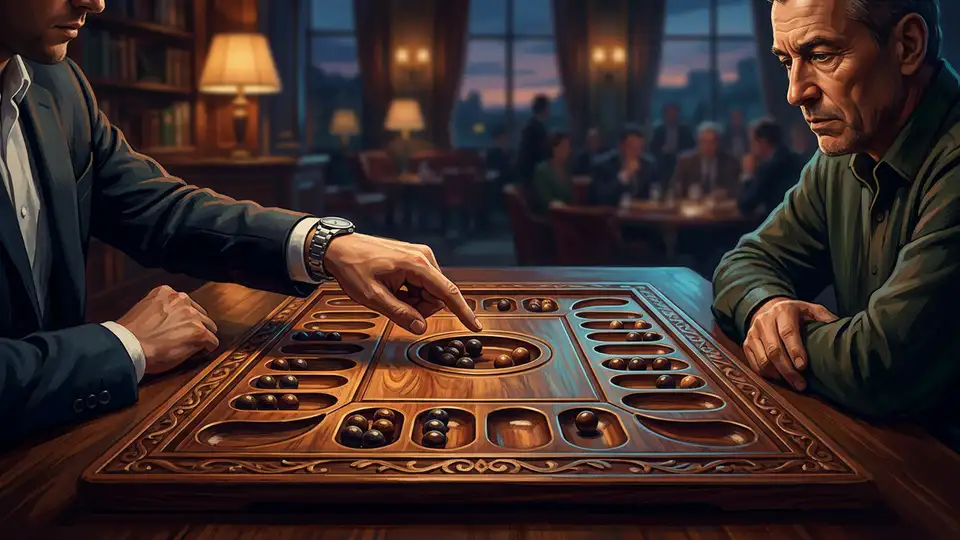
Every champion begins with the same physical position: eighteen holes, 162 stones, and no advantage. What changes over time is the player's ability to see the board. A beginner sees stones. A tournament player sees last-stone landing squares, parity, capture routes, tuzdik threats, tempo, and endgame exits.
Daliyeva's career points to a realistic development path. First comes rules fluency: the player stops thinking about how sowing works and starts thinking about where the final stone lands. Next comes tactical fluency: the player notices odd and even targets, protects valuable holes, and avoids giving back more than they capture. Finally comes strategic fluency: the player chooses a plan that still works after the opponent's best reply.
This is why a short "play more games" recommendation is not enough. Champions do not merely play. They review, compare, and correct. After every serious game, ask three questions: which move changed the score, which move changed the structure, and which move changed the opponent's options?
Training across time controls
A public 2024 NewVenture Games roundup lists Daliyeva among the women's Classic and Rapid winners and also on the women's Blitz podium. Because that source is a video description rather than an official federation archive, it should be treated as a public roundup, not as the only historical record. Still, the format itself is instructive: classical, rapid, and blitz test different parts of the same skill.
- Classical games reward deep calculation, patient tuzdik planning, and endgame conversion.
- Rapid games reward practical evaluation: choosing a good move quickly instead of searching forever for the perfect move.
- Blitz games reward stored patterns, clean counting, and emotional control after a surprise capture.
If you want to train like a competitor, do not play only one format. Use slow games to build understanding, rapid games to test practical choices, and short games to expose counting mistakes. Then review the same position without the clock and identify whether the problem was calculation, strategy, or nerves.
How AI changes champion preparation
Modern players have tools that earlier generations did not have. In March 2026, Kyzylorda hosted a "Champion" tournament format where strong players tested themselves against artificial intelligence. Local reporting described the AI as a system that can learn the national game's rules and respond according to the opponent's moves; 24KZ later reported that players found the AI difficult because it calculates several moves ahead and can suggest unfamiliar tactical methods. Those reports prove a public AI-training context, not a published engine benchmark or an official Toguz Arena performance claim.
For a human player, the practical use of AI is not to copy every engine move. The goal is to discover the moment where your own evaluation became unreliable. In Toguz Arena, treat the AI trainer as a second coach:
- Mark the first move where the evaluation changed sharply.
- Compare your move with the suggested move.
- Write the reason in plain language: parity, capture, tuzdik, tempo, or endgame.
- Replay a similar position until the pattern feels familiar.
Mental toughness is trained, not gifted
Daliyeva's public comments about defeat are important because they remove the myth that champions never fail. In a game with deep branching, even strong players lose. The difference is what they do next. A weak review says, "I was unlucky." A useful review says, "I allowed this capture because I did not count the last stone after my opponent's reply."
Use a simple review routine after every game:
- One tactical error: the exact move where stones were lost.
- One strategic error: the plan that made the position difficult.
- One psychological error: the moment you rushed, defended passively, or kept attacking after the position required control.
Your own champion path
The lesson from Asel Daliyeva's career is not that every reader will become a world champion. The lesson is that improvement has a shape. Start early if you can, but if you are already an adult, start structured. Play, review, isolate one mistake, solve similar positions, and return to the board with a sharper habit.
On Toguz Arena, a practical weekly plan is enough: three serious games on the play board, three reviews in the AI trainer, one sandbox session for a critical position, and ten minutes of puzzle work on the pattern you missed most often. Use the rules wiki and move-counting guide whenever a position review exposes a basic counting mistake.
Practical Toguz Arena links
If this profile is your entry point, treat it as a training map rather than a medal archive. For rules and notation, start with the Togyz Kumalak wiki. For public organizations and source context, use the federations and source hub. For tournament context, compare this story with the events hub, the World Championship overview, and the women in Togyz Kumalak article. Then return to the board through online play and the AI trainer.
Sources
Fact-check note: the Astana Times profile is the strongest source for Daliyeva's biography. The Kyzylorda-news.kz and 24KZ reports support the public AI-tournament context only. The NewVenture Games YouTube description is treated as a public 2024 roundup, not as an official federation archive.