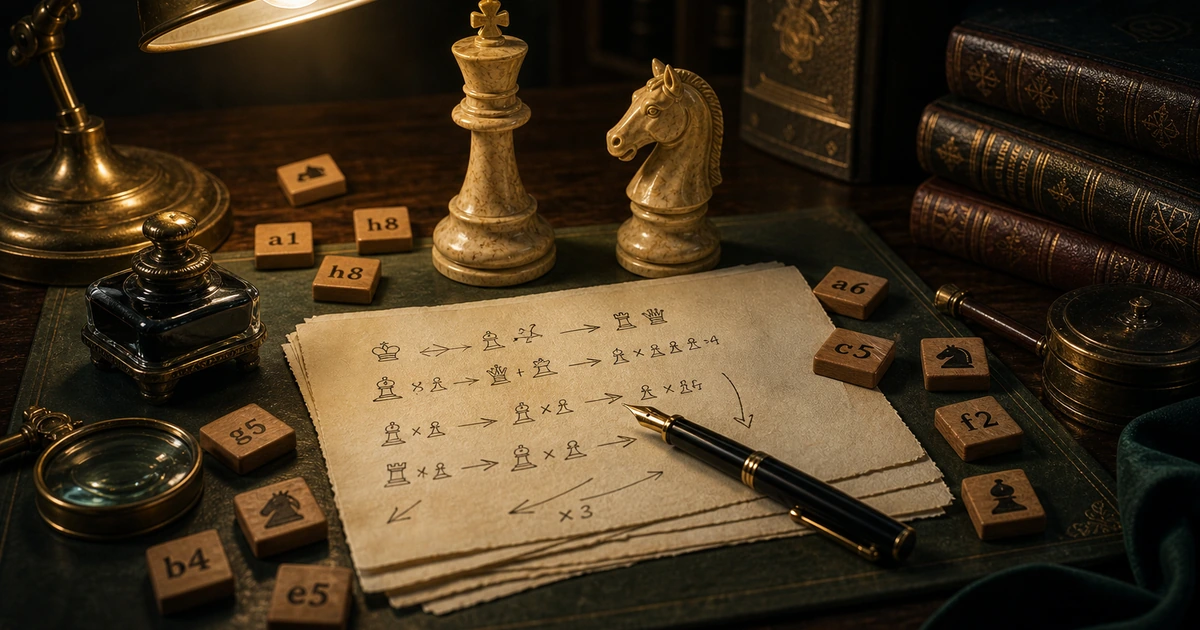
Main idea: notation is not paperwork. It is the memory layer that lets you return to the exact position where the game changed.
Why chess notation matters
Notation lets a chess game survive after the pieces are put away. Without it, you can remember a few moments, but you cannot reliably reconstruct every move. With notation, a game becomes something you can analyze, send to a coach, enter into a database, or replay years later.
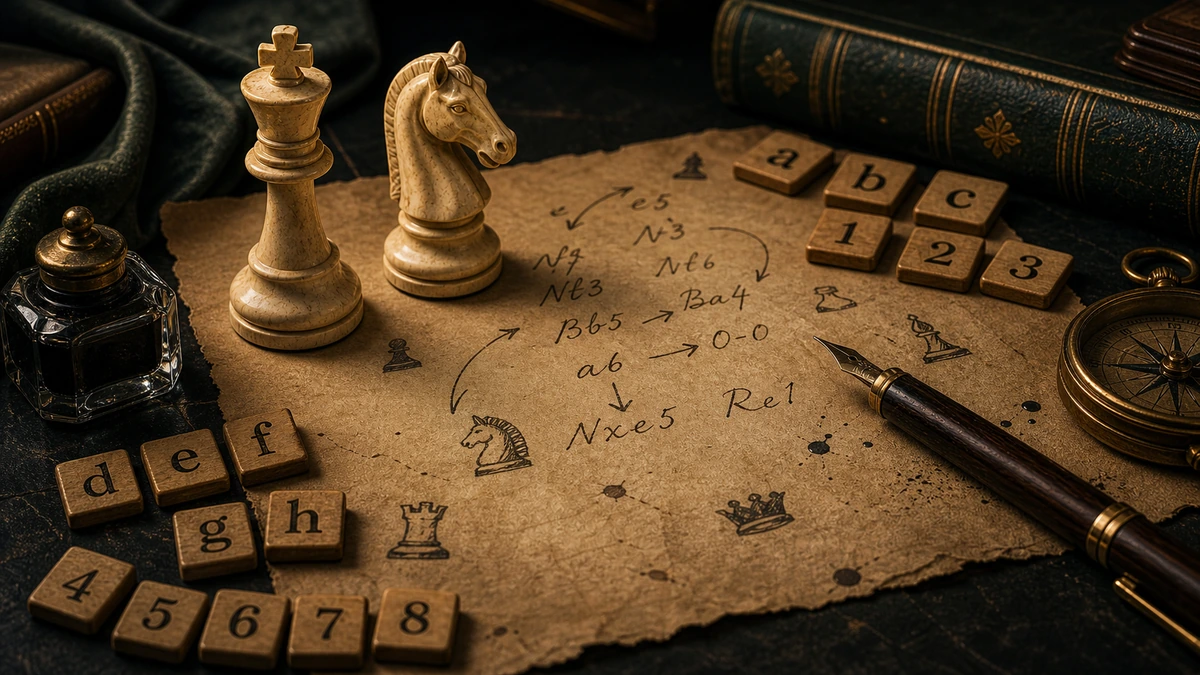
The commercial platform describes a score sheet as a record of moves in an over-the-board game, along with player names, the result, event, date, and other details. That is the practical value: notation turns a live game into a usable record.
For beginners, notation also improves board vision. When you know that e4 is not just "the middle square" but a file-and-rank address, you start seeing the board more clearly. That makes puzzles, lessons, and game reviews much easier.
Notation also makes chess less dependent on memory. Instead of saying "I think I moved my bishop somewhere near the king," you can write the move and return to the exact position later. That precision is what allows a short club game to become a useful lesson.
Board coordinates first
Every square has a coordinate. The files are the vertical columns named a through h. The ranks are the horizontal rows numbered 1 through 8. Put them together and you get square names such as e4, c6, h7, and a1.
House of Staunton uses e4 as a beginner example: the square is e4 because it lines up with the e-file and the fourth rank. That is the whole idea. File first, rank second.
The fastest way to learn coordinates is to name squares out loud while you play or solve puzzles. Do not start with every notation symbol at once. First become comfortable seeing that a knight on f3, a pawn on e4, and a king on g1 all have exact addresses.
If coordinates feel slow, practice from both sides of the board. Many players know the board from White's side but hesitate when Black's pieces are at the bottom. The square names do not rotate. The a-file is still the a-file, and the eighth rank is still the eighth rank.
Coordinate notation
Coordinate notation writes where a piece starts and where it goes. House of Staunton describes it as writing the starting square, a dash, and the destination square. A rook moving from e4 to b4 can be written as e4-b4.
This style is beginner-friendly because it shows both squares. If a piece moves from b4 to b8, the notation b4-b8 tells you the whole path idea. It is not the compact style most players use in published games, but it is useful for learning the board.
Coordinate notation also helps when algebraic notation feels too compressed. If you cannot yet read Nf3 instantly, writing g1-f3 can remind you that the knight started on g1 and moved to f3.
| Notation style | Example | What it emphasizes |
|---|---|---|
| Coordinate notation | e2-e4 | Start square and destination |
| Algebraic notation | e4 | Move number, piece if needed, destination |
| Castling notation | O-O | Special king move |
| Checkmate marker | Qh4# | Move plus result marker |
Algebraic notation basics
Algebraic notation is the compact form most chess players see in books, lessons, and game scores. The commercial platform explains that algebraic notation shows the move number, the piece name, and the destination square.
Piece letters are simple but one of them surprises beginners. The commercial platform lists king as K, queen as Q, rook as R, bishop as B, and knight as N because K is already taken by the king. Pawns have no letter. If a pawn moves to e4, the move is written as e4, not Pe4.
That means Nf3 is a knight move to f3, Bb5 is a bishop move to b5, and Qh5 is a queen move to h5. The destination square is always doing a lot of work. Learn coordinates well and algebraic notation becomes far less mysterious.
Captures, check, checkmate, and castling
The commercial platform says captures use a lower-case x. If a bishop captures on c6, algebraic notation can show Bxc6. For pawn captures, the starting file matters: a pawn from the b-file capturing on c6 is written bxc6.
Check is marked with + at the end of a move. Checkmate is marked with #. That is why a move like Qh4# tells you not only where the queen moved, but that the move delivered mate.
Castling has its own notation. Chessprogramming notes the common castling strings O-O for kingside castling and O-O-O for queenside castling. Do not confuse the capital letter O with the number zero when typing games into some tools.
Sometimes two identical pieces can move to the same square. House of Staunton gives examples such as Rac1 or Rfc1 to show which rook moved, and Nbd2 or Nfd2 to show which knight moved. This extra letter removes ambiguity.
Scoresheets and common beginner mistakes
A scoresheet is the paper or form where moves are recorded. The commercial platform says score sheets record the moves, player names, game result, event, date, and other game details. It also says score sheets help reduce disputes and allow later analysis.
House of Staunton warns about a common beginner mistake: writing White's first move on one line and Black's first move on the next. In a normal scoresheet, White's first move and Black's first move belong to the same move number. White plays move 1, Black replies on move 1, then both players move to move 2.
If your notation gets messy, fix the habit early. Write the move number, write White's move, write Black's move, and keep the rows aligned. The goal is not calligraphy. The goal is a record you can replay later.
Practice routine for learning notation
Start with coordinates for five minutes a day. Pick random squares and name them. Then reverse the exercise: say "f6" and point to the square. The open-source platform has a coordinate trainer, and even a physical board works if you cover the labels after a while.
Next, copy a short game in algebraic notation and play it on a board. Say the piece and destination before moving. For example, Nf3 means knight to f3, not "some knight move I recognize from an opening."
Finally, record one of your own games. It can be a casual slow game. Afterward, replay it from your scoresheet. Any place where you cannot reconstruct the position shows what notation habit needs practice.
For club players, the practical first target is simple: read pawn moves, piece letters, captures, check, checkmate, and castling without stopping. Disambiguation and technical notation can come after that.
Here is a small drill. Write a four-move opening in algebraic notation, then rewrite the same moves in coordinate notation. For example, compare e4 with e2-e4 and Nf3 with g1-f3. The two systems describe the same movement from different angles, and seeing both helps the notation become concrete.
Another useful habit is to replay a game from the notation without moving until you understand each symbol. If you see Bxc6+, say the meaning in plain language: bishop captures on c6 and gives check. Translating notation this way turns symbols into board actions.
Keep the first practice games short. A complete ten-move game written clearly teaches more than a full scoresheet that you cannot replay accurately afterward.
FAQ
What does e4 mean in chess?
It means the square on the e-file and fourth rank. If a pawn move is written as e4, a pawn moved to that square.
Why is knight written as N?
Knight uses N because king already uses K. The commercial platform lists the other main letters as Q for queen, R for rook, and B for bishop.
What does x mean in chess notation?
The lower-case x marks a capture. For example, Bxc6 means a bishop captured on c6.
What is a chess scoresheet?
A scoresheet records an over-the-board game: moves, players, result, event, date, and other details. It lets players and organizers reconstruct the game.
Sources
- House of Staunton - Chess Notation Handout: https://www.houseofstaunton.com/pages/chess-notation-handout. Used for coordinates, coordinate notation, and beginner scoresheet mistakes.
- Chess.com - Chess Notation & Algebraic Notation: https://www.chess.com/terms/chess-notation. Used for algebraic notation, piece letters, captures, check, and checkmate.
- Chessprogramming - Algebraic Chess Notation: https://www.chessprogramming.org/Algebraic_Chess_Notation. Used for SAN, coordinate notation, and castling notation context.
- Chess.com - Chess Score Sheet: https://www.chess.com/terms/chess-score-sheet. Used for scoresheet purpose and recorded fields.
- Lichess - Chess board coordinates trainer: https://lichess.org/training/coordinate. Used for coordinate-practice context.