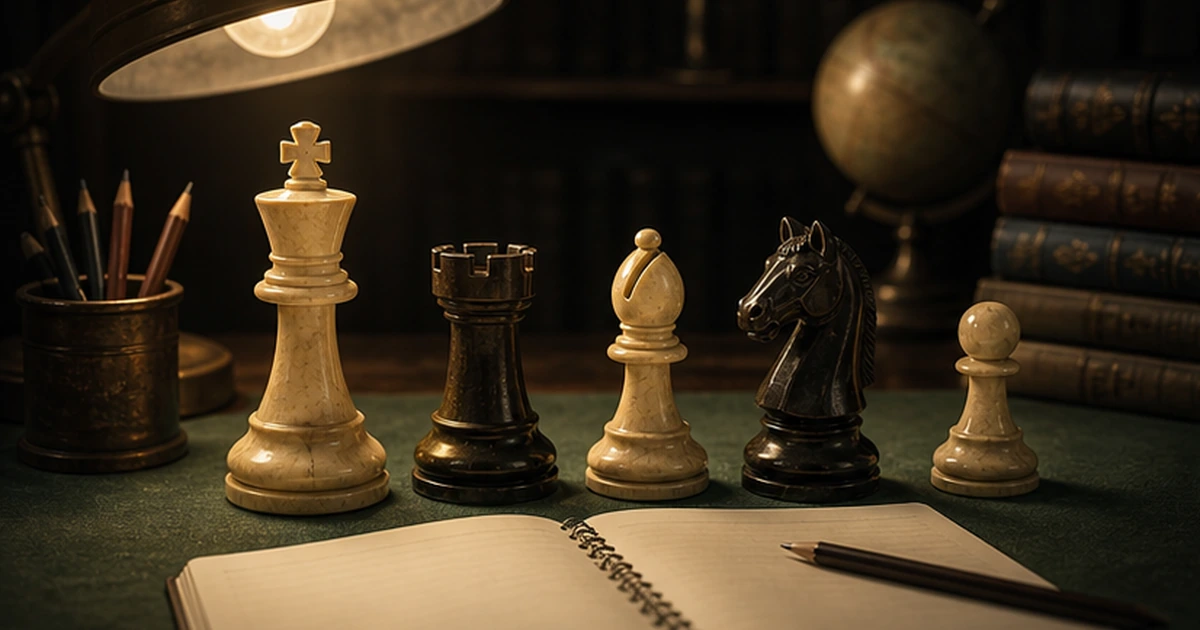
The Chessboard and How to Set Up the Pieces
A chessboard has 64 alternately coloured dark and light squares arranged in an 8x8 grid, according to regencychess.co.uk. Before placing a single piece, make sure the board is oriented correctly: the square in each player's bottom-right corner must be a light square.
Each player begins with 16 pieces. The back rank (the row closest to you) is set up in a fixed order from the outside in. According to regencychess.co.uk, the rooks occupy the corner squares, the knights sit beside them, the bishops go next to the knights, the queen takes the central square that matches her colour (white queen on a light square, black queen on a dark square), and the king stands on the remaining square beside the queen. The eight pawns fill the entire row directly in front of these pieces — the second rank for White and the seventh rank for Black.
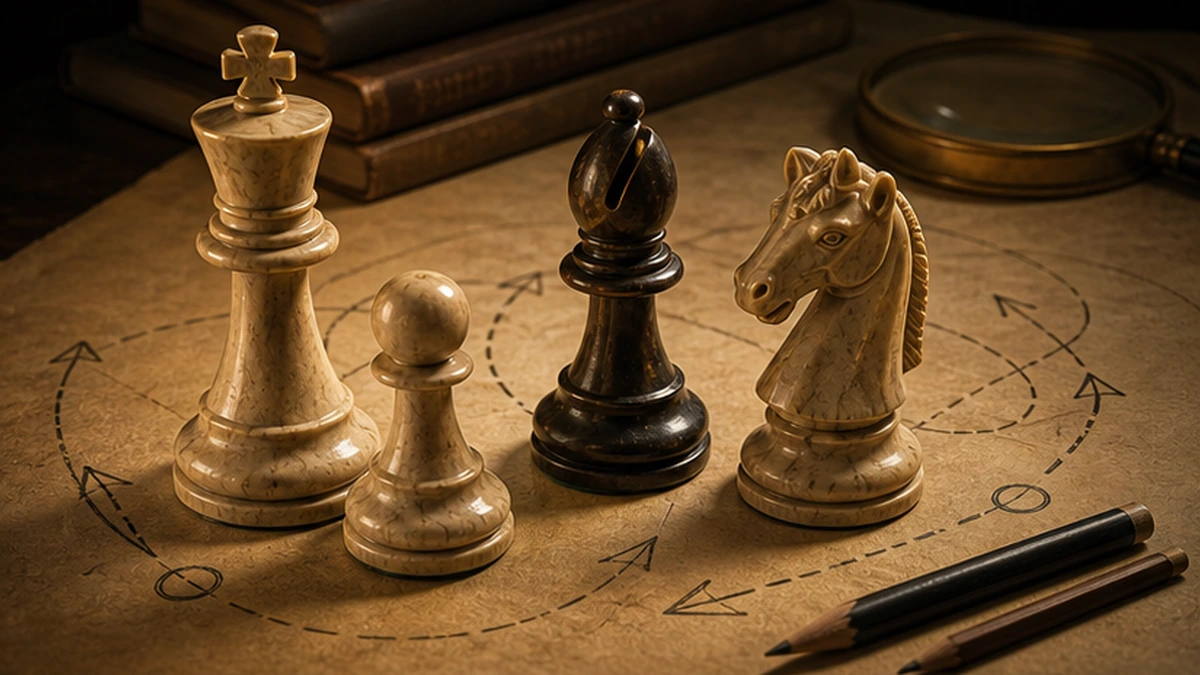
White always makes the first move. Players alternate turns, moving one piece at a time, with the goal of trapping the opponent's king.
How Every Piece Moves
Each of the six piece types moves in a distinct pattern. Learning them is straightforward once you group them by behaviour.
King — The king moves one square in any direction: vertically, horizontally, or diagonally. According to regencychess.co.uk, a king can never move directly beside the opposing king. It also cannot move to a square that is under attack.
Queen — The queen is the most powerful piece. She can move any number of squares in any direction — horizontally, vertically, or diagonally — as long as there are no pieces blocking the path. According to chesshouse.com, the queen's unmatched range is sometimes playfully described as the piece that "owns the moon," a metaphor for her sweeping control of the board.
Rook — The rook moves any number of squares horizontally or vertically. It cannot jump over other pieces but can capture an enemy piece by landing on its square.
Bishop — The bishop moves any number of squares diagonally. Because it stays on squares of one colour for the entire game, each player has a light-square bishop and a dark-square bishop.
Knight — The knight moves in an L-shape: two squares in one direction (horizontal or vertical) and then one square perpendicular to that direction, or one square first and then two. According to chesshouse.com, a knight can move backwards just as easily as forwards — the L-shape applies in every direction. The knight is the only piece that can jump over other pieces of either colour.
Pawn — Pawns are the least powerful but most numerous pieces. According to regencychess.co.uk, a pawn can move either one or two squares forward on its very first move; after that it moves only one square forward each turn. A pawn captures diagonally forward — one square to the left or right — and can never move backwards.
| Piece | Movement pattern | Beginner note |
|---|---|---|
| King | One square in any direction. | Never move into check. |
| Queen | Any distance along ranks, files or diagonals. | Powerful, but early queen moves can waste time. |
| Rook | Any distance horizontally or vertically. | Works best on open files and ranks. |
| Bishop | Any distance diagonally. | Each bishop stays on one colour complex. |
| Knight | L-shape and can jump over pieces. | Useful when the board is crowded. |
| Pawn | Forward moves, diagonal captures. | First move can be one or two squares. |
Practical Tip: When you are learning, focus on getting your knights and bishops into the game early (developing your pieces) and moving your king to safety by castling before you worry about deep strategy. These two habits prevent most opening mistakes.
Castling: The King's Special Escape
Castling is the only move in chess that lets you move two of your own pieces at once — the king and one rook. According to regencychess.co.uk, the king moves two squares left or right toward the chosen rook, and the rook jumps to the square on the king's other side.
There are two types. Kingside castling (notated as O-O) moves the king toward the rook on the h-file. Queenside castling (notated as O-O-O, according to chesshouse.com) moves the king toward the rook on the a-file. In queenside castling the king travels two squares, but the rook travels three squares — a greater distance.
Castling is only legal when all four of these conditions are met, as described by regencychess.co.uk:
- Neither the king nor the chosen rook has moved yet in the game
- All squares between the king and the chosen rook are empty
- The king is not currently in check
- The king does not move through a square that is attacked by an enemy piece and does not end up in check
Many beginners forget the fourth condition. You cannot castle "through check" — if the square the king passes over is under attack, the move is illegal even if the king's starting and ending squares are safe.
En Passant and Pawn Promotion
Two special pawn rules surprise almost every new player.
En passant (French for "in passing") applies when a pawn advances two squares from its starting position and lands directly beside an opposing pawn. According to regencychess.co.uk, the opposing pawn may capture it as if it had only moved one square — the capturing pawn moves to the square the first pawn jumped over. This capture is only available on the very next turn. If the opponent makes any other move first, the opportunity is lost forever.
Promotion occurs when a pawn reaches the opposite end of the board — the eighth rank for White or the first rank for Black. According to regencychess.co.uk, the pawn must be converted into a bishop, knight, rook, or queen of the same colour. The new piece takes effect immediately. According to chesshouse.com, it is theoretically possible to have up to nine queens on the board at once (your original queen plus all eight promoted pawns), though in practice most promotion positions involve one or two extra queens.
Check, Checkmate, and Winning the Game
When a piece attacks the opponent's king, the king is said to be in check. According to regencychess.co.uk, a player whose king is in check must escape immediately by one of three methods:
- Move the king to a safe square that is not under attack
- Capture the attacking piece
- Block the attack by placing another piece between the king and the attacker
Blocking is not possible when the attacker is a knight, because knights jump over pieces. It is also impossible against a double check (two pieces attacking the king at once) — only moving the king can escape that situation.
Checkmate occurs when the king is in check and has no legal way to escape. The game ends immediately, and the player who delivered checkmate wins. This is the only way (besides an opponent's resignation) to win a chess game.
How a Chess Game Can End in a Draw
Not every chess game ends with a winner. According to regencychess.co.uk, there are five ways a game can end in a draw:
- By agreement — both players agree that neither can force a win
- Stalemate — the player whose turn it is has no legal moves but their king is not in check. The game ends in a draw
- Insufficient material — neither side has enough pieces left to deliver checkmate (for example, king vs. king, or king and bishop vs. king)
- Threefold repetition — the same position occurs three times, and a player claims the draw
- Fifty-move rule — no piece has been captured and no pawn has moved for fifty consecutive moves by each player
Stalemate is the draw type that beginners encounter most often and find most frustrating. According to chesshouse.com, the best way to avoid stalemate when you are winning is to make sure your opponent's king always has at least one legal move available unless you are delivering checkmate.
Algebraic Notation: Reading and Writing Moves
Algebraic notation is the standard system for recording chess moves. According to chesshouse.com, each square on the board has a unique coordinate: the vertical columns (files) are labelled a through h from left to right from White's perspective, and the horizontal rows (ranks) are numbered 1 through 8 from White's side of the board.
A move is written as the piece's initial letter (K for king, Q for queen, R for rook, B for bishop, N for knight — note that the knight uses N because K is taken) followed by the destination square. For example, Qd4 means the queen moves to the d4 square.
Pawns are the exception: a pawn move is written with only the destination square. The move e4 means a pawn moves to the e4 square, with no piece letter needed.
Captures are written with an x between the piece and the square: Bxf6 means a bishop captures whatever piece is on f6. Castling is recorded as O-O for kingside and O-O-O for queenside, as chesshouse.com confirms.
Learning notation lets you read chess books, follow online games, and review your own matches — it is well worth the five minutes it takes to memorise the coordinate system.
Frequently Asked Questions
Can a knight move backwards in chess?
Yes. According to chesshouse.com, a knight moves in its characteristic L-shape regardless of direction — forward, backward, or sideways. This makes the knight one of the most versatile pieces, especially in closed positions where other pieces struggle to manoeuvre.
What does O-O-O mean in chess?
O-O-O is the notation for queenside castling (chesshouse.com). The king moves two squares toward the rook on the a-file, and the rook moves to the square next to the king on the opposite side. Single O-O means kingside castling.
How many queens can you have in chess?
You can have up to nine queens of the same colour at once — your original queen plus one queen for each of the eight pawns you manage to promote. According to chesshouse.com, most commercial chess sets now include extra queens because having two queens on the board at the same time is fairly common in practice.
Can the king move diagonally in chess?
Yes. According to chesshouse.com, the king can move one square in any direction — vertically, horizontally, or diagonally — as long as that square is not under attack by an enemy piece. This diagonal movement is essential in endgame combat, where the king becomes an active fighting piece.
What is a blunder in chess?
According to chesshouse.com, a blunder is a significant mistake that severely weakens a player's position, often losing material or the game itself. Blunders differ from minor inaccuracies in that they dramatically shift the balance of the game, turning a winning or equal position into a losing one.
Sources
- chesshouse.com — F.A.Q. Chess Rules (https://www.chesshouse.com/pages/faq-chess-rules)
- regencychess.co.uk — Chess Rules (https://www.regencychess.co.uk/chess_rules.html)