What Is a Chess Tactic?
A chess tactic is a sequence of forcing moves — checks, captures, and threats — that achieves a concrete objective. That objective is usually winning material, delivering checkmate, or reaching a winning endgame. Tactics are distinct from strategy: strategy deals with long-term plans, pawn structures, and piece placement, while tactics are the short-term explosions that decide most games below master level.
The standard method for spotting tactics is the CCT protocol: Checks, Captures, Threats. Before every move, scan for checks first (they are the most forcing), then captures, then direct threats. This simple routine catches the vast majority of tactical opportunities and also prevents blunders — because if you look for your opponent's threats as carefully as your own, you rarely miss a danger.
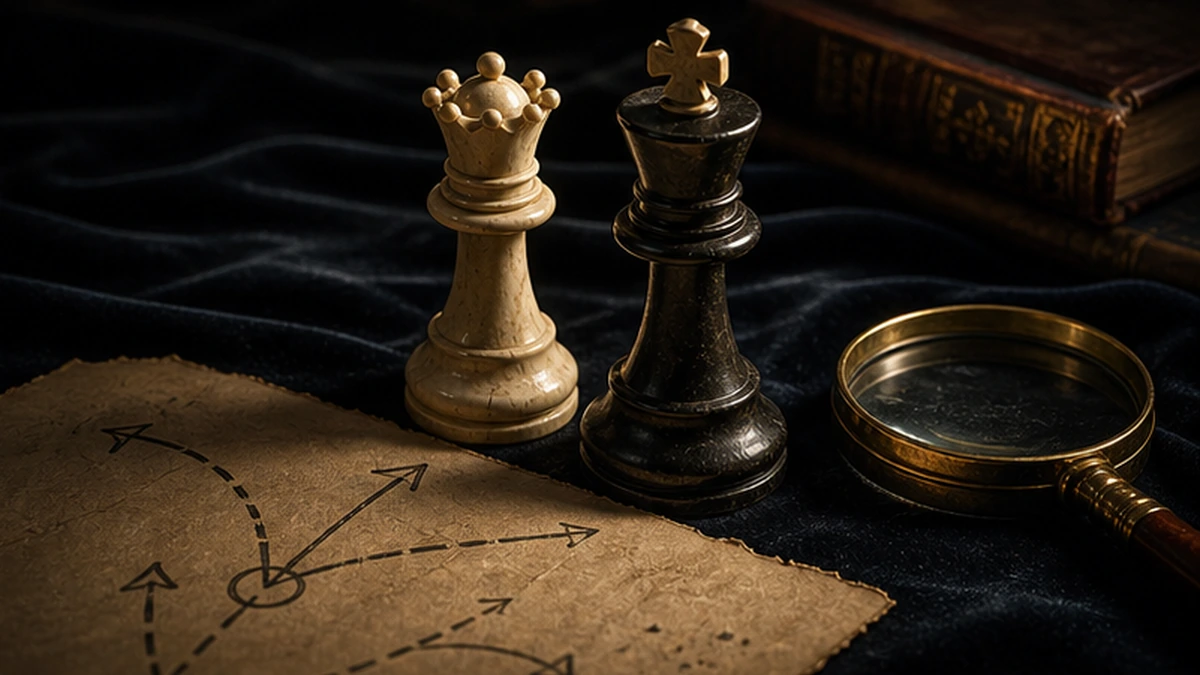
Two tactical concepts every player should master are blunders and mate-in-two puzzles. Together they cover the full range of tactical decision-making, from avoiding catastrophe to finishing the game with precision.
Blunders: When One Move Changes Everything
A blunder is a move that turns a winning or equal game into a losing one. It is more severe than a mistake, which worsens your position but may not be immediately decisive. In chess, a blunder is widely understood as a move that shifts the evaluation by more than two pawns — the kind of error you regret the moment you take your hand off the piece.
Common blunder types include hanging a piece, overlooking a checkmate threat, moving into a fork, or miscalculating a tactical line. All blunders share a failure of pattern recognition: the player did not see the opponent's threat or did not realize the consequence of their own move.
| Concept | Typical Evaluation Impact | Common Cause |
|---|---|---|
| Inaccuracy | Less than 1 pawn | Minor positional concession |
| Mistake | 1–2 pawns | Positional or tactical oversight |
| Blunder | More than 2 pawns | Complete tactical failure |
The practical takeaway is simple: the distinction matters less than whether you lost. The way to reduce blunders is not to calculate more deeply, but to train pattern recognition so that common tactical motifs become automatic.
Mate in Two — The Shortest Forcing Sequence
A mate-in-two puzzle challenges you to deliver checkmate in exactly two moves, regardless of what the opponent plays in between. This is the shortest possible forcing sequence, and it is the ideal training tool for beginner and intermediate players. The first move is often a check, but it can also be a quiet move that sets up an unstoppable threat on the next turn.
The open-source platform offers a dedicated "Mate in 2" puzzle theme where players must "Deliver checkmate in two moves." One puzzle from this collection, puzzle #SexrH, has been played 24,020 times and comes from a 5+0 blitz game — a reminder that mate-in-two positions arise even in real rapid games, not just in puzzle collections. FM Ryan Harper of Trinidad and Tobago created an open-source platform study titled "Beginner Practice Puzzles (Ratings of 700–1000)" that specifically tests "checkmates in two moves" alongside double attacks and discovered attacks. The study contains 10 puzzles designed for players at the 700–1000 rating level, making it an excellent starting point for beginners.
SparkChess offers 45 mate-in-two puzzles in its catalog, along with 61 mate-in-three puzzles and 34 mate-in-four puzzles. The platform categorizes puzzles by difficulty: Easy (21 puzzles), Moderate (88), and Hard (36). Each puzzle includes historical details and can be played live against the computer, which means you can experiment with different replies rather than simply reading a solution.
Common Mate-in-Two Patterns
Most mate-in-two puzzles fall into a handful of recognizable patterns. The back-rank mate uses a rook or queen to deliver checkmate along the eighth rank when the enemy king is trapped behind its own pawns. The smothered mate uses a knight to deliver check while the king is surrounded by its own pieces. Queen-and-bishop batteries create diagonals that the opponent cannot block in time. Rook lifts — moving a rook to an open file or rank — often set up mate threats that the opponent cannot meet.
What these patterns share is what FM Ryan Harper's study calls "co-operation of two pieces." A single piece rarely delivers checkmate — it takes two or more working together to cover the escape squares and deliver the final blow. This is why double attacks and discovered attacks are the building blocks of mate-in-two patterns: they force the opponent to deal with two threats at once, and the second threat becomes unstoppable.
How Mate-in-Two Puzzles Build Tactical Vision
Mate-in-two puzzles are the best starting point for tactical training because they limit the search tree. With only two moves to calculate, the cognitive load is low enough to focus on pattern recognition rather than deep calculation. As your skill grows, you can move to mate-in-three puzzles (SparkChess lists 61 of those) and eventually to open-ended puzzles on Chess Tempo, which offers a rating system to target puzzles at your level.
The training value of mate-in-two puzzles goes beyond checkmate patterns. Every mate-in-two puzzle trains you to think in forcing moves: "If I play this check, can he block? If he blocks, do I have a checkmate on the next move?" This mental habit — thinking in terms of forced sequences — is the same habit that prevents blunders. When you are used to scanning for forcing sequences, you are far less likely to overlook your opponent's forcing threat.
For club players: start with the open-source platform's "Mate in 2" puzzle theme or FM Ryan Harper's beginner study. Solve 10–15 puzzles per day for two weeks. Do not rush — the goal is to recognize the pattern, not to solve as fast as possible. Once you solve most mate-in-two puzzles within 30 seconds, move to mate-in-three puzzles for the next level of challenge.
How Blunders and Mate-in-Two Connect
A blunder is what happens when you miss a forcing sequence. A mate-in-two is a forcing sequence you correctly identify. These two concepts are different expressions of the same tactical skill.
FM Ryan Harper's beginner study tests "co-operation of two pieces to do double attacks and checkmates in two moves." This co-operation is the thread that connects blunders and mate-in-two patterns. When two pieces work together, they can create a mating net (mate in two). And when you fail to see the co-operation between your opponent's pieces, you blunder.
The CCT protocol — Checks, Captures, Threats — helps with both. Scanning for checks helps you find mate-in-two patterns. Scanning for captures helps you avoid blundering material. And scanning for threats helps you recognize danger before it strikes.
Training Resources for Each Concept
| Platform | Best For | Target Rating | Free? | Key Feature |
|---|---|---|---|---|
| the open-source platform | Mate-in-2 puzzles, beginner study | 700–1500 | Yes | "Mate in 2" theme (24,020+ plays), FM Ryan Harper study (10 puzzles) |
| SparkChess | Mate-in-2 through mate-in-7 | All levels | Yes | 45 mate-in-2 puzzles, historical game details, playable against computer |
| Chess Tempo | Rated tactics progression | All levels | Free tier | Rating system targets puzzles to your level |
| the commercial platform | Puzzle variety, forum puzzles | All levels | Free tier | Community puzzle threads with discussion |
The open-source platform is the best free resource for pure mate-in-two training. The "Mate in 2" puzzle theme delivers a steady stream of two-move checkmates drawn from real games, and FM Ryan Harper's beginner study offers 10 curated puzzles that test the fundamental patterns. SparkChess is useful for variety — its 45 mate-in-two puzzles come with historical context and the ability to play the position against the computer.
Chess Tempo takes a different approach with rating-based training. According to Chess Tempo (single source), the platform lets users "receive chess puzzles targeted at your level" through a free registered rating system. This is valuable once you have mastered mate-in-two patterns and want to tackle longer forcing sequences.
Frequently Asked Questions
What is the difference between a blunder and a mistake?
A blunder is more severe than a mistake. A blunder turns a winning or equal game into a losing one, while a mistake worsens your position without necessarily being decisive. Many players think of a blunder as an error that shifts the evaluation by more than two pawns.
How do I get better at mate-in-two puzzles?
Practice daily on the open-source platform's "Mate in 2" puzzle theme or use FM Ryan Harper's beginner study designed for players rated 700–1000. Focus on recognizing patterns — back-rank mates, smothered mates, queen-bishop batteries — rather than calculating from scratch.
How do I stop blundering in my games?
Use the CCT protocol (Checks, Captures, Threats) before every move. Solve 10–15 tactics puzzles daily to sharpen pattern recognition. Play slower time controls so you have time to double-check your planned move. Most blunders happen not because you cannot calculate, but because you did not look.
What is the fastest way to improve tactical vision?
Solve at least 10–15 mate-in-two puzzles daily for two to three weeks. These build the foundation for all other tactical patterns. Once mate-in-two becomes automatic, move to mate-in-three puzzles and then to open-ended tactics. The key is consistency — ten minutes of daily puzzle training is more effective than two hours once a week.
Summary
Blunders, mate-in-two patterns, and zugzwang are the three pillars of practical chess tactics. A blunder is what happens when you miss a forcing sequence. A mate-in-two is a forcing sequence you correctly identify. Zugzwang is a position where every legal move is itself a blunder. All three train the same skill: the ability to recognize patterns of piece co-operation and forcing moves.
The fastest way to improve all three is consistent puzzle training. Start with mate-in-two puzzles on the open-source platform, use FM Ryan Harper's beginner study for foundation patterns, then expand to SparkChess and Chess Tempo. Scan the board with the CCT protocol before every move.
Train these concepts daily, and you will blunder less, spot more checkmates, and recognize endgame opportunities you would have missed before.
Sources
- Lichess — Mate in 2 puzzle theme. https://lichess.org/training/mateIn2. Used for mate-in-two puzzle count, puzzle #SexrH game data.
- Lichess study by FM Ryan Harper — Beginner Practice Puzzles (700–1000). https://lichess.org/study/ayTRRsJs/1stfnhKx. Used for beginner puzzle curriculum and tactical themes.
- SparkChess — Mate in 3 chess puzzles catalog. https://www.sparkchess.com/mate-in/three. Used for puzzle counts, difficulty categorization, and historical puzzle descriptions.
- Chess.com forum — Easy Chess Puzzles by GM JMB2010 (2011). https://www.chess.com/forum/view/more-puzzles/chess-puzzles-for-low-rated-players. Used for forum puzzle thread context.
- Chess.com forum — Hard mate in 3 by gchkAdrianWong (2020). https://www.chess.com/forum/view/more-puzzles/hard-mate-in-3-3. Used for mate-in-3 forum discussion context.
- Chess Tempo — Chess Tactics and Puzzles. https://chesstempo.com/chess-tactics/. Used for Chess Tempo rating system description (single source).