Strategy vs. Tactics: Understanding the Difference
In chess, strategy involves long-term planning — piece development, pawn structure, king safety, and endgame goals. Tactics, on the other hand, focus on immediate opportunities: a fork that wins material, a pin that paralyses the opponent, a skewer that cuts through a defended line, or a checkmate that ends the game on the spot.
For beginners and intermediate players, tactics matter most because games at these levels are often decided by a single tactical blow rather than a deep strategic plan. Recognising tactical patterns is the fastest path to consistent improvement, which is why major platforms structure their training around puzzles.
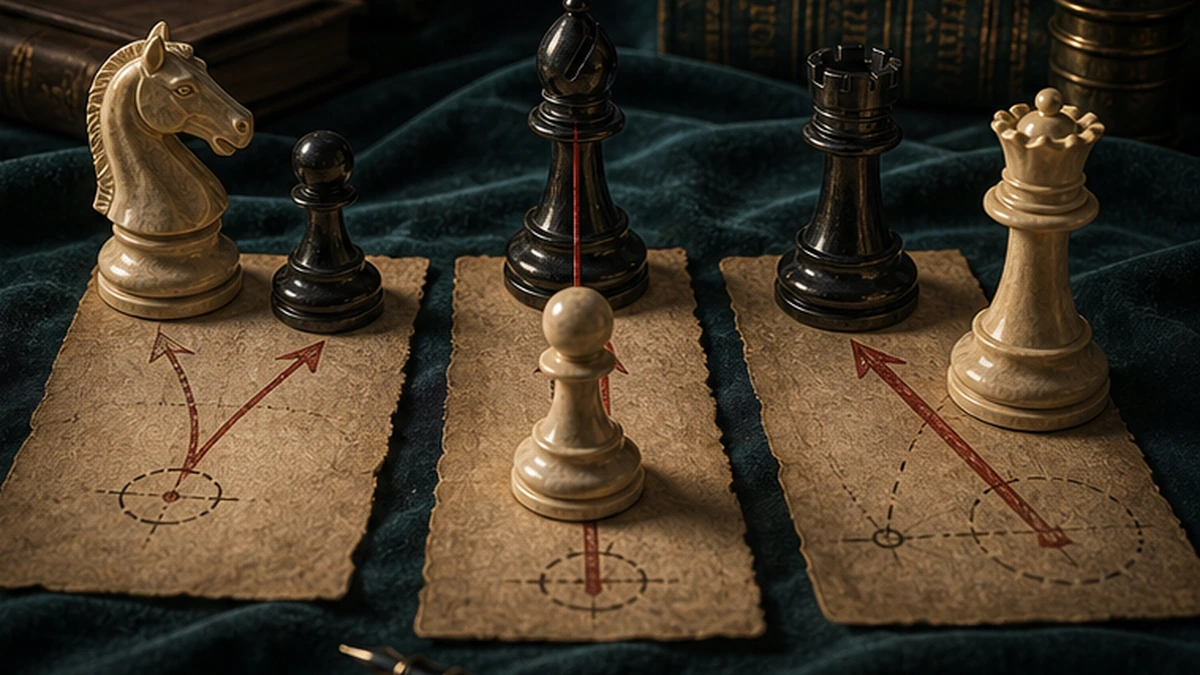
Key idea: a tactic matters only when you can name the target, the forcing move, and the gain before you touch the piece.
| Tactical motif | What it attacks | First training cue |
|---|---|---|
| Fork | Two or more targets at once | Look for checks and loose high-value pieces. |
| Pin | A piece that cannot move freely | Trace lines to the king, queen, or rook behind it. |
| Skewer | A valuable front piece hiding a weaker one | Ask what falls after the front piece moves. |
| Checkmate pattern | The king's escape squares | Count checks, blockers, and defenders before calculating. |
The Fork — Attacking Two Targets at Once
A fork is one of the most powerful and common tactics in chess. It occurs when a single piece attacks two or more enemy pieces simultaneously. Since the opponent can only respond to one threat, you win material on the next move.
Knights are the most famous forking pieces. Their unique L-shaped movement makes them hard to track, and they can reach squares that no other piece can. But knights are not alone — pawns can fork two pieces, and queens, with their versatile movement, can fork multiple pieces across the board. Bishops and rooks can also deliver forks when the geometry of the position allows.
A classic example: a knight on b5 forks the opponent's king on e8 and rook on a8 by moving to c7. The king must move out of check, and the knight captures the rook on the following turn. This single move turns an equal position into a winning material advantage.
Fork Subtypes Every Player Should Know
Grandmaster Gabuzyan Hovhannes, writing for ChessMood, identifies six distinct fork types that every player should recognise:
- Absolute fork — One of the attacked pieces is the King. Because the opponent must escape check first, the fork cannot be interrupted, guaranteeing material gain.
- Relative fork — None of the attacked pieces is the King. The opponent can choose which piece to save, but you still win material.
- Royal fork — The Knight attacks both the King and the Queen. This is devastating because the Queen is almost certainly lost.
- Family fork — Also called a grand fork. The Knight attacks the King, Queen, and Rook at the same time. As one ChessMood contributor put it, "the whole Black kingdom is on fire."
- German fork — The rarest and most spectacular. A Knight attacks four enemy pieces at once: King, Queen, Rook, and Bishop. Also known as a quadruple fork.
- Unstoppable fork — A fork that the opponent cannot prevent, no matter what they do. Even if they see it coming, there is no adequate defence.
The Pin — The Invisible Shackle
A pin occurs when a piece is trapped and cannot move without revealing a more important piece hidden behind it. The pinned piece becomes a liability — it may still defend squares, but its mobility is severely restricted. There are two types.
Absolute pin: The pinned piece sits directly in front of the King. Moving it would expose the King to check, which is illegal. The pinned piece is completely frozen. A bishop on g4 pinning an opponent's knight on f6 to the queen on d8 creates a relative pin — the knight can move, but the queen would be lost. However, if the king were behind the knight instead of the queen, moving the knight would be illegal. That is an absolute pin, and it is one of the most powerful tactical constraints in chess.
Relative pin: A more valuable piece sits behind the pinned piece. The pinned piece can legally move, but doing so would lose material. A rook pinning a bishop to a queen creates a relative pin — the bishop can move, but the queen would be captured. Relative pins are common in the middlegame and often set up deeper tactical combinations.
Bishops, rooks, and queens create pins by lining up with another piece on the same row, column, or diagonal. The defender cannot escape without paying a price. Spotting these alignments is a skill that improves rapidly with targeted puzzle practice.
The Skewer — The Tactic That Works in Reverse
A skewer is like a pin in reverse. Instead of a less valuable piece hiding a more valuable one behind it, a skewer puts a more valuable piece in front of a less valuable one. When the front piece moves out of the line of attack, the piece behind is exposed.
Suppose your rook is on f1, and the opponent's queen and rook sit on the same file — queen on e4, rook on e8. Moving your rook to e1 skewers both pieces. The opponent must move the queen to safety, and your rook captures the rook behind it.
Queens, rooks, and bishops excel at skewers because of their long-range abilities. The key is to look for two enemy pieces aligned on the same row, column, or diagonal, with the more valuable one in front.
Checkmate Patterns — The Final Blow
Tactics like forks, pins, and skewers typically win material. Checkmate patterns win the game. Understanding how different combinations of pieces deliver checkmate is the next step in tactical training.
A systematic approach organises checkmate patterns by piece combinations. Korpalski Chess catalogs 17 distinct combinations, from a single king and rook working together to a queen and knight coordinating the attack. Each combination teaches you how a specific "team of chessmen" delivers the final blow. For example, using pawn promotion in mate-in-1 scenarios is a key skill — a pawn reaching the eighth rank can become a queen or rook and deliver immediate checkmate.
Platforms like the open-source platform dedicate entire theme pages to "Mate in 1" puzzles, where the task is to deliver checkmate in a single move. These puzzles are the foundation of checkmate training because they teach basic coordination patterns that scale to more complex positions.
Chess Puzzle Platforms — Your Tactical Training Ground
All major chess platforms offer puzzle training, and understanding what each offers helps you choose the right tool for your goals.
The commercial platform offers over 500,000 puzzles, making it the largest single puzzle library. Solving puzzles on the commercial platform is positioned as a way to improve tactics, pattern recognition, and board awareness. The platform also features Puzzle Rush and Puzzle Battle, adding time pressure to the solving process.
The open-source platform sources its puzzles from real games played on the platform. Each puzzle shows the source game's players, their ratings, and the time control. The open-source platform offers theme filtering through its "Puzzle Themes" page, allowing you to practise specific motifs like forks, pins, or mate-in-1. The mixed puzzle mode serves "a bit of everything, so you remain ready for anything — just like in real games."
ChessMood takes a curated approach that stands apart from algorithmic puzzle selection. Grandmaster coaches update the daily puzzle, offering a fresh challenge every day. Solve it correctly on the first try and you earn 500 MoodCoins as a reward. Puzzles are attributed to their authors, such as the composer Pogosiants.
SparkChess offers a hard puzzle category featuring positions from historical master games — including famous encounters by Paul Morphy, Garry Kasparov, Bobby Fischer, Paul Keres, and others. Each puzzle can be played live against the computer, with full solutions and historical context provided. This is particularly valuable for players who enjoy the narrative aspect of chess alongside the tactical challenge.
Building Your Tactical Training Routine
Knowing the patterns is one thing. Building the habit of spotting them in real games is another. Here is a practical training framework based on expert recommendations.
Start with themed puzzles. Grandmaster Hovhannes recommends solving specific puzzle types to build neural connections, much like training specific muscle groups. If you struggle with forks, solve nothing but fork puzzles for a session. If pins are your weakness, filter for pin puzzles on the open-source platform or the commercial platform.
Practise Knight vision. Knight forks are harder to spot because our brains have weaker neural connections for L-shaped movement compared to straight lines. Even grandmasters fall victim to knight forks in faster time controls. The fix is simple: place a knight on a1 and move it to h8 in the quickest possible path. Then do it blindfolded. Visualise different paths — from a1 to g8, from h1 to c8, from h1 to f3. This builds the mental map for spotting knight forks during calculation.
Mix it up. Once you are comfortable with individual themes, switch to mixed puzzles. The open-source platform's mixed mode serves unpredictable positions, training you to stay alert for anything. This mirrors real-game conditions where you do not know which tactic will appear.
Review your games. Studying your own games for missed tactical opportunities is one of the most effective ways to improve. Look for alignments where pieces sit on the same row, column, or diagonal. Check whether your opponent's pieces are overworked or unprotected. Create a feedback loop: miss a tactic in a game, find similar puzzles, and drill them until the pattern is automatic.
Be consistent. ChessMood, the open-source platform, and the commercial platform all emphasise daily puzzle habits. Ten minutes of focused tactical training every day beats two hours once a week.
How to Defend Against a Fork
Forks can feel devastating, but there are proven escape strategies. When your pieces are forked, stay calm and work through these options in order:
- Check and run — Give a check with one of the attacked pieces, then move the other to safety on the next turn. This works for almost any tactical situation.
- Destroy the forking piece — If one of your pieces can capture the attacker, do it. This is especially effective in family forks where multiple pieces are under attack.
- Counterattack — Create a bigger threat that forces the opponent to respond instead of capturing your forked piece. A checkmate threat or a queen attack can save the day.
- Countertactics (the lifeline) — Use another tactic, such as a pin or discovered attack, to escape. Grandmaster Johan Hellsten has written extensively on the lifeline tactic.
- Lose minimum — If you cannot avoid losing material, minimise the damage. Sacrifice your least valuable piece and keep fighting. A rook for a knight is better than losing the queen.
FAQ
What is the difference between a fork and a skewer?
A fork attacks two or more enemy pieces simultaneously with a single move. A skewer lines up two pieces on the same row, column, or diagonal, with the more valuable piece in front — when it moves, the piece behind is captured. Forks spread the attack; skewers penetrate through a single line.
Why are Knight forks harder to spot than other tactics?
According to Grandmaster Hovhannes, our brains have relatively weaker neural connections for L-shaped movement compared to the straight-line patterns we encounter in everyday life — cars, buildings, roads. Knight forks require visualising a path that does not follow these familiar patterns. The fix is specific practice: tracing knight paths across the board, both visually and blindfolded.
Which chess platform has the most puzzles?
The commercial platform claims over 500,000 puzzles in its library, making it a very large puzzle collection. The open-source platform generates puzzles from its database of real games and offers extensive theme filtering. ChessMood takes a curated daily approach with puzzles updated by Grandmaster coaches. The best platform depends on whether you prefer quantity, curation, or themed practice.
What is an absolute pin?
An absolute pin occurs when the pinned piece stands directly in front of the King. Moving it would expose the King to check, which is against the rules. The pinned piece is completely immobilised — it can defend, block, or capture along the pin line, but it cannot move off it. This makes absolute pins extremely powerful tactical tools.
How do I escape from a fork in chess?
There are five proven strategies: give check with one attacked piece and move the other (check and run); capture the forking piece if possible; create a bigger counterattack; use another tactic like a pin or lifeline to escape; or if all else fails, lose the minimum material and continue the fight.
Sources
- ChessMood Blog — "The Fork Tactic in Chess Explained" by GM Gabuzyan Hovhannes: https://chessmood.com/blog/fork-in-chess. Used for fork categories and training advice.
- Chess.com Blog — "Simple Chess Tactics: Forks, Pins, and Skewers" by Shashinottharoor: https://www.chess.com/blog/Shashinottharoor/simple-chess-tactics-forks-pins-and-skewers. Used for fork, pin, and skewer definitions.
- Lichess Training — Puzzle platform: https://lichess.org/training. Used for puzzle platform context.
- Korpalski Chess — Mate-in-1 catalog: https://korpalskichess.com/?page_id=61630. Used for mate-in-one pattern context.
- ChessMood Daily Puzzle: https://chessmood.com/daily-puzzle. Used for daily puzzle and coach-curation context.
- Chess.com Puzzles: https://www.chess.com/puzzles. Used for puzzle library context.
- SparkChess — Hard chess puzzles from master games: https://www.sparkchess.com/difficulty/hard-chess-puzzles. Used for historical puzzle examples.