
Fair play in online chess is the refusal of computer assistance during a game, the use of multiple accounts (“smurfing”), the deliberate draining of points (“rating boost”), as well as any technical manipulation of the clock or connection. Major platforms (the open-source platform, the commercial platform) use statistical cheat detection algorithms that compare a player's moves with computer analysis. Punishment: account ban and rating cancellation.
Why talk about fair play at all if the rules are already clear
Fair play seems obvious until you find yourself in a situation where "one time" seems harmless. The enemy looks weaker, but wins;the rating has been stuck at the same level for a month;The next tournament is important, but there is no certainty. It's at these points of frustration that people open Stockfish for the first time in a nearby tab - not because they're "cheaters," but because the pressure is real.
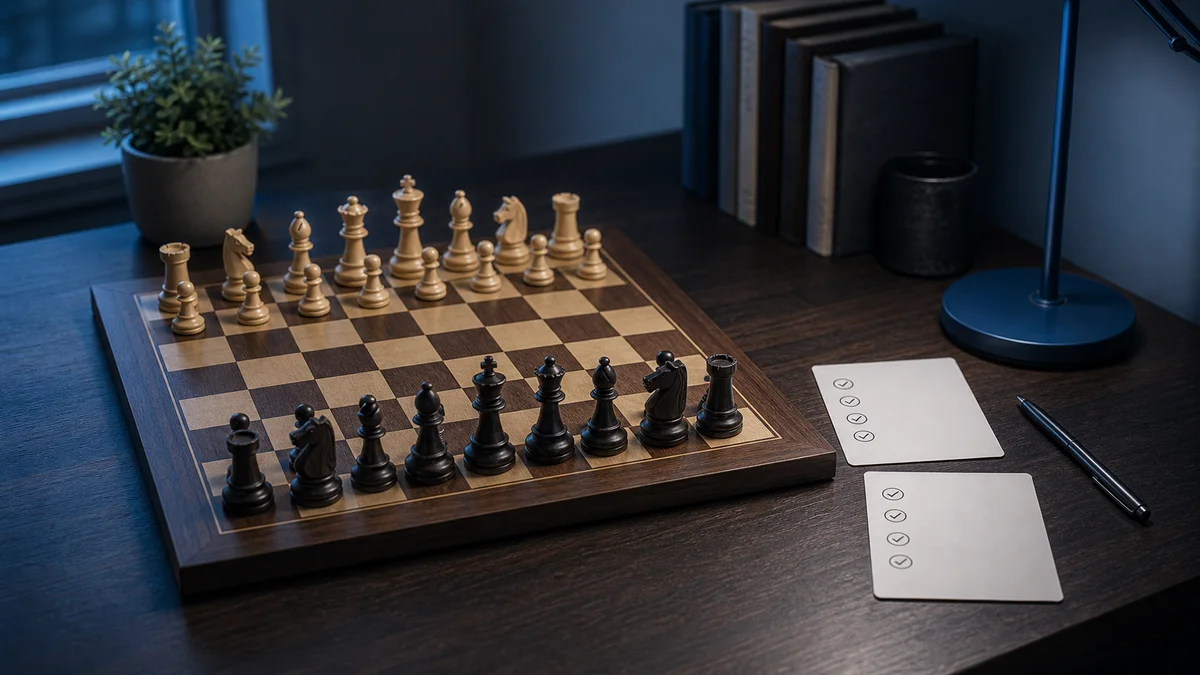
This article is not about “cheating is bad” - you know that. It is about how to understand where the line of dishonest play is (it is not always obvious), what real consequences violations have, and - most importantly - why fair play is beneficial strategically, and not just ethically.
What is considered a violation of fair play: detailed map
The boundaries of fair play are broader than “don’t use Stockfish.” Below is a systematic description of violations adopted by major platforms.
Direct Computer Assistance
The most obvious and most common: using any engine or position analyzer during the game. This includes not only Stockfish, but also any position analysis sites, mobile applications with an engine, queries to ChatGPT or other AI systems with a real-time position description.
An important nuance: analyzing games after they are completed is completely legal and recommended for training. A violation is during a game.
Multi-accounting / Smurf accounts
Creating a new account to bypass the ban or to play against obviously weak opponents (“smurfing”).On the open-source platform, the rules directly prohibit having more than one account. The commercial platform has a similar policy. Platform algorithms link accounts through IP addresses, behavioral patterns and other signals.

Intentional drain of points (Rating Manipulation)
Fixed games, where one player deliberately loses to increase the rating of the other. This is a less obvious violation, but just as serious - it distorts the rating system for all other players. The algorithms detect suspicious patterns: for example, one account systematically loses to only one specific opponent.
Intentional connection delays
Intentional disconnection in a losing position or artificially delaying moves for the opponent’s “flag” is a violation of fair play, fixed in the rules of the open-source and commercial platforms. Technically, it is not always possible to distinguish from random disconnection, but systematic behavior is monitored.
| Violation | Typical punishment | Difficulty of Detection |
|---|---|---|
| Computer help | Account ban, rating cancellation | Medium-High |
| Multiple accounts | Ban all linked accounts | Average |
| Draining glasses | Warning → ban | High |
| Intentional disconnect | Warning → ban | Average |
How cheat detection algorithms work
Understanding how platforms detect cheating can help dispel myths such as “you won’t get caught once.”
The basic principle is a statistical comparison of a player's moves with computer analysis and with his own game history. Platforms look not at one beautiful move, but at a stable pattern: a sharp jump in accuracy, an atypical choice of moves, repeated matches with engine recommendations and the context of the game. The exact thresholds are not published so as not to help bypass anti-cheat.
The open-source platform uses the open Stockfish engine for analysis and publishes its anti-cheat policy. The commercial platform uses its own algorithms and additionally uses human experts to review controversial cases. Both take into account the context: a sharp jump in the quality of the game, atypical for the player’s level, is a signal for manual verification.
An important fact: the algorithms work retrospectively. An account that cheated six months ago may be banned today - when the algorithm has processed the archive of games or when a complaint has been received.“They didn’t catch it right away” does not mean “they won’t catch it at all.”
Why cheating doesn't help you become a better person: the paradox of false progress
The most underrated reason against cheating is not ethical, but practical. Cheating creates the illusion of progress, which hides the real level and blocks real development.
Rating is a feedback tool. When your rating is 1400, the system selects opponents for you at level 1400. If you “rose” to 1600 through cheating, you play against the 1600s, lose to them (because your real level remains 1400), and continue to cheat in order to maintain your position. You never get honest feedback: you don’t know which positions are really difficult for you, which tactical patterns you don’t see, which openings you don’t understand.
An honest rating of 1400 with a growth plan gives incomparably more than a “bought” rating of 1600 without understanding how to earn it. Every honest lost game is information about your real weaknesses. Each cheating game is information that you hid from yourself.
Gray area: what is allowed and what is not
There is a gray area between obvious cheating and obvious fair play that many players are unclear about.
Allowed:
- Analysis of positions with the engine after the game is completed - standard training practice
- Study of the theory of openings, including using databases and engines - before the game
- Consultation with a coach or teammate - before the start of the game (in online tournaments - check the rules of the specific tournament)
- Using chess books and textbooks for self-education - outside the game
Prohibited:
- Any consultation with the engine, analysis site, other person during the game
- Using opening bases with scores during the game to select a move (the situation is controversial - check the platform rules)
Gray zone (depending on regulations):
- Playing with an open party database on another screen - some platforms prohibit this, others do not
- Tools for analyzing decision time - as a rule, not prohibited, but require verification
Fair play as a community: why it matters to everyone
Online chess platforms only work if the rankings make sense. If a significant portion of players cheat, the rating system ceases to be a reliable indicator of level - and the platform loses value for everyone. Each cheater not only deceives his opponents in a particular game: he degrades the quality of the platform as a whole.
The open-source platform, as an open-source project, makes this especially clear: the rating belongs to the community, not to a specific player. An account that cheats “steals” points from honest players who would have received a win or a draw - and legitimately earned rating points.
Reporting a suspicious player through the platform's built-in tools is an investment in the quality of the system for everyone. This is not “snitching,” but participation in supporting the infrastructure that you also use.
Psychology of cheating: why people cheat and how to get out of this trap
Most cheaters are not “natural cheaters.” These are people who find themselves in a specific psychological moment: disappointment, pressure, desire to feel progress. Understanding this mechanism is the first step to the solution.
If you have already used computer assistance: the fairest solution is to create a new account and start from scratch (provided the platform allows this - check the rules), playing fairly. Some platforms provide the opportunity to “self-report” and reassess the situation - check the policy of a particular service.
Long-term: work with real ratings.200 points of “real” progress in three months of fair play provides a stable base that does not need to be supported by deception. This is not a utopia - this is the mathematics of the Elo system.
Toguz Arena and fair play policy
Toguz Arena is already building a competitive environment, where there are games with friends and bots, a rating profile, game history and AI analysis after the game. Therefore, fair play here does not look like a formal future policy, but as a natural condition for fair progress: the rating should reflect a person’s play, and analysis with AI should help to learn after the game, without replacing the game itself.
In chess materials, this can be presented as part of the general culture of the platform: play honestly, save the history of your games, sort out your mistakes and come back stronger. As the chess direction develops, Toguz Arena will have even more tools that will make this habit more convenient.
Bottom line: Honesty is an investment in your own progress
Fair play is not only an ethical category. This is a strategic choice: an honest rating provides real feedback, without which development is impossible. Every honestly lost game is a lesson. Each “bought” rating point is information that you stole from yourself.
Three main conclusions:
- Cheating isn't just an ethical issue: it blocks real progress by hiding honest feedback.
- Detection algorithms work retrospectively: “they didn’t catch it right away” ≠ “they won’t catch it”
- Fair play is a contribution to the quality of the platform for the entire community, not just a personal choice
Practical Toguz Arena links
- Play a rated game on Toguz Arena: use the shared play entry and keep assistance outside the game.
- Open the chess blog hub: related articles on rating systems, analysis, platforms and training.
- Read the Toguz Arena chess fair-play page: the current public trust surface for chess rating claims.
Sources and limitations
- Lichess policy: Lichess Fair Play prohibits external assistance during an ongoing game.
- Chess.com policy: Chess.com Fair Play Policy prohibits engines, software, bots, plugins and other analysis tools during play.
- Limitation: this article does not claim that Toguz Arena ratings are interchangeable with FIDE, Chess.com or Lichess ratings, and it does not disclose a proprietary anti-cheat algorithm.