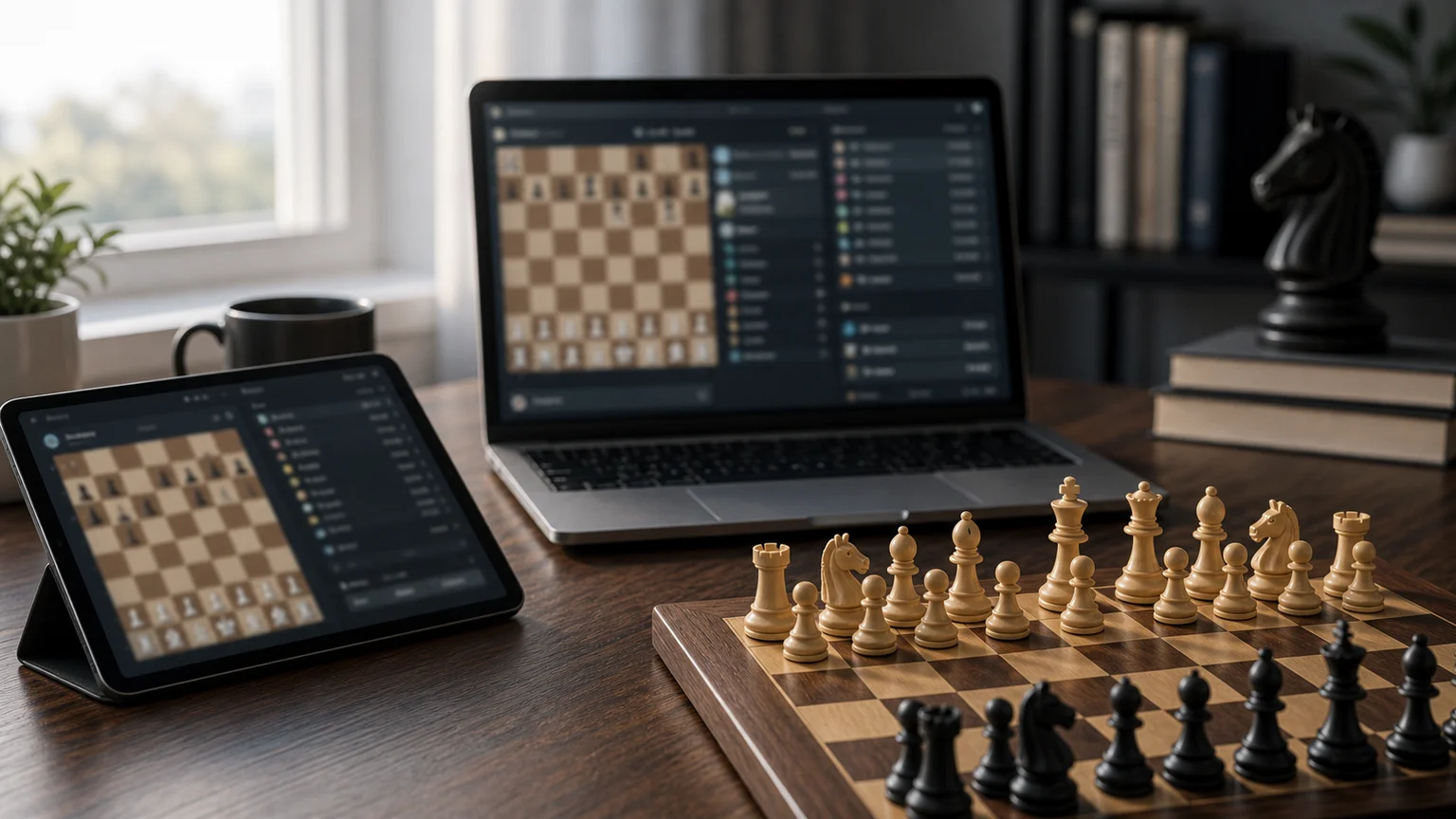
When choosing a platform, the following are important: the quality of the rating system, the level of anti-cheat protection, the pool of active opponents in your rating range, the availability of post-game analysis tools and available time controls. The open-source option and the large commercial option are two market benchmarks. New platforms that combine multiple games offer a different format for the multi-game profile.
Each platform has its own board sound
Chess platforms differ not only in the number of players - they differ in culture. The open-source platform was created as an open, non-profit project with the philosophy “chess should be accessible to everyone”: no advertising, no paywall for functions, complete transparency of algorithms. The commercial platform has grown into a commercial ecosystem with tens of millions of users, investments in content, streaming and integration with the professional chess community.

This doesn't mean that one is better than the other - it means that they are optimized for different priorities. A player who cares about the openness of the system, transparent ratings and free access to everything will choose the open-source platform. A player who values a large pool of opponents, rich educational content, and a streaming ecosystem will choose the commercial platform. The choice depends on what you are looking for, not on what is “objectively better.”
Below is an honest analysis of the key parameters that affect rating growth. The information is current at the time of writing (June 2026) and may change - always check the platform websites for the latest status.
What to compare besides the number of players
The number of active users is the most frequently mentioned indicator when comparing platforms, but for a rated player it is not the most important. Here are the parameters that really affect the quality of a rated game:
1. Rating system. What mathematical model? Elo or Glicko-2? How is a “new” account (provisional rating) processed? The open-source platform uses Glicko-2 and publishes a full description of its system. The commercial platform uses a modified system with publicly described principles. Different systems mean incomparable ratings between platforms: 1500 on the open-source platform ≠ 1500 on the commercial platform - this is important to understand.
2. Anti-cheat. How effective is anti-cheat protection? This directly affects the quality of your rating: if there are a lot of cheaters in the pool, your rating is unrepresentative. The open-source platform publicly describes using Stockfish for analysis; the commercial platform uses a proprietary system with additional manual verification. Both platforms invest in anti-cheat as a reputational priority.

3. Pool of opponents in your range. Even on a large platform in your specific rating range and preferred time control, there can be a long wait for a match - especially during non-standard hours for the selected geo.
4. Analysis tools. Is it possible to analyze the game immediately after the game? The open-source platform provides free engine analysis for all games. The commercial platform has analysis tools, some of which are limited in the free plan.
5. Mobile accessibility. For gamers who frequently switch between devices, a quality mobile app is critical.
Open-source platform: openness as a principle
The open-source platform is a non-profit open-source platform created in 2010 by Thibaut Duplessis. As of 2024–2025, it is among the largest chess platforms in terms of the number of daily games. All features are free for all users without exception: engine analysis, tournaments, educational tools, open APIs and game databases.
Key Features:
- Rating system: Glicko-2, separate rating for each time control
- Initial rating: 1500 with high RD (rating deviation), which means rapid changes in the first games
- Anti-cheat: use of Stockfish, public fair play policy
- Analysis: free engine analysis for all games, immediately after the game
- Open-source: source code is publicly available on GitHub
For whom the open-source platform is especially suitable:
- Players who value complete transparency of the system
- Those who want maximum analysis without a subscription
- Chess players who value a non-commercial environment
Commercial platform: ecosystem and scale
The large commercial platform is a commercial service that, according to its own data, is one of the largest in the world in terms of the number of registered users. The platform is actively developing educational content, streaming, integration with professional players and corporate partnerships.
Key Features:
- Rating system: own modified system;not identical to FIDE and not identical to Glicko-2 in its pure form
- Tariffs: basic functions are free;advanced analysis, lessons, training tools - in paid plans
- Anti-cheat: proprietary system with claimed expert support
- Tools: “Game Review”, opening opening trees, lessons, videos
- Community: active streaming, integration with the professional chess world
Who the commercial platform is especially suitable for:
- Players who value rich educational content in one ecosystem
- Those who want to follow professional tournaments and streams on the same platform
- Users looking for the largest pool of opponents
FIDE Online Arena: official context
FIDE Online Arena / Chess Arena is a separate online environment associated with FIDE regulations for online rankings and titles. It must be distinguished from both a regular account on mass chess platforms and from the classic FIDE OTB rating.
It is important to understand the difference: the usual online rating on any platform is the internal rating of the platform, not the FIDE rating. FIDE Online Arena / Chess Arena is a specialized product with separate regulations and verification requirements. Before publishing a comparison article, please check the current domain, partner model and conditions directly on the FIDE/World Chess/Chess Arena pages.
Comparative matrix (current: June 2026)
| Parameter | Liches | the commercial platform | Note |
|---|---|---|---|
| Basic Access Cost | Free (everything) | Free (part) | Commercial platform - paid plans for advanced functionality |
| Rating system | Glicko-2, publicly described | Own modification | Ratings are not comparable between platforms |
| Party Analysis | Free engine | Partially free | Open-source platform - no restrictions on quantity |
| Anti-cheat | Stockfish + public policy | Proprietary + manual verification | Both invest in protection as a priority |
| Open source | Yes (GitHub) | No | For those who value transparency |
| Mobile application | Yes | Yes | Both support iOS and Android |
| Educational content | Basic free | Extensive (partially paid) | the commercial platform is much larger in volume |
| FIDE rating | No | Not the usual platform rating; separate FOA/Chess Arena context is needed | Single dedicated product |
Important: all data was verified at the time of writing. Platform features and rates are subject to change - please check the official platform pages for the latest status before making a decision.
Where is it easier for a beginner to start
For a player who is just starting online ranked play, the key question is not “which platform is better,” but “where am I more comfortable studying and not quitting after two weeks.”
Selection criteria for a beginner:
- How clear is the interface in the first 10 minutes?
- Are there built-in training materials that will help you understand the rating system?
- Is it possible to sort out the game for free immediately after the game?
- How fast is the opponent in the initial rating range?
By these criteria, both large options work. The open-source platform wins in terms of transparency and complete freeness;the commercial platform - in terms of the volume of built-in training. The most honest advice: try both platforms, play 10 rated games on each, and choose the one where the process was more comfortable.
Where a pool of opponents is more important to a strong player
For 1700+ Elo players, the key parameter is the quality of the pool of opponents in a particular range. If there are few active players in your range, you will wait a long time for a game or play with opponents outside the comfort zone of the rating.
Here The commercial platform wins in terms of numbers in most ranges. The open-source platform is stronger among an audience that values open-source culture, and has an active European community. For niche time controls (such as very long classics), the pool may be small on both platforms.
Actionable tip: Before choosing a platform, check the average batch wait time in your time control and rating range. This is easy to do by creating a test account and trying the search.
How Toguz Arena is built into this scenario
Toguz Arena is a platform for intellectual games, where you can play with friends, start games with bots, see Elo/Glicko-like ratings, return to the history of games and analyze what you have played using AI. For a chess player, this is an important signal: the chess section does not appear in an empty place, but falls on the already clear competitive contour of the platform.
Further this circuit will expand: more modes, more convenient selection of opponents, stronger analytics, more scenarios for training. Therefore, the choice of site can be associated with Toguz Arena natively: there is already an infrastructure of rating habit, and the chess direction will grow around it.
Practical Toguz Arena links
- Play on Toguz Arena through the shared play entry instead of an invented chess-only route.
- Read the chess hub for the current rating, training and post-game analysis articles.
- Check the Toguz Arena fair-play page before treating any online rating as equivalent to another platform.
Sources and limitations
- Glicko-2 rating system paper - rating systems differ by platform, pool size and implementation details.
- Lichess fair-play page - useful for understanding one major platform's public policy, not Toguz Arena policy.
- Chess.com fair-play policy - useful for comparison, not a statement of equivalence or endorsement.
Limitation: online ratings are platform-specific. A rating on one site does not automatically equal a rating on another site or a federation rating.
Final: choose based on whether the platform returns the best game
The best platform for you is the one you want to return to after a loss. Not the one that promises more features or advertises the largest user base. One where analysis of a game brings understanding, and the next game seems more important than the previous one.
This is a subjective criterion - and it is the correct one. Chess progress is built on thousands of games, lost and won. A platform that helps you return to those games again and again is the right choice.