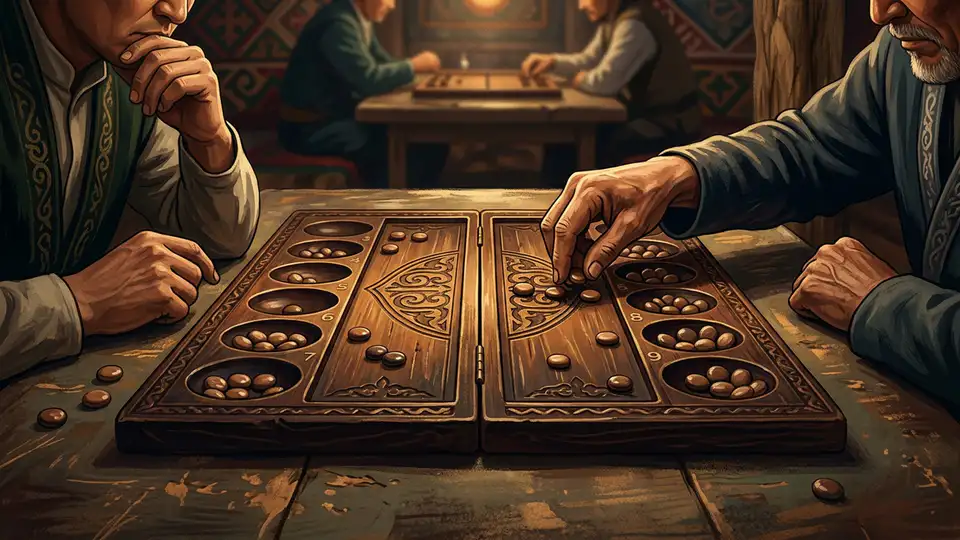
The reliable thinking model is: count the last stone first, evaluate parity second, then compare the opponent's best reply. If you reverse that order, you will often fall in love with a capture that gives the opponent a stronger answer.
For rule verification, start with the Toguz Arena wiki, the federation and source hub, and the public rule reference listed below. For practice, open browser play, review one missed route in the AI Trainer, and use the events hub only for tournament context. The counting filters in this article are a Toguz Arena practice method, not official federation rules.
Why counting matters
In modern rules, each player starts with nine holes containing nine stones each. A move takes all stones from one of your holes and distributes them one by one. Captures are determined by the final landing square. If your last stone lands in an opponent's hole and makes that hole even, those stones are captured. If it makes exactly three stones in an opponent's hole, a tuzdik may be created if the restrictions allow it.
This makes Togyz Kumalak a last-stone game. The visible number in the starting hole matters only because it tells you the final destination.
The last-stone calculation
Before every candidate move, ask one question: "Where does my last stone land?" Then use this four-step check.
- Choose the hole you are considering.
- Count the stones in that hole.
- Trace the sowing route one point at a time.
- Mark the final landing hole and evaluate what changed.
Do this slowly at first. Speed is not the goal. Accuracy is the goal. After enough repetitions, your eye will start seeing common distances automatically.
The parity principle
Parity is the odd/even state of a hole. It decides whether a landing can capture. In simple terms, if your last stone lands in an opponent's odd hole, it usually turns it even and creates a capture. If it lands in an even hole, it usually turns it odd and does not capture.
| Before landing | After adding your last stone | Practical meaning |
|---|---|---|
| Opponent hole has an odd count | It becomes even | Capture is possible if the final stone lands there. |
| Opponent hole has an even count | It becomes odd | No normal capture from that landing. |
| Your own large hole is odd | Opponent may target it | Consider a defensive move that changes its parity. |
As a Toguz Arena practice method, protect valuable holes by turning them even when a simple reply could otherwise make them capturable. This does not make you safe forever, but it removes many one-stone capture routes. Treat this as arithmetic training built from the public capture rule, not as an extra official rule.
Counting attack and defense together
A beginner counts only captures. A stronger player counts captures and protected stones. For each legal move, write a quick mental score:
- How many stones can I capture or seriously threaten?
- How many of my stones become protected by parity?
- What is the opponent's biggest reply?
This is not a perfect engine evaluation, but it prevents the most common error: taking a medium prize while leaving a bigger prize behind.
Building a small variation tree
Humans cannot calculate the full game tree. As a practical branching example, nine candidate moves followed by eight possible replies already create 72 first-step continuations before deeper calculation. So the goal is not to calculate everything. The goal is to calculate the forcing lines.
Use this compact tree:
- My best capture or tuzdik threat.
- Opponent's strongest capture or tuzdik reply.
- My best answer after that.
If your line still looks good after the opponent's best reply, it is a real candidate. If it collapses immediately, choose a quieter move.
The tuzdik dimension
Tuzdik calculation deserves its own check because it changes the rest of the game. A player may create only one tuzdik. The ninth opponent hole cannot become a tuzdik. A player also cannot create a tuzdik in the symmetrical hole to the opponent's tuzdik. Because of those restrictions, the question is not only "can I create one?" but "is this the right one?"
A good tuzdik sits on a route where stones will continue to pass. A weak tuzdik may look exciting but collect little later. In Toguz Arena review, compare the immediate tuzdik move with the best move that keeps pressure without committing.
Three exercises for better counting
1. Last-stone drills
Pick any legal move and say the final landing hole before you move. Then play it and check. Repeat until the count becomes automatic.
2. Parity scan
Before choosing a move, identify the three most valuable odd holes: yours and your opponent's. Ask which side can reach them first.
3. One-reply discipline
After every attractive capture, force yourself to count the opponent's best reply. This single habit will save more games than memorizing long openings.
Sources and practice limits
- PlayStrategy: Togyzqumalaq rules - sowing rules, captures, tuzdik and winning condition.
- World Togyzqumalaq Federation - federation context, championships, rankings and organization layer.
- Toguz Arena source hub - quick route to federation, UNESCO and public-source context.
- Togyz Kumalak rules, Toguz Korgool rules and strategy guide - internal route from counting mechanics to rules, variants and practice planning.
The practical filters above are Toguz Arena practice method, not official federation rules. For official tournaments, confirm the current regulations with the organizer or federation source.