
The rating grows not from inspiration, but from repeated work
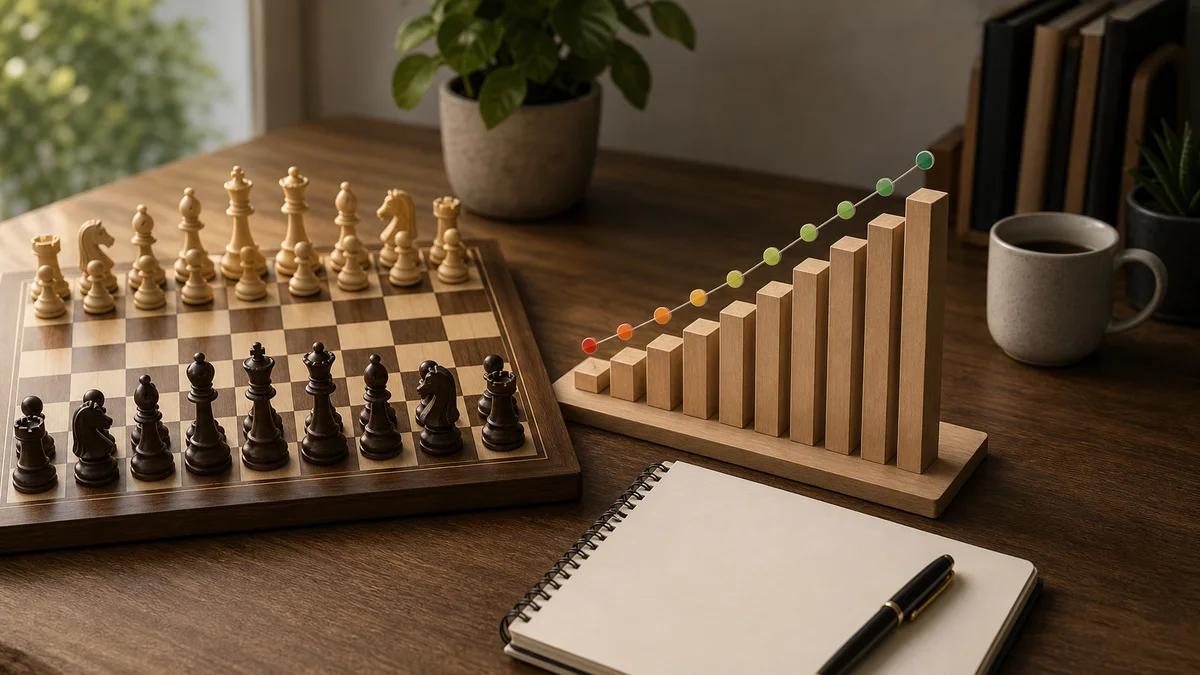
Rating is not a measure of your genius, but a measure of the consistency of your game. You can find fantastic five-move combinations, but if every other game you blunder a rook in one move due to inattention, your rating will stagnate. The growth of points occurs when you raise the lower bar of your game: you get rid of gross mistakes and accustom yourself to the discipline of calculating options before each click of the mouse button.
This 30-day plan does not guarantee you instant master status or an increase of exactly 200 Elo. His goal is to replace chaotic play with a proven training system that takes the chaos out of your decisions. Rank growth will be a natural side effect of your new discipline as daily work transforms complex tactical patterns into automatic reflexes.
What really drives ratings
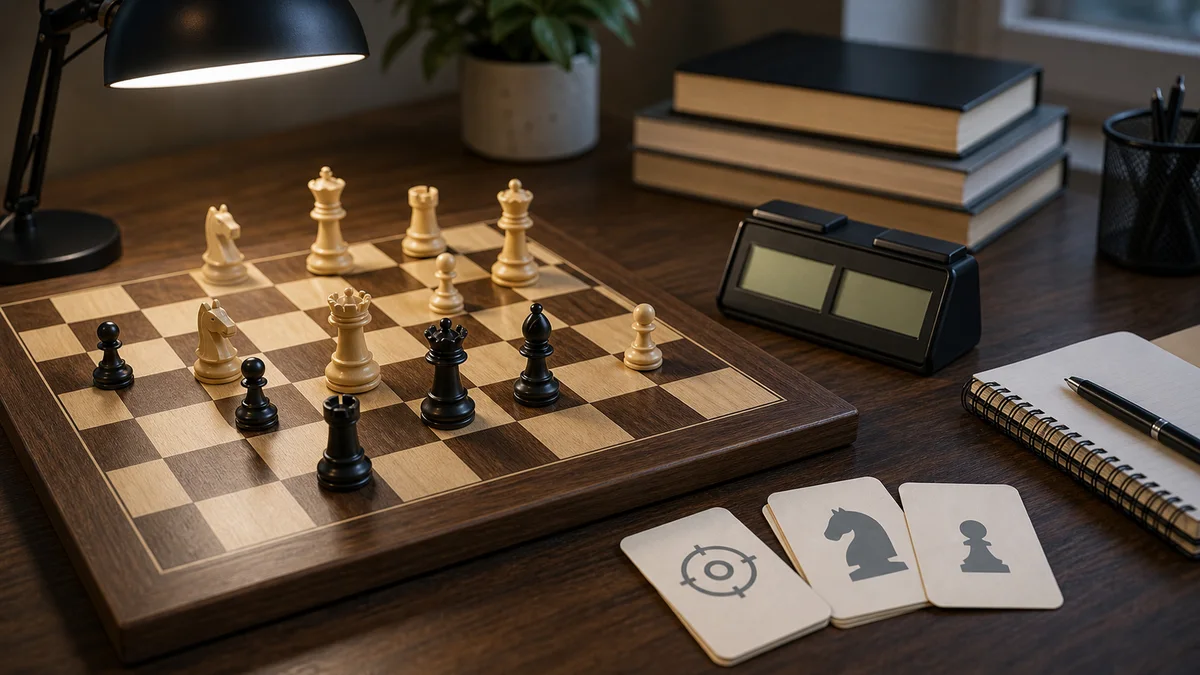
To raise your chess rating, you need to implement three daily habits: solve 10-15 tactical problems with full calculation of options, play one thoughtful game of rapid with time increments, and carry out a mandatory 10-minute analysis of it without a computer engine. The 30-day training plan focuses on consistently eliminating bad blunders, automating basic tactical motivations, and emotional discipline after losses.
The main secret of success is regularity. It is better to practice chess for 20 minutes every day than to have a grueling five-hour session once a week. The brain must get used to recognizing chess geometry through daily unobtrusive scanning.
Below is a training program divided into four thematic weeks. Each step targets a specific layer of your skill, from basic piece safety to tactical acumen.
Week 1: Eliminate gross yawns
The first seven days of the program are entirely dedicated to “chess safety.” At this stage, your goal is not to win beautifully, but not to lose stupidly. In games of beginners and players of the lower intermediate range, it is the rough blunders of pieces in one or two moves that most often decide the result;the exact percentage depends on the platform, timing control and batch sampling.
Implement the “two seconds of safety” rule into your gameplay: before you make a move, mentally ask yourself three questions:
- What battle does my piece face after this move?
- Which square or piece did I stop protecting by leaving?
- What directly threatens my king (checks, checkmates)?
Play only rapid games with a time reserve of at least 10 minutes and increments. If you notice that your hand is reaching out to make a move instantly, remove your fingers from the mouse. Your goal for this week is to play 7 games in a row without a single blunder of a clean piece. The result of the game is not important, the purity of your moves is important.
Week 2: Tactics Every Day
Once you've reduced your own blunder rate, it's time to move on to active threats. Chess is 90% tactics. Tactical motives are the building blocks from which any winning strategy is built. If you don't see forks, connects or doubles in a split second, you will constantly miss winning chances.
Start every morning by solving tactical problems. Correct solution method:
- Don't make the first move in a task on autopilot, hoping to guess right.
- Calculate the entire branch of options until the very end (until checkmate or obvious material advantage) in your head.
- Only after complete calculation make the first move on the screen.
Remember that you need to solve problems with quality, not speed. If you solve 5 problems correctly, having fully calculated the options, this will bring you much more benefit than 20 problems guessed on the third try.
Week 3: debut as a way to a clear position
Many beginning players spend weeks memorizing complex opening lines before move 20. It's a waste of time. In a real game, your opponent will abandon the theory you have learned already on the 4th move, and you will find yourself in an unfamiliar situation with a mess in your head.
Your task in week three is to develop a simple opening repertoire based on general principles rather than rote learning:
- Fight for the center: Capture the central squares with d4/e4 or d5/e5 pawns.
- Develop minor pieces: First bring the knights, then the bishops to active positions.
- Safety of the King: Castling as early as possible, preferably in the first 8-10 moves.
- Rook Link: Move the queen away from the first/eighth rank to link the rooks.
Choose one opening for White (for example, the Italian Game or the London System) and two reliable responses for Black (for example, the Caro-Kann Defense against the King's Pawn and the Slavic Defense against the Queen's).Your goal is to consistently exit the opening into a clear, strong position without material losses.
Week 4: Game Analysis and Emotion Control
The last week of the plan ties all the skills together through a culture of analysis. The fastest way to grow is to study your own games. Analyzing victories pleases your pride, but it is analyzing defeats that indicates your areas of growth.
Analyze each game played according to the following scheme:
- Without a computer: Review the game for 5 minutes and find the move that seemed to you to be a turning point.
- With a computer (engine): Check your findings. Pay attention to the moments where the engine's score jumped sharply (blunders and missed tactical opportunities).
- Recording an error: Write down the type of error in a notepad or text file (for example: “missed a link”, “hurried under time pressure”).
Control your emotions. If you lose two games in a row, close the game. This is your “stop-loss” rule of thumb: continuing to play in frustration will usually degrade the quality of your decisions and make the next game useless as a training game.
Practical program for 30 days
The table below presents a detailed training program adapted to different rating levels. Select your range and follow these guidelines:
| Weekly Focus | Level 800–1000 | Level 1000–1400 | Level 1400–1700 |
|---|---|---|---|
| Week 1: Safety | 10 yawning tasks daily;1st batch rapid (15+10) | 15 defense tasks;1 rapid game (10+5) with analysis | 20 prevention tasks;2 rapid games with deep analysis |
| Week 2: Tactics | Study of motifs (fork, bunch);15 problems | Solving thematic blocks of problems;20 tasks | Solving complex tactical studies;25 problems |
| Week 3: Debut | Compliance with the rules of center and castling | Consolidating the repertoire (3 schemes);analysis of opening mistakes | Setting up transitions from opening to middlegame |
| Week 4: Analysis | Finding one critical moment in the game | Analysis of games with the search for alternative plans | Error logging;identifying repeating patterns |
Note: Rating growth is individual and depends on initial training. No method guarantees linear growth without declines, since chess is a probabilistic environment, which is confirmed by the research of Mark Glickman (Glicko rating system).
What not to do for the sake of rating
Sometimes what we give up is more important than what we do. To save your points and nerves, eliminate the following actions from your chess routine:
- Do not play at night or when tired: Fatigue impairs judgment and self-control, so the risk of simple blunders and impulsive decisions increases.
- Do not memorize opening traps as your main weapon: The trap will work once against a weak opponent, but against a prepared opponent you will be left in a worse position without a game plan.
- Don't play in automatic mode: If you find yourself making moves in a split second, without thinking about your opponent's answers, turn off the game immediately.
Finale: the habit of returning to the board
Progress in chess is like climbing a mountain: the road is full of small stones, scree and temporary descents. During these 30 days, you will definitely encounter disappointing defeats, annoying blunders and days when it seems that you are only playing worse. This is a normal stage of restructuring thinking.
The main thing is not to give up what you started and continue to follow the chosen system. Discipline always beats class in the long run. Return to the board every day, make your moves consciously, and one day you will notice that those positions that previously caused you fear and confusion have become simple and understandable, and the rating number itself has risen to new heights.
Practical Toguz Arena links
- Play on Toguz Arena when you need rated practice inside the shared play flow.
- Use the chess hub to connect this 30-day plan with tactics, openings, time control and review articles.
- Read the fair-play page before turning rating growth into a volume-only grind.
Sources and limitations
- Mark Glickman's Glicko rating system overview - useful context for why rating movement is probabilistic, not a guaranteed staircase.
- FIDE Laws of Chess - rules context for legal play and tournament-style habits.
Limitation: no 30-day plan can guarantee a fixed Elo or Glicko gain. The plan is a training routine, not a promise of rating growth.