
Kalah Rules: How to Play Kalaha Online Without Guessing
Many shops sell Kalah simply as "mancala", which is why new players often mix the names. Think of it this way: mancala is the family, Kalah is one member of that family. Once Kalah feels natural, Oware, Mangala, Toguz Korgool, and Bestemshe become easier to approach because the basic sowing motion is already familiar.
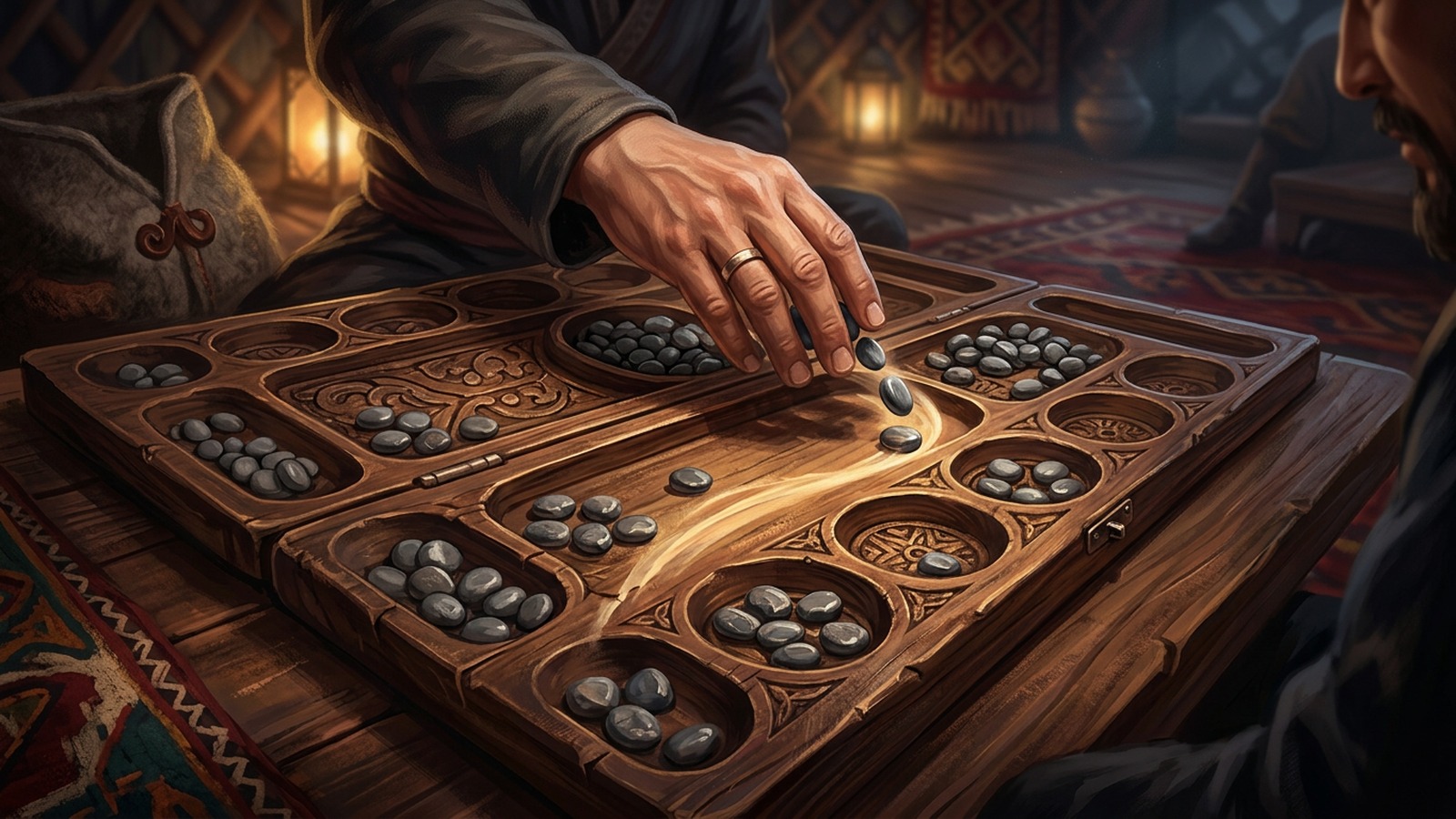
Kalah Board Setup and Stores
A common Kalah board has two rows of six small pits plus one scoring store for each player. The small pits usually start with the same number of stones. On your turn, you choose one non-empty pit on your side, pick up all stones in it, and drop them one by one into following pits. Your own store receives stones; the opponent's store is skipped.
The store matters because it makes progress visible. Every stone placed there is safe score. This is why Kalah feels clear to beginners: the scoreboard is part of the board, not a separate calculation hidden after the game.
Kalah Game Rules Step by Step
- Choose a pit on your side. You cannot move from the opponent's row.
- Sow forward. Place one stone in each pit and in your own store as you pass it.
- Skip the opponent's store. Your move never adds score directly to the opponent.
- Earn another turn. If the last stone lands in your store, you move again.
- Capture from an empty pit. If the last stone lands in your empty pit and the opposite pit has stones, those stones plus your last stone go to your store.
- Finish when one side is empty. Remaining stones are collected according to the table rules, then stores are counted.
Kalah Strategy: Extra Turns Before Captures
Beginners often chase captures first. In many positions, however, an extra turn is more valuable because it lets you shape the next capture or prevent the opponent from taking one. Before moving, count the distance from each pit to your store. If one move lands exactly in the store, ask whether the follow-up move is useful. A weak extra turn only delays the opponent; a strong one changes the board before they can respond.
Here is a simple exercise. During your next three AI games, do not try to win quickly. Instead, write down every move that gives you another turn and every move that gives the opponent another turn. After a few games you will start seeing tempo patterns before they happen.
Kalaha Online Multiplayer: Human Errors to Watch
Against the computer, you can pause and count. Against people, errors usually come from speed. Players forget to skip the opponent's store, miss a capture because an empty pit looked harmless, or empty their side too early. In a live match, slow down whenever a pit contains enough stones to cross your store. Long sowing routes are where most surprising swings begin.
Kalah vs Oware and Mangala
Kalah rewards tempo and visible store score. Oware is less direct because you manage the opponent's supply of seeds and avoid starving positions. Mangala sits between them for many learners: it has quick tactical feedback but asks for more capture timing than Kalah. Toguz Korgool and Togyzkumalak are deeper nine-pit games, while Bestemshe is a small-board trainer for counting skills.
Play Kalah Against Computer: 20-Minute Practice Plan
- Minutes 1-5: Play slowly and count only the landing pit.
- Minutes 6-10: Mark every extra turn before selecting a move.
- Minutes 11-15: Look for empty-pit captures, then check the opponent's reply.
- Minutes 16-20: Replay one lost position and choose a safer move.
Kalah Search Terms and Local Names
Useful names include Kalah, Kalaha, Калах, Калаха, and the mistaken query Kalahari game. You may also see phrases like "kalah game rules", "kalaha game online", "играть в Калаху онлайн", "jugar kalaha en línea", "jouer au kalaha en ligne", or "Kalaha gegen Computer". Use those names to find the right table, then let real positions teach the game.
Kalah is simple only at the rule level. The skill is in knowing when one extra turn is worth more than a flashy capture.
Play Kalah Online on Toguz Arena
Open a Kalah table, choose AI for quiet practice or invite a friend for a faster match. You do not need a separate download to begin. After a few games, compare the same sowing habit in Oware, Mangala, Toguz Korgool, and Bestemshe; the differences will make more sense because Kalah has already taught the rhythm.