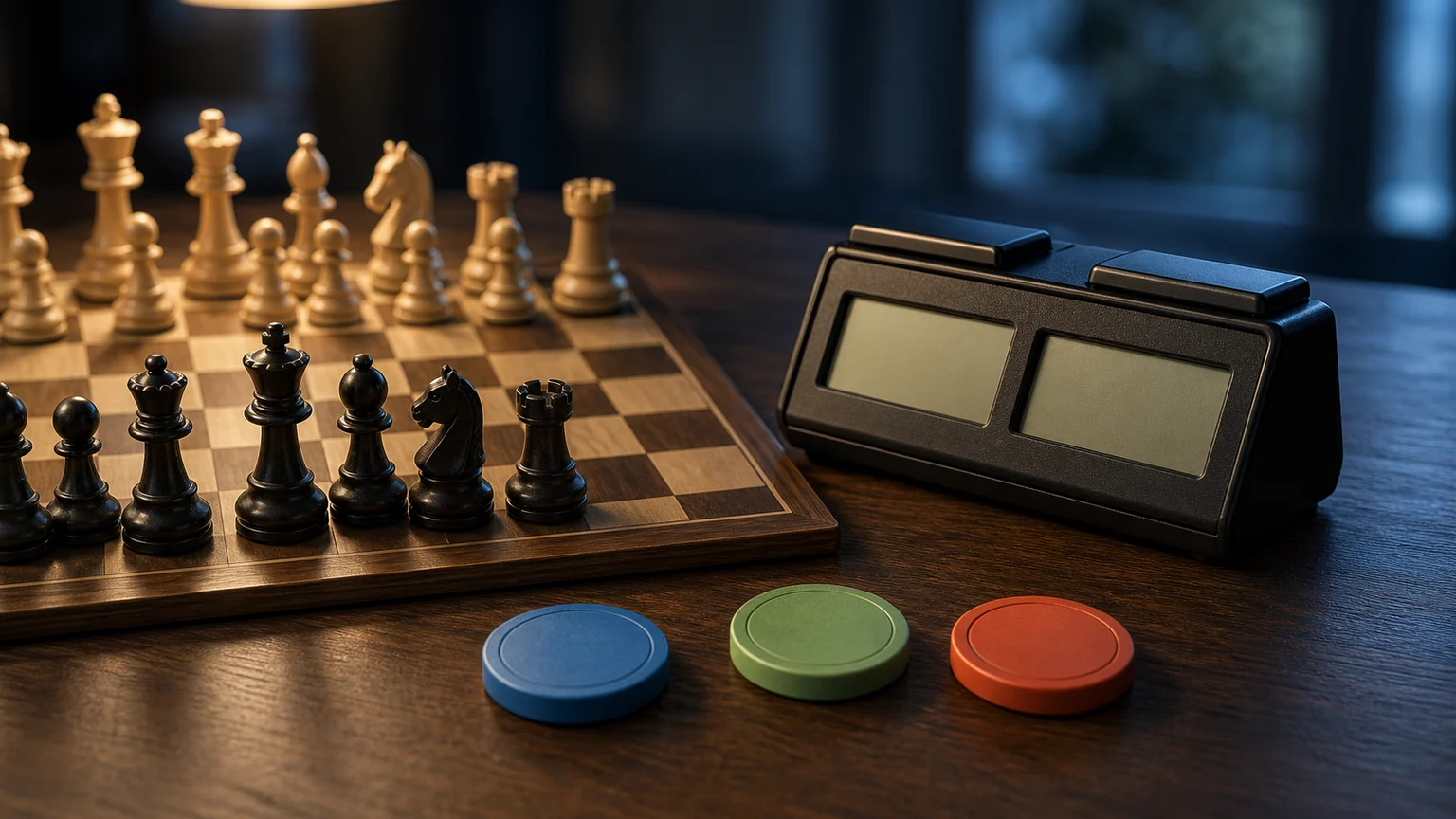
Time control determines how you think, not just how much. In classic (90 min + increment) you can check every move;in rapid (10–25 min) intuition plus basic tactics decides;in blitz (3–5 min) automation and composure under time pressure win. To increase your rating, choose a format in which your specific weaknesses are least punished in one game.
What is time control and why does it affect ratings
FIDE divides time control into three official categories: classic (standard), rapid and blitz. The boundary between them is not determined in the abstract - Elo ratings are calculated separately for each format precisely because the psychology of decision-making is radically different in the presence or absence of time pressure.
In a classic game (for example, with a long control and increment according to the regulations of a particular tournament), the chess player has time to build a full-fledged plan: evaluate the position, find tactical motives, compare several options and make sure there are no traps. Mistakes here are often of a strategic nature - the player knew how to play, but chose the wrong plan. In blitz, a significant part of decisions are made intuitively, and “knowledge” is less helpful where there is no time to apply it.
This is why the same chess player can have a rapid rating 200–300 points higher or lower than the classical one. This is not an anomaly - it is a reflection of the real profile of competencies: some are able to think deeply, others - quickly and accurately. Understanding this difference allows you to make strategic choices about which format will help you rank faster while you work on your game's weaknesses.
Classic: time as an ally of strategic thinking
Classic control is the only format in which chess is fully revealed. Only here can a grandmaster allow himself to think for 40 minutes on one move in a critical position, check dozens of ramifications and build a plan ten moves ahead. For a growing chess player, this is a unique opportunity: each game turns into a learning experience, where time is a resource for understanding a position, and not an enemy.
The main risk of classics is time trouble on moves 30–40, when the position is as difficult as possible. Players with good positional understanding but slow counting often correctly assess the position, but technically lose the game due to lack of time in the endgame. Solution: train counting speed rather than depth - include tactical tasks with a timer in practice (up to 30 seconds per task) and solve 10-15 positions daily.
For a player with a 1000–1500 Elo rating, classical control is most useful precisely because mistakes are visible: you can stop, check the variation and realize the mistake right during the game. This builds the right habit of “checking your moves,” a skill that then goes on autopilot even in faster formats.
Rapid: balance between depth and speed
Rapid is the most convenient online format for learning: it's slow enough to practice basic strategy, but fast enough to play several games in an evening. To make an accurate statement about the popularity of specific time controls on the open-source platform, you need to separately consider the open database of games by time tags;Without such a calculation, it is safer to talk about rapid as a practical training choice rather than as a statistically proven leader.
The following decision-making model works in rapid: for the first 20–25 moves (the opening and early middlegame), there is enough time for meaningful decisions, but then the “rapid mode” begins - an intuitive game with periodic checks of obvious tactical threats. Chess players who have well-trained patterns (typical pawn structures, standard maneuvers of pieces, typical sacrifices) play rapid chess much stronger than their classical level - precisely because the patterns are recognized quickly, without in-depth calculation.
Practical advice: to increase your rapid rating, invest in studying typical positions, rather than deep theory. If you know that in the “isolated d4 pawn” structure you need to keep tension and attack along the e-file, you don’t need to count it, you just see the plan. It is this “library of patterns” that allows you to make good decisions when you are short on time.
| Control | FIDE category | Separate rating | Feature |
|---|---|---|---|
| 90 min + 30 sec/stroke | Classic | Yes | Maximum depth |
| 15 min + 10 sec/step | Rapid | Yes | Balancing speed and quality |
| 3 min + 2 s/stroke | Blitz | Yes | Automaticity and composure |
| 1 min | Bullet | No (on FIDE) | Reflexes, not chess |
Blitz: when automation decides everything
Blitz is the most deceptive format. He seems approachable: “just three minutes, what’s there to think?”- but it is this illusion that destroys the ratings of thousands of players who start with blitz instead of slower formats. With three minutes per game, you literally have no time to think about the position - only to act. And if the patterns are not automated at the reflex level, you lose not because you don’t know, but because you know, but don’t have time to apply.
A strong blitz player is a person who has a large library of “situation → immediate action” stored in his head. He doesn't count the options - he recognizes the position and makes a move. This library is built through playing classic and rapid, and not through blitz itself: it is the slow game that forms patterns that then work automatically in fast formats.
Another blitz trap is the flag. When the opponent has 5 seconds left, many people start playing “for the flag”: making quick moves so that the opponent loses time. This is a legitimate tactic, but it requires a separate skill: playing exactly within your own 10 seconds on the clock. Train this skill separately - decide on speed tactics so that your hand and brain work synchronously under time pressure.
How to choose a format for ranking growth
Choosing a format is a strategic decision depending on your chess profile. Below is a practical matrix:
Choose classic if:
- You're just starting out and want to really learn - playing slowly builds good habits
- Your main weakness is tactical miscalculations: in the classics you have time to find threats
- You want to participate in official FIDE tournaments (club championships, qualifiers)
Choose rapid if:
- You have limited time: 2–3 games per evening is a real session
- You want to combine the growth of your rating with the pleasure of the game: the games are fast enough so as not to get tired
- You already know the openings and want to “set up” strategic patterns
Avoid blitz for now if:
- You're below 1500 Elo: Playing fast reinforces bad habits rather than helping you break them
- You are prone to tilt: a series of defeats in blitz is psychologically destructive (for more details, see the article on the psychology of rating chess)
Time management within the party: specific techniques
Regardless of the format chosen, time management within a party is a separate skill. A professional chess player does not spend time evenly: he invests it at critical moments.
Rule of time prioritization: In the opening, spend the minimum - if you prepared the opening, the moves should go quickly. In the transition to the middlegame (moves 10–20) - this is where the plan is born, and this is where you should think longer. In critical tactical positions, do not waste time checking: one missed fork is worth more than 10 minutes spent.
Example time distribution in a 15+10 game:
─────────────────────────────────────────────────────
Moves 1–8   (opening):       spend less than 2 minutes total
Moves 9–20  (planning):      spend 5–7 minutes
Moves 21–35 (middlegame):    spend 4–5 minutes
Moves 36+   (endgame):       increment + remaining time
─────────────────────────────────────────────────────
A common mistake is to “think longer when something is unclear.” This is a trap: if a position is unclear, an extra five minutes will rarely clear it up. The best strategy is to make a smart move, maintain control of the center or improve the piece's position, and wait for the position to clear up. Time pressure due to indecision is destructive.
Psychology of time pressure: time pressure without panic
Time pressure is the moment when rational thinking turns off and panic turns on. Physiologically, this is explained simply: the threat of losing time is perceived by the brain as a threat, which activates the stress response - adrenaline, tunnel thinking, loss of a broad view of the position.
The only way to deal with time pressure is to train it separately. Specific exercise: deliberately give yourself tight control (5 minutes versus the usual 15) in training games and accustom your nervous system to the feeling of pressure. After 20-30 such sessions, time pressure stops causing panic - you just start making moves faster, while maintaining the ability to make reasonable decisions.
Another practical technique is the “last move rule”: when there are less than 30 seconds left, do not stop to analyze. Make the best move you see in 3-5 seconds. Stopping to analyze when you don't have time is paradoxically harmful: you waste time, but your decisions don't improve due to stress.
Increment: an underrated time management tool
Increment (adding seconds after each move) radically changes the nature of the game. Control 3+2 (three minutes + 2 seconds per move) is fundamentally different from 3+0 precisely in that when incrementing the game does not end on the flag in a technically winning position - you always have a minimum time for a move.
For a developing chess player, incremental formats are preferable for two reasons. The first is that there are fewer “accidental” losses from the flag, and there are more chances to realize the advantage. Second, incremental games statistically contain more “quality” moves, which makes them more useful for post-game analysis.
On the open-source platform, the recommended formats for growth are: 15+10 (rapid, best balance), 10+5 (fast rapid), 5+3 (fast blitz).Non-incremental formats (5+0, 3+0) make sense to play only to train a specific skill - playing under severe time pressure.
Time control and type of errors: what to analyze after the game
Post-game analysis must take into account the format. In the classics, most mistakes are strategic or tactical miscalculations that could have been avoided with the right thinking. In blitz, half the mistakes are technical: blunders that would not have been made given time. To confuse them is to draw the wrong conclusions.
Rule of thumb: analyze classical and rapid games for “what should I have understood?” Analyze blitz games for “what pattern didn’t I recognize quickly enough?” These are different questions and indicate different training priorities.
Toguz Arena: formats and time management
Toguz Arena already provides the basis for a competitive habit: games with friends and bots, Elo/Glicko-like rating, game history and AI analysis after the game. Against this background, time control can be presented as the next layer of convenient chess practice: the player chooses the tempo for the goal of the session, and then returns to the game and understands exactly where the speed helped or hindered.
As the chess direction develops, there will be more modes and training scenarios on the platform. For the reader, this is a simple message: there is already a rating, history and analysis, and a richer chess environment lies ahead.
Practical Toguz Arena links
- Start from the shared play entry and choose the available game flow instead of expecting a separate `/play/chess` URL.
- Use the chess hub for related rating, tournament and post-game review material.
- Review fair-play notes before comparing blitz, rapid and classical results across platforms.
Sources and limitations
- FIDE Rapid and Blitz Regulations - official context for rapid and blitz categories.
- FIDE Laws of Chess - general rules context for time, legal moves and competition play.
Limitation: specific online time controls vary by platform and event. Treat the examples as training choices, not a universal tournament regulation.
Bottom line: choosing a format is part of a chess strategy
Time control is not just a technical adjustment, it determines what chess skills you practice and what mistakes you make. Classics build the foundation;Rapid is a working format for the majority;blitz is a specialized tool for those who already have a base.
Three main conclusions:
- Choose a format based on your current level and weaknesses - not based on what is “more interesting to play”
- Time management within a party is a separate skill that is specially trained
- Analyze errors based on format: classic and blitz errors require different fixes