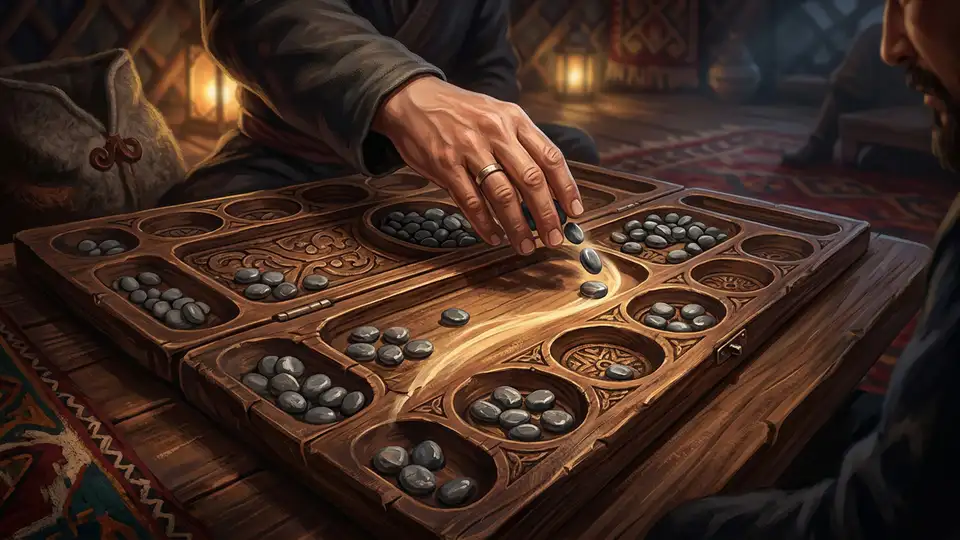
The current Toguz Arena leagues page presents a roadmap for seasonal competition: four tournament formats, ELO-based competition, rewards, and a planned five-level league path from Bronze to Legend. This guide explains how to read that system, what is already useful for players, and what to prepare before the season ladder becomes fully active.
Understanding the league system
A league is not just a leaderboard with nicer colors. It groups players into competitive tiers so that the next goal is visible. A new player should not be comparing themselves with the strongest master on day one; they should be trying to graduate from basic mistakes to stable calculation. A strong player should not only farm easy wins; they need pressure from peers near their level.
| Planned tier | Rating guide from Toguz Arena | Competitive meaning |
|---|---|---|
| Bronze League | Up to 1200 | Friendly start, rules confidence, basic capture counting and Swiss-style learning events. |
| Silver League | 1200-1600 | Real competition begins: different openings, better tactics, more consistent opponents. |
| Gold League | 1600-2000 | Advanced tactical play, prize pools in coins, and pressure to convert advantages cleanly. |
| Diamond League | 2000+ | Elite pool, planned streams, AI commentary and tighter knockout-style competition. |
| Legend League | Invitational elite | Small monthly finals, exclusive rewards, titles and public recognition. |
This five-level roadmap is more precise than a generic "Bronze to Champion" ladder. It also fits Togyz Kumalak better because the game has a sharp learning curve: a beginner needs space to learn sowing and captures, while elite players need formats that reward deep endgame and tuzdik calculation.
How seasons work
A season gives the ladder a beginning and an end. Without seasons, ratings can become static: a player reaches a number, stops playing risky opponents, and protects the account. Seasonal competition solves that by creating a fresh race. The old rating still matters, but the season asks a new question: who is active, improving and consistent now?
For Toguz Arena, the practical season loop should be:
- Placement: early games estimate the player's current form.
- Climb: rated games, arena events and Swiss tournaments move the player through the tier.
- Stabilization: the player learns what mistakes prevent promotion.
- Final push: stronger events and focused review decide whether the player holds or advances.
- Recognition: the season ends with badges, coins, skins, titles or qualification paths.
The leagues page already shows the reward direction: coins, exclusive skins, titles and badges for tournament wins and high rating. The important implementation detail is clarity. Players should always know whether an event is rated, what time control is used, what format is active, and what result changes their season standing.
Four tournament formats
Toguz Arena's public leagues page lists four formats: Arena, Swiss, Knockout and Round Robin. Each format trains a different skill.
| Format | Best for | Player mindset |
|---|---|---|
| Arena | Activity, streaks, quick adaptation and repeated games in a fixed time window. | Recover fast after mistakes and keep momentum. |
| Swiss | Fair multi-round competition with a declared number of rounds. | Stay stable; every round matters even after one loss. |
| Knockout | High pressure finals where one loss can end the run. | Reduce risk and calculate critical positions carefully. |
| Round Robin | Small elite groups where every player meets every other player. | Prepare for specific opponents and play consistently across styles. |
The Swiss format has a long history in mind sports. FIDE's Swiss rules state the core principles clearly: the number of rounds is declared beforehand, players generally should not meet the same opponent more than once, and pairings are generally made between participants with the same score. For Togyz Kumalak, that structure is useful because it produces meaningful competition even when there are too many players for a full round robin.
Matchmaking principles
Fair matchmaking tries to balance three goals that often conflict: rating proximity, wait time and event integrity. If the system waits forever for a perfect match, players leave. If it pairs anyone instantly, the rating becomes noisy and beginners get crushed. A good system starts narrow and gradually widens the search when necessary.
Ratings are not moral rankings. They are estimates. FIDE's rating regulations show the basic logic used in many rating systems: expected score depends on rating difference, and rating change compares actual result with expected result. Toguz Arena uses ELO-style matchmaking language on its public site, so the same practical lesson applies: beating a much stronger opponent should matter more than beating a much weaker one; losing to a lower-rated opponent should cost more than losing to a favorite.
How to climb the ladder
Climbing is less about one hot session and more about removing repeatable leaks. In Togyz Kumalak, common league blockers are missed even-count captures, late tuzdik defense, careless endgames and time trouble after long sowing calculations.
A simple season routine works well:
- Play two or three rated games with full focus, not ten distracted games.
- Review every loss in AI Trainer and write down the first critical mistake.
- Train one theme before the next session: tuzdik, parity, tempo or endgame.
- Use arena events for volume, Swiss events for stability, and knockout only when you can handle pressure.
Rewards and recognition
Rewards are not only decoration. They make progress visible to other players and give a season a memory. A title, badge, rare skin or profile marker says: this player was active and strong during a particular competitive window. For a traditional game trying to build a modern online community, that kind of recognition matters.
The best league system will keep two promises at once: serious enough for competitive players, friendly enough that newcomers understand the next step. That is the standard Toguz Arena should hold for its season ladder.
Sources used
- Toguz Arena Leagues page for current roadmap, formats, tiers and reward language.
- FIDE Swiss rules for general Swiss-system pairing principles.
- FIDE rating regulations for the rating-difference and expected-score model used as general rating context.