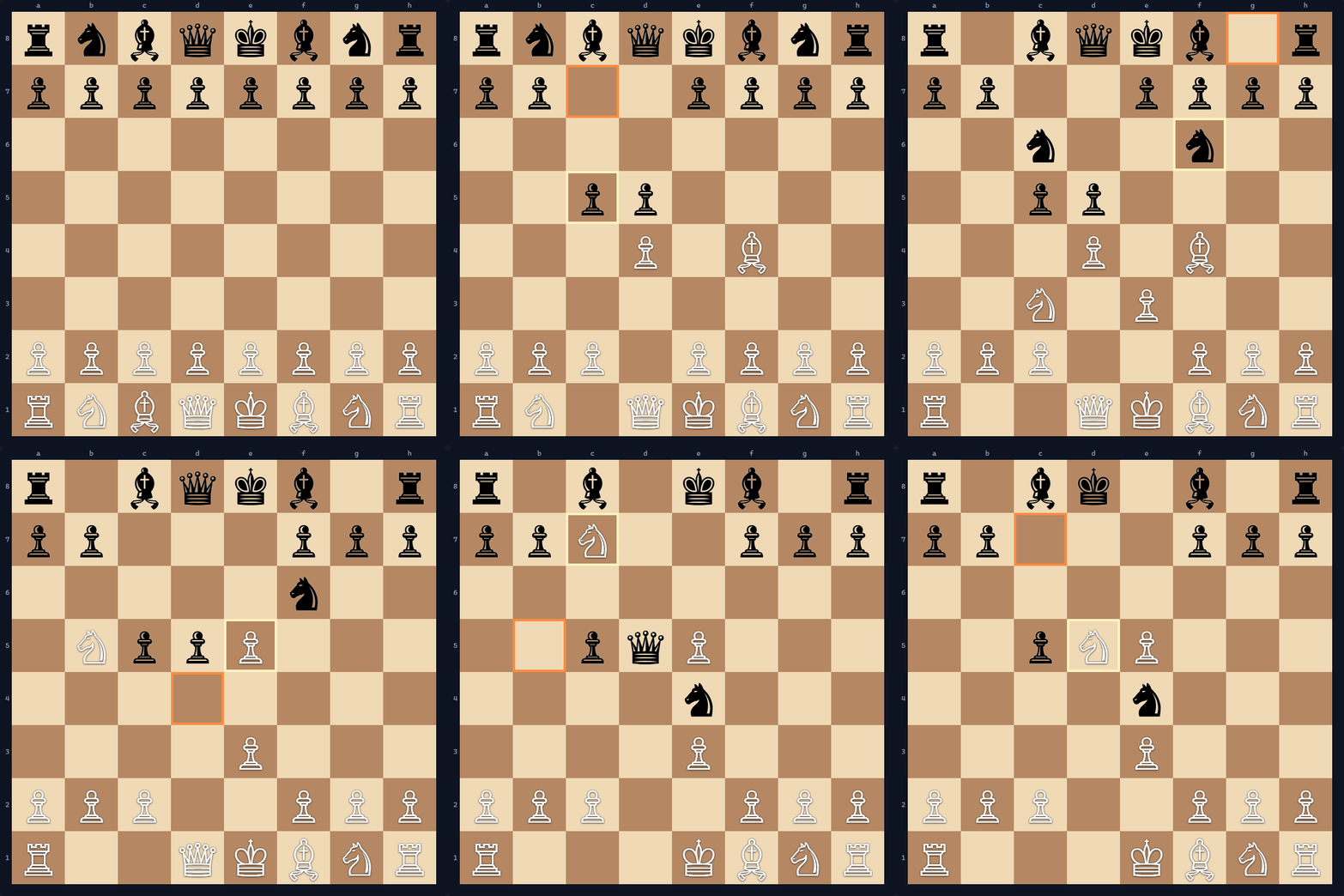
What the London is and isn't
The London System is one of the cleanest examples of a system opening in modern chess. The defining idea is simple: White plays the same setup (the "pyramid" of c3-d4-e3, with the dark-squared bishop on f4 outside the pawn chain) regardless of what Black does. The theory is finite, the plans are clear, and the resulting positions are playable at every rating level.
Two ways to reach the London
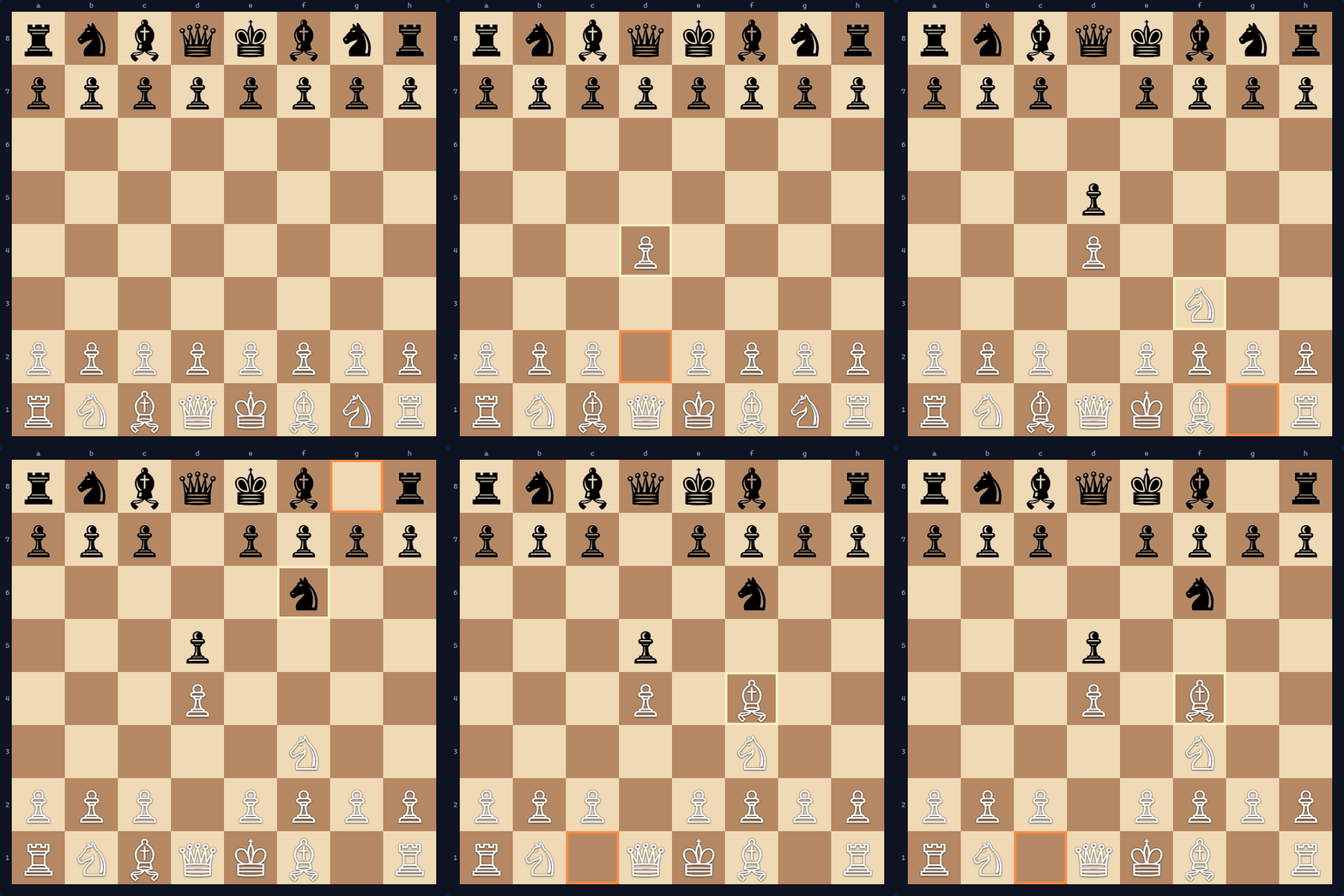
Two move orders reach the London. The modern (accelerated) order is 1.d4 d5 2.Bf4, where White commits to the setup immediately. The traditional order is 1.d4 d5 2.Nf3 Nf6 3.Bf4, where White develops the kingside knight first and then places the dark-squared bishop. Current theory at the top level prefers 2.Bf4 because it makes it harder for Black to avoid the London via an early ...c5, which 2.Nf3 allows. The difference is small at the club level, but at the elite level the 2.Bf4 move order is now standard.
White's setup: the pyramid
The London System is built around a "pyramid" pawn structure: pawns on c3 / d4 / e3, with the dark-squared bishop developed to f4 outside the pawn chain. The knights go to d2 and f3, the light-squared bishop to d3 (or e2 against ...g6 fianchetto), and the king castles short. The dark-squared bishop is the soul of the setup: it is developed actively before e3, avoiding the bad-bishop problem of many 1.d4 openings. The light-squared bishop on d3 rules the b1-h7 diagonal and prepares a potential e4-break in the middlegame.
Black's three main responses
Black has three principled options against the London, each leading to a different kind of position.
The ...g6 fianchetto (KID-style). Black plays 1.d4 Nf6 2.Bf4 g6, fianchettoing the dark-squared bishop and aiming for a King's Indian-style setup. The light-squared bishop often goes to e2 (not d3) to avoid being blocked by Black's pawns. White's standard response is e3, h3, c3, Nbd2, and castle, building the standard London pyramid. Black's plan is to strike the center with ...c5 and ...Qb6, exploiting the fact that e3 came before the bishop could be challenged.
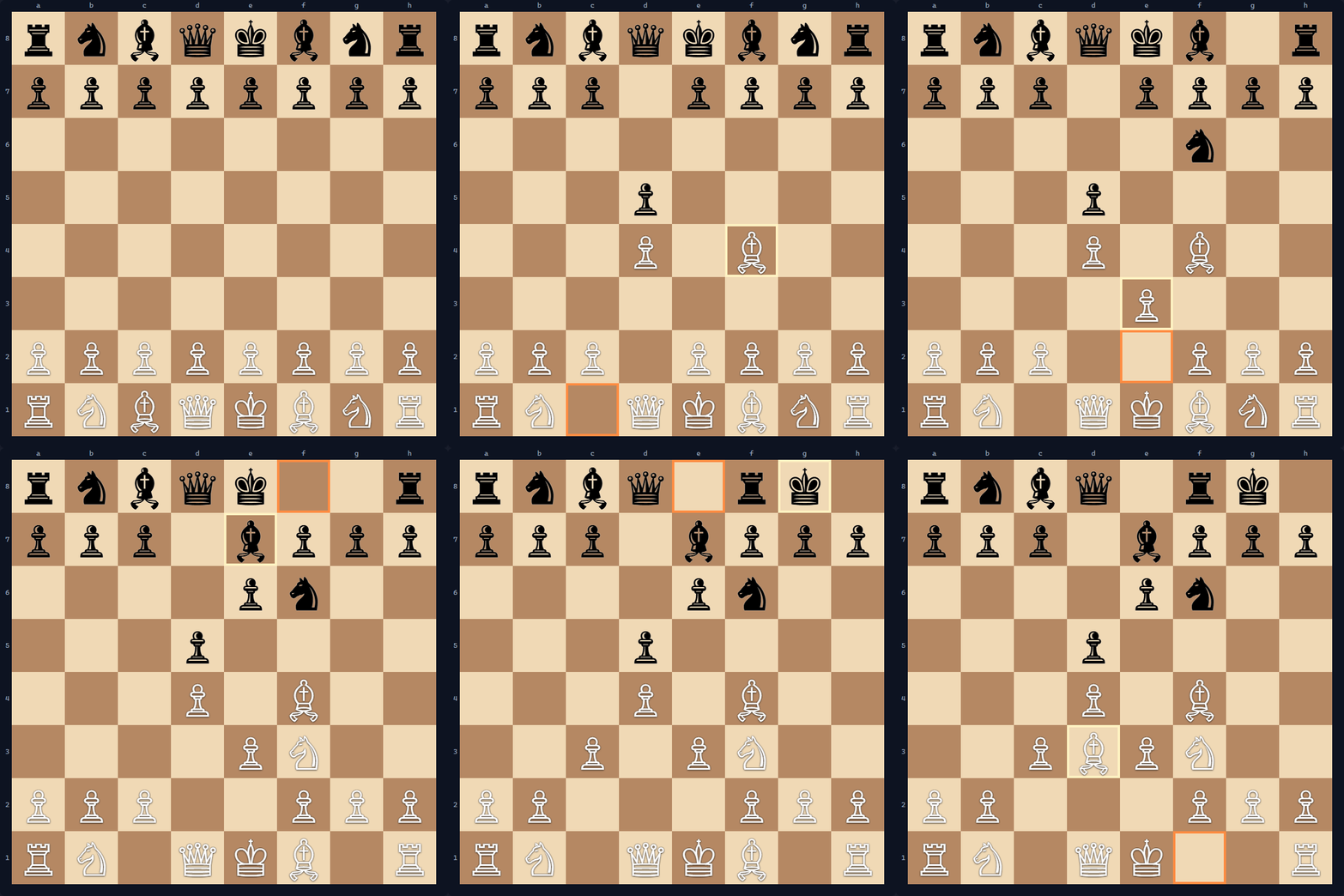
The ...e6 with ...c5 (QGD-style counter). Black plays 1.d4 d5 2.Bf4 Nf6 3.e3 c5 4.c3 Nc6 5.Nd2 e6 6.Ngf3, striking at the center with ...c5. This is the sharpest of the three Black responses. White usually responds with the standard pyramid but must be ready to react if Black pushes ...c4.
The ...e6 without ...c5 (QGD-style patient). Black plays 1.d4 d5 2.Bf4 Nf6 3.e3 e6 4.Nf3 Bd6, the patient setup. The main motif is the bishop trade ...Bd6 against White's dark-squared bishop. White's best response is to challenge this trade, often with 4.Bg3 retreating to avoid doubling pawns, or to attack g7 with the sharp 4.Qg4.

| Black response | What Black wants | White's practical focus |
|---|---|---|
| ...g6 fianchetto | A King's Indian-style setup and pressure with ...c5 and ...Qb6. | Use e3, h3, c3, Nbd2 and castle before choosing the attack plan. |
| ...e6 with ...c5 | A sharp QGD-style counterstrike against the center. | Keep the pyramid, but be ready for ...c4 and central tension. |
| ...e6 without early ...c5 | A slower bishop exchange plan with ...Bd6. | Challenge the bishop trade or use the Qg4 idea when it fits. |
Counter-tactics for Black
Four named tactical motifs define Black's counterplay against the London. Each is a sharp line that punishes inaccurate White play, and each has a known response.
The early ...c5 with ...Qb6 (the b2-attack). This is the most-tested try against the London. Black plays 1.d4 Nf6 2.Bf4 c5 and follows with ...Qb6, attacking the b2-pawn that White's bishop on f4 no longer defends. According to a major opening explorer, Black scores 49% wins, 23% draws, and 22% White wins in this line. White's best response is 3.d5, which is "not within the realm of the London System" but it is the most accurate way to handle the b2-attack.
The Bd6 trade (and the G7 Heist trap). Black plays ...Bd6 offering to trade dark-squared bishops. The trade itself is fine for Black, but White has a sharp tactical resource: 1.d4 d5 2.Bf4 e6 3.e3 Bd6 4.Qg4! Bxf4 5.Qxg7! Qf6 6.Qxf6 Nxf6 7.exf4. White wins a pawn and the trap is named the "G7 Heist" because the queen hijacks the g7-square before the king can defend it. The line is the most common tactical resource in the London against ...Bd6.
The c5 + Nc6 + Nb5 + C7 Sting. If White chooses the alternative move order 1.d4 d5 2.Bf4 c5 4.Nc3 (instead of the standard 4.c3), the position can lead to a sharp fork. After 4...Nc6 5.Nb5 e5 6.Bxe5 Nxe5 7.dxe5 Ne4 8.Qxd5 Qxd5 9.Nc7+ Kd8 10.Nxd5, White wins a pawn by forking the king and queen on c7.
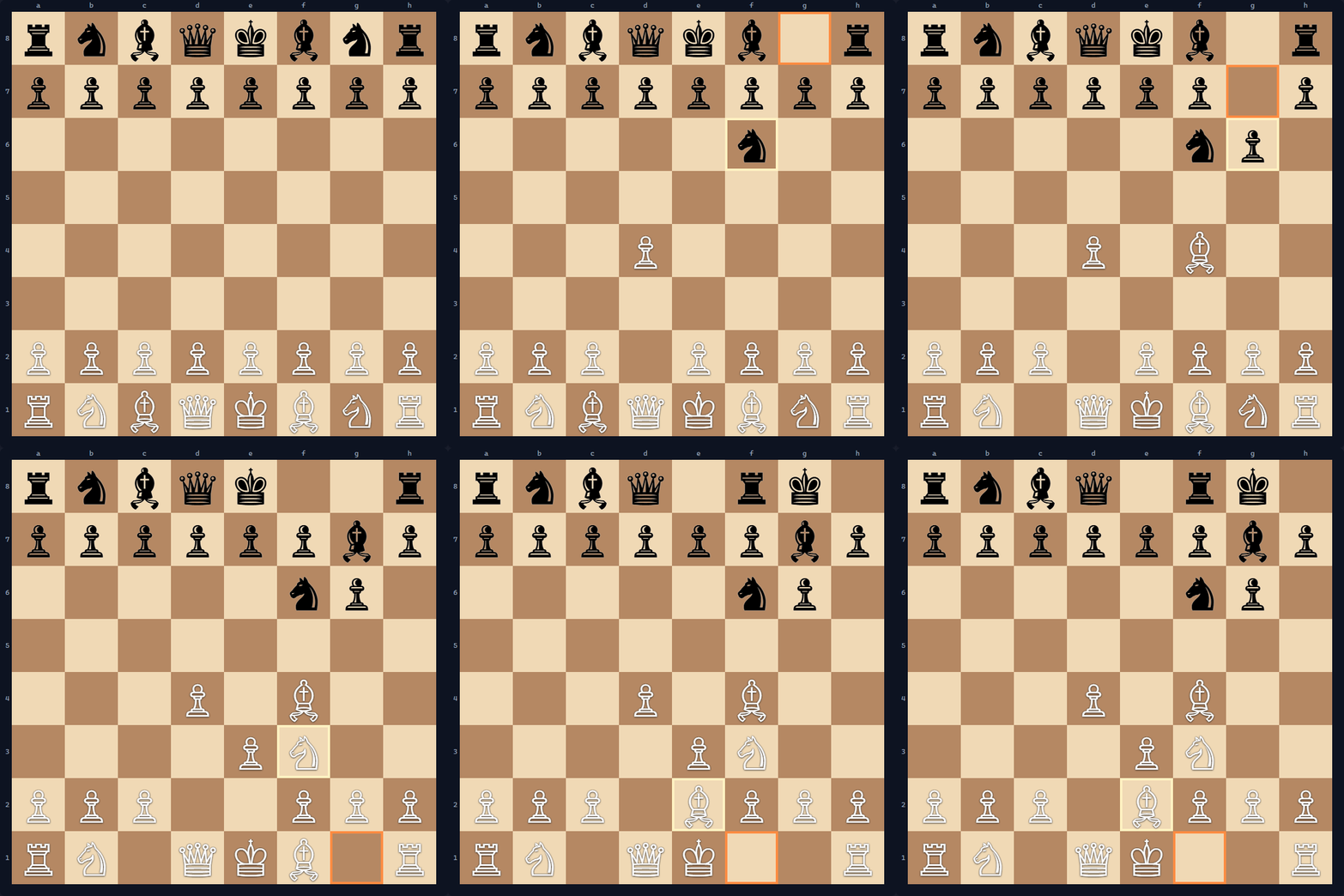
The f6 / F-Pawn Folly. The line 1.d4 d5 2.Bf4 f6 3.e3 e5 4.dxe5 fxe5 5.Qh5+ g6 6.Qxe5+ loses material for Black, who fell into a check followed by a queen recapture. The line is rare in practice but useful to know as a tactical weapon.
These four motifs are not the only tactical resources in the London, but they are the most commonly cited. For practical purposes, learn the b2-attack and the G7 Heist first; the others appear less often.
White's main plans
From the standard London position, White has four named plans. The first is the Ne5 outpost, posting a knight on e5 supported by the d4-pawn and transferring the queen to the kingside via Qf3-Qh3. The second is the Stonewall structure, pushing f2-f4 to support a knight on e5 and creating a Stonewall Dutch-like position with colours reversed.
The third is the h-pawn push, advancing h4-h5-h6 to weaken Black's king position, especially against ...g6 fianchetto setups. The fourth is the e3-e4 push, central expansion when the e5-outpost is unavailable. After 1.d4 d5 2.Bf4 c5 3.e3 cxd4 4.exd4, the position transposes to a Carlsbad structure with colours reversed, where White's queen's bishop is already developed — a favourable version of the Carlsbad for White.
These plans are not mutually exclusive. A typical London game might start with Ne5, switch to a Stonewall structure after Black challenges the e5-knight, and then launch a kingside attack with the h-pawn. The strength of the system is that the same setup supports many different middlegame plans.
The Jobava London
The Jobava London (also called the Rapport-Jobava System) is a sharp alternative. The defining moves are 1.d4 d5 2.Nc3 Nf6 3.Bf4. According to modern-chess.com, the Jobava London was neglected until 2013, when the Georgian GM Baadur Jobava started playing it on a regular basis, producing some memorable attacking games.
The 365chess main line runs 1.d4 Nf6 2.Nc3 d5 3.Bf4 e6 4.Nb5 Na6 5.e3 c6 6.Nc3 Nc7. White's two main ideas are an early e4 push to gain space, and the Nb5 attack on c7 forcing ...Na6 and disrupting Black's development. The Jobava London transposes into its own theory but shares the dark-squared-bishop-outside-the-pawn-chain motif with the standard London.
The Jobava is best treated as a sharp specialist weapon rather than a primary repertoire. A standard London player can pick it up after fifty standard games, and use it as a surprise in slow tournaments or longer online games. The early e4 push is the simpler of the two ideas; the Nb5 fork is sharper and more memorable when it works.
A brief history
One opening reference says the system gained popularity at the top level after the 1922 London Congress, especially after the match between GMs Alexander Alekhine and Max Euwe. Several opening references connect the name with the 1922 London Congress; the Alekhine–Euwe match detail is one source's specific attribution.
Modern elite practice was rehabilitated in the 2010s, when Magnus Carlsen, Gata Kamsky, and other top grandmasters began using the London regularly. According to modern-chess.com, Magnus Carlsen started playing the London regularly in 2017. The London reached the World Championship stage in 2023, when Ding Liren used it in his match against Ian Nepomniachtchi, including Game 6, which he won. Ding Liren became World Chess Champion a few days later. The 2024 World Championship match between Ding Liren and Gukesh also featured a London-related line, where Ding played 5.Be2 transposing to a QGD structure in Game 10.
For club players: what to actually learn first. The London is famous for being beginner-friendly, but the easy first impression can mislead you. The setup is simple, but the tactical motifs are not. Learn the b2-attack and the G7 Heist before anything else — they are the two most common tactical resources in London games. Then learn the Ne5 outpost, the Stonewall structure, and the h-pawn push. Don't try to memorize every Black sub-variation. The London rewards understanding, not memorization.
How to learn the London System
A practical five-step plan is to play twenty games with the standard setup, identify the move where Black first challenges the setup, learn the specific counter-tactic for that challenge, add the Jobava London as a surprise weapon after fifty standard London games, and re-study the line every three months.
FAQ
Is the London System a real opening?
Yes. The London System is a fully sound system opening for White, characterized by 1.d4 d5 2.Bf4 and a "pyramid" pawn structure of c3-d4-e3. Top grandmasters including Magnus Carlsen, Gata Kamsky, and Ding Liren have used it at the highest level. It is not a gambit or a trick — it is a long-term strategic setup that works at every rating level.
What is the best response to the London System?
The two most-tested options are an early ...c5 with ...Qb6 (attacking the b2-pawn that White's bishop on f4 no longer defends) and the ...g6 fianchetto (King's Indian-style setup). Data from one large opening database shows Black scoring 49% with the early ...c5 and 38% with ...g6. The ...g6 stat is from more than 2,000 games; the early c5 stat has no stated sample size.
Do grandmasters play the London System?
Yes. Magnus Carlsen adopted the London as a regular part of his repertoire in the 2010s. Gata Kamsky has used the London as a lifelong main weapon. Ding Liren used the London in the 2023 World Chess Championship match against Ian Nepomniachtchi, including Game 6, and won both the game and the match a few days later.
Is the London System for beginners?
Yes — it is one of the most recommended first openings. You play the same solid setup against almost everything, so your study time goes to plans and tactics rather than memorizing long forced lines. The opening is fully sound at every level. The main thing to learn is the few counter-tactics Black has (...c5 with ...Qb6, ...Bd6 trade, ...g6 fianchetto) and the standard White answers.
Where this leads
The London System sits within a wider 1.d4 family. For a survey of the major 1.d4 openings, see the chess openings hub. The Jobava London is a sharp variant of the same setup and is covered in its own article. The King's Indian Defense is the most common...g6 response to the London, and the Queen's Gambit Declined is the most common...e6 response — both have dedicated articles.
Sources
This article draws on the following pages, accessed 2026-06-30:
- chess.com — London System: https://www.chess.com/openings/London-System. The two move orders, pros and cons, Mainline, Indian Setup, Jobava London, the 1922 London Congress naming, the Carlsen / Kamsky / Ding Liren attribution, the Early c5 and ...g6 counter-statistics, and the Kamsky-Shankland 2014 and Carlsen-Ding Liren 2020 famous games.
- 365chess.com — London System Opening Complete Guide: https://www.365chess.com/chess-openings/London-System. The KID response, Grunfeld response, Slav response, Rapport-Jobava System, anti-London systems, the Ding Liren 2023 WCC detail, and the Petrosian-vs-Chistiakov 1954 notable game.
- chessreps.com — London System: https://www.chessreps.com/opening/london. The "pyramid" structure, the ...Qb6 / ...Bd6 / ...Bf5 / ...Nh5 counter-system, the G7 Heist, F-Pawn Folly, C7 Sting, and Rook Lure named tactics, the "beginner-friendly" FAQ.
- modern-chess.com — A Comprehensive Guide to the London System (by GM Michael Roiz): https://www.modern-chess.com/opening/london-system/. The five positional plans (Ne5, Stonewall, h-pawn, e3-e4, Carlsbad), the 2023 WCC Ding Liren Game 6 attribution, the Kamsky-Goganov 2016 full PGN model game, and the Jobava London history.
- thechessworld.com — London Opening System: How to Play for White and Black: https://thechessworld.com/articles/openings/london-opening-system-how-to-play-for-white-and-black/. Move-order tricks (the 5.Nc3 Nc6 5.Nb5 line), the main line with ...Bd6, and the FAQ on whether the London is for "lazy players."
- chessable.com — The London System – Play the Opening as White & Black: https://www.chessable.com/blog/the-london-system/. The three main Black setups (QGD-style, Indian-style, KID formation) and the move-order note preferring 2.Bf4.
- simplifychess.com — London System (How To Play It, Attack It, And Counter It): https://simplifychess.com/london-system/. The three main Black setups in plain language.