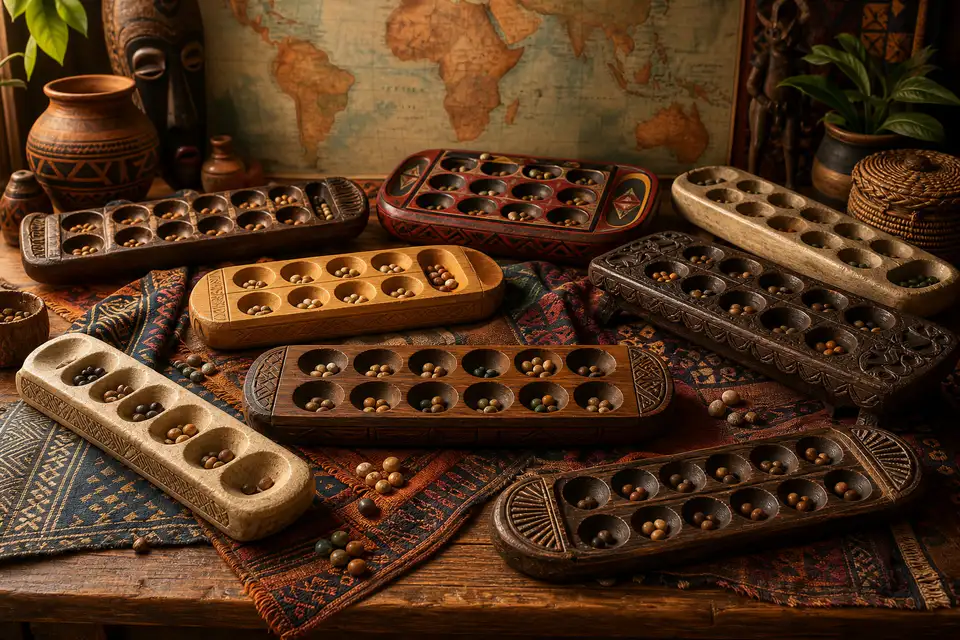
This is why Togyz Kumalak is best understood in two layers. At the family level, it shares the ancient sowing-and-capturing logic of mancala games. At the competitive level, it has a distinct Central Asian identity: nine holes per side, 162 stones at the start, even-count captures, and the tuzdik rule that can change the value of an opponent's hole for the rest of the game.
Use this page as an orientation map, then verify exact rules in the rules wiki, the source hub and the events hub. When you want to test a family pattern on a real board, open browser play or review finished games with the AI Trainer.
What makes a game part of the mancala family
UNESCO describes Togyzqumalaq, Toguz Korgool and Mangala/Gocurme as a traditional intelligence and strategy game played with pellets distributed across pits. The equipment can be a crafted board or improvised pits in the ground, and the pieces can be made from stone, wood, metal, bone, nuts, or seeds. That description captures the core of the mancala family: counting, distributing, and converting movement into a score.
World Nomad Games uses the same family language for Toguz Korgool, calling it part of the mancala family and explaining the word "mancala" through the idea of movement. This matters because it separates the family from any single rule set. Oware, Mangala, Bao, Kalah, Togyz Kumalak and many regional games are related by mechanics, not identical by rules.
Quick comparison of related games
| Game | Region or tradition | Typical board | Starting material | Strategic signature |
|---|---|---|---|---|
| Togyz Kumalak / Togyzqumalaq | Kazakhstan, Central Asia | 2 rows x 9 holes | 162 stones, 9 in each hole | Even-count capture, 82 stones to win, one tuzdik per player with restrictions. |
| Toguz Korgool | Kyrgyz tradition | 2 rows x 9 holes | 9 korgools in each hole | World Nomad Games presents it as the Kyrgyz version of the mancala family. |
| Mangala | Turkish tradition | 2 rows x 6 small pits plus storage pits | 48 stones, 4 in each small pit | Fast two-row race to collect more stones in storage. |
| Oware | West Africa and Caribbean traditions | 2 rows x 6 houses | 48 seeds, 4 in each house | Captures happen when a final seed makes an opponent house contain exactly 2 or 3 seeds. |
| Bao | Swahili coast and East Africa | Usually 4 rows x 8 pits | Often 64 counters, with staged setup in Bao la Kiswahili | Relay sowing, named special pits and a two-phase structure make it much more complex to learn. |
Oware: smaller board, sharp capture logic
Oware shows how a smaller board can still create deep calculation. PlayStrategy describes Oware as a mancala family game played throughout West Africa and the Caribbean. It starts with four seeds in each of six houses per player, for 48 seeds total. Capturing 25 seeds is enough to win; 24-24 is a draw.
The capture rule is different from Togyz Kumalak. In Oware, a capture happens when the final seed makes an opponent's house contain exactly two or three seeds. Consecutive previous houses can also be captured if they meet the same condition. There is also a practical fairness idea: if the opponent has no seeds, a player must make a move that gives the opponent seeds when possible. For a Togyz player, Oware is useful training because it punishes lazy counting, but the target counts are different.
Mangala: closest cultural cousin in the UNESCO file
Mangala is not the same game as Togyz Kumalak, but UNESCO lists Mangala/Gocurme together with Togyzqumalaq and Toguz Korgool in the same multinational intangible heritage element for Kazakhstan, Kyrgyzstan and Turkiye. The World Nomad Games page describes Mangala as a Turkish intellectual-strategy game for two players, with two rows of six small pits, storage pits, and 48 stones placed four per pit.
That makes Mangala easier to enter for many new players: fewer pits, fewer stones, shorter local calculations. Togyz Kumalak asks for a longer counting horizon because each side has nine holes and the opening begins with 162 stones. A player moving from Mangala to Togyz should not only learn new rules; they should also slow down and check longer sowing routes before trusting a familiar mancala instinct.
Toguz Korgool and Togyz Kumalak: one family, precise naming
Toguz Korgool and Togyz Kumalak are closely related names in the Central Asian nine-hole tradition. World Nomad Games presents Toguz Korgool as the Kyrgyz version and explains that "toguz" means nine. PlayStrategy describes Togyzqumalaq as played in Kazakhstan and notes that its modern rules were codified in 1949 by Mukhtar Auezov and Kalibek Kuanishbayev.
For player clarity, it is useful to keep the names precise. If a reader searches "Toguz Korgool," they may be thinking of the Kyrgyz sporting context. If they search "Togyz Kumalak," they may be looking for Kazakh spelling, rules, or online play. Toguz Arena can speak to both audiences, but the article should not flatten the names into one generic label.
Why the tuzdik rule makes Togyz different
The tuzdik rule is the feature that makes Togyz Kumalak feel different even to experienced mancala players. PlayStrategy describes three important limits: each player can create only one tuzdik per game, the opponent's ninth hole cannot become a tuzdik, and a player cannot create a tuzdik symmetrical to the opponent's one. Stones that later fall into a tuzdik are captured by its owner.
This turns one successful tactical moment into a long-term positional asset. In smaller mancala games, a capture often ends as soon as the seeds leave the board or enter a store. In Togyz Kumalak, a tuzdik can keep changing the board economy. It affects route choice, endgame counting, defensive holes, and the psychological pressure on both players.
Where Bao and Kalah fit in the bigger map
Bao and Kalah matter because readers often meet them when they search for "mancala games." They are useful orientation points, but they should not be used to make unsupported claims. Bao is usually discussed as a four-row East African mancala with staged play and relay sowing; use the Bao guide when that ruleset is the focus. Kalah is a popular modern two-row store-based game often taught as "mancala" in English-speaking contexts; use the Kalah rules page before transferring Kalah tactics into deeper variants. They help readers see the range of the family, while Oware, Mangala and Toguz Korgool give us stronger official-source comparisons for this article.
How this helps a Togyz Kumalak player
Comparing the family is not trivia. It improves decision-making. Oware teaches exact target counts. Mangala teaches tempo and store pressure. Bao shows how far relay-sowing complexity can go. Togyz Kumalak combines long-route counting with a high starting stone count and permanent tuzdik pressure. If you come from another mancala game, the first adjustment is to count the final stone more carefully. The second adjustment is to treat every possible tuzdik as a strategic event, not just a capture.
On Toguz Arena, use the AI Trainer after games and ask one family-style question during review: did the move fail because the count was wrong, because the capture target was wrong, or because the long-term pit structure was wrong? That habit turns family knowledge into practical Togyz strength. For broader practice routes, compare the online mancala games guide, Oware rules and Bestemshe practice.