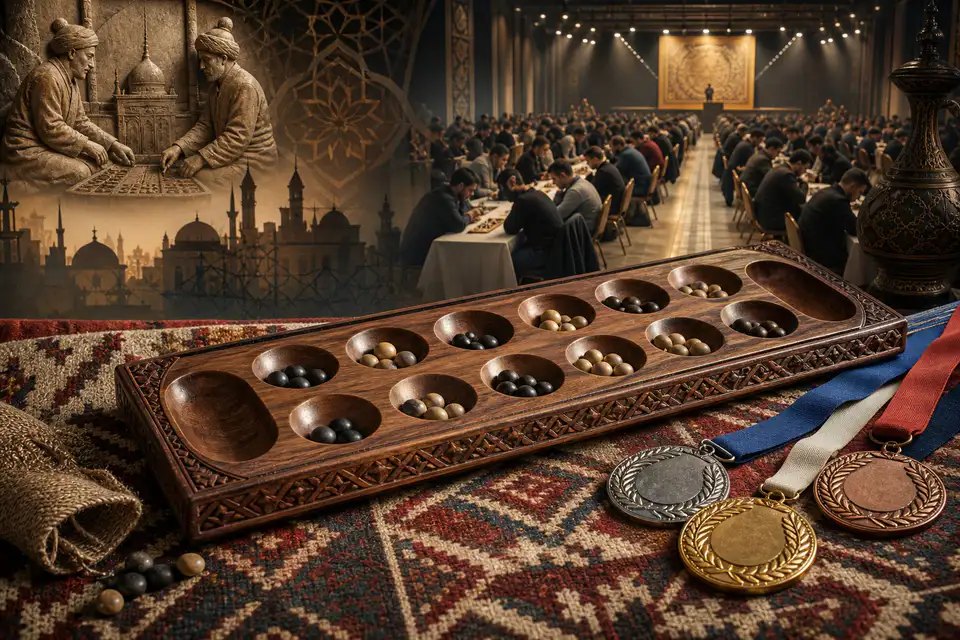
Turkish Mangala is one of the clearest examples of a traditional board game becoming an official sport. The age of the rules and the cultural symbolism matter, but the decisive point is institutional: a state federation lists the discipline, publishes regulations, manages referee procedures, and gives schools a stable language for teaching it.
The key body is Türkiye Geleneksel Spor Dalları Federasyonu, known as GSDF. On its website, Mangala appears among recognized traditional sports. That changes the game’s status: it is no longer only a family pastime, but part of a system of competitions, documents, coaches, and arbiters.
Use the federation and UNESCO source hub for primary references, the knowledge base for rules vocabulary, the events hub for tournament context, and the AI trainer or Mangala online board for practice after reading. Toguz Arena is a playable training platform, not an official GSDF, UNESCO, or ministry rules authority.
GSDF: an administrative frame for a traditional game
The GSDF page for Mangala Oyunu describes the game as an intelligence and strategy game in which stones are moved from pits into the treasury, and the player with the most stones wins. It also gives the symbolic layer: each pit is associated with the “baba ocağı”, the family hearth through which the stones pass.
The practical signals are even more important. GSDF states that Mangala Oyunu was attached to the federation as a branch on January 2, 2025, after which the Mangala Oyunu Müsabaka Talimatı competition instruction was published. On the Turkish Ministry of Youth and Sports regulations page, the same Mangala instruction appears with approval dates of December 5, 2025 and an updated April 10, 2026 version. That is no longer a decorative web page; it is a regulatory contour with documents and referee procedures.
UNESCO: a cultural umbrella
In 2020, UNESCO inscribed Togyzqumalaq, Toguz Korgool, and Mangala/Göçürme on the Representative List of the Intangible Cultural Heritage of Humanity. The UNESCO description links the practice to craftsmanship, education, cognitive and motor skills, and mobile applications as a new channel of transmission.
For Mangala, that matters. The Turkish federation gains not only domestic sports status, but also an international cultural frame. The game can be taught as more than a puzzle: it belongs to a shared line of Central Asian and Anatolian play where board, craft, and strategy meet.
Digital practice and neighboring platforms
Mangala does not yet have chess-level online infrastructure, but its digital environment grows beside other mancala games. PlayStrategy develops the mancala block through Oware, Togyzkumalak, and Bestemshe; PlayOK remains a mass platform for fast games; Turkish learning materials and local sites help beginners find the first rules.
In practice, a player can begin with Mangala online, then move to rules, puzzles, and comparisons with Togyz Kumalak or Oware. That route matters for international readers: Mangala appears not as an isolated Turkish curiosity, but as one voice in the larger mancala family.
Active institutions around Mangala
| Organization or environment | What it does | Why the game needs it |
|---|---|---|
| GSDF | Regulates the discipline and publishes documents | Gives status, calendar, and referee structure |
| Turkish sports administration | Supports traditional sports | Places Mangala inside the official sports frame |
| UNESCO | Recognizes the multinational heritage element | Strengthens cultural legitimacy |
| Schools and method projects | Use the game as logic training | Bring children into strategy through stones and counting |
| Online platforms | Provide practice between events | Reduce the geographic barrier |
What the sources prove - and what they do not
| Source layer | What it supports | Limit |
|---|---|---|
| GSDF Mangala Oyunu page | Mangala is presented as a GSDF discipline with current announcements and a cultural description. | It does not make Toguz Arena an official GSDF platform. |
| GSDF competition-instruction notice | The federation announced a competition instruction after Mangala became a branch. | Exact event calendars still need dated event pages. |
| Turkish sports administration page | Public regulation listings connect Mangala documents to the official sports-administration layer. | The page should not be read as a product endorsement. |
| UNESCO ICH listing | Mangala/Göçürme is part of the multinational Togyzqumalaq, Toguz Korgool, Mangala/Göçürme heritage element. | UNESCO recognition is cultural context, not approval of any private website. |
| PlayStrategy changelog | Adjacent digital mancala development exists around Oware, Togyzkumalak, and Bestemshe. | It is not a Turkish Mangala federation source. |
Why the Turkish model matters
Türkiye shows a path different from pure club growth. Once a federation publishes instructions and referee procedures, the game gains repeatability: a tournament in one city can be compared with a tournament in another, and coaches know what they are preparing players for.
For the global mancala family, that is a useful lesson. Tradition alone does not guarantee a future. When documents, arbiters, teaching materials, digital platforms, and international recognition surround a game, it begins to live not only in memory, but in calendars.
Sources and fact-check
- GSDF: Mangala Oyunu
- GSDF: Mangala Oyunu Müsabaka Talimatı
- Turkey Ministry of Youth and Sports: federation regulations
- UNESCO ICH: Togyzqumalaq, Toguz Korgool, Mangala/Göçürme
- PlayStrategy changelog
- Mangala article hub and Toguz Arena source hub — internal routes for practice and source checking, without claiming official federation affiliation.