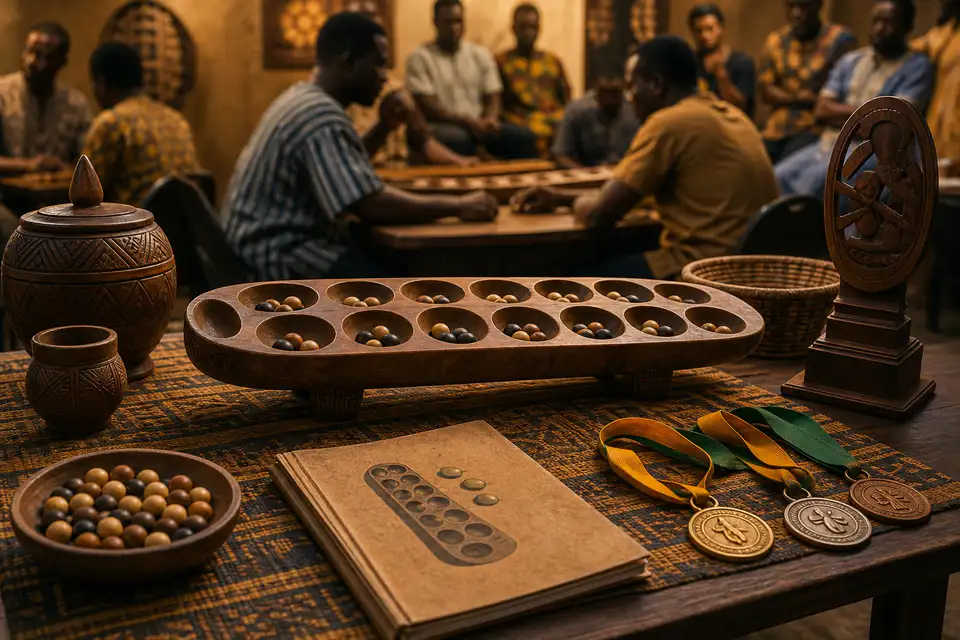
Oware is often presented as the West African classic of the mancala family, but its modern life depends on more than tradition. Around the Abapa version there is an international network of clubs, school workshops, online leagues, rankings, and tournament services. It is less a centralized sports machine than a living network of people who know how to keep an old game in regular use.
The most visible center is The Oware Society in London. The organization acts as cultural archive, education provider, tournament coordinator, and school-facing service. It does not merely say that Oware is ancient; it gives the game formats through which children, museums, clubs, and online players can meet the same discipline.
The Oware Society: a London bridge to Abapa
The society describes Oware as a two-row game in the broader “pits and pebbles” family, strongly associated with West Africa and the Caribbean. One important distinction is the competitive version Abapa, the “good version”, contrasted with the children's Nam-nam. That split helps explain why Oware can be both a family game and a serious adult discipline.
Its educational work is practical. The booking page lists workshops for primary and secondary schools, youth groups, and after-school clubs. The format is structured and paid: from two-hour sessions to longer workshops, plus competition management and basic training courses.
Tournaments: schools, Cannes, PlayOK
The Oware Society also maintains the competitive layer. Its site includes calendar, results, rankings, membership, event registration, and news sections. Society reports regularly mention online tournaments, PlayOK rankings, and players from Kazakhstan, Benin, Poland, Cabo Verde, Kyrgyzstan, Uganda, and the United Kingdom.
The Events & Registration page shows that this is not archival activity. It lists the 4th Online Oware Leagues on PlayOK, Awale activities at the 39th Cannes International Festival des Jeux, Mind Sports Olympiad Grand Prix championships, and recurring practice tournaments on PlayStrategy and PlayOK. For a game without a single state-run system, that calendar effectively acts as an international pulse.
The PlayOK rankings article is especially revealing. It describes weekly practice tournaments and monthly championships, and it notes that players can replay old games, download moves, or test alternative moves. For a game with deep endgame arithmetic, that is almost as important as a physical club room.
PlayStrategy: a newer digital stage
PlayStrategy added Oware in May 2022 and later expanded its mancala group with Togyzkumalak and Bestemshe. This matters because Oware is increasingly treated not as an isolated ethnographic curiosity, but as part of a wider abstract-games shelf beside chess, go, shogi, draughts, and other strategy games.
There are also narrower digital projects. PlayAwale is not a federation, but it gives players AI levels, replays, and country rankings; in April 2026 it restored per-game JSON export for research use and redesigned its country ranking system. This is the layer where a small game gains data, practice, and a long memory of played games.
For new players, digital platforms solve the basic problem: where to find an opponent. A player can start with Oware online, enter a quick game, then move toward rankings or tournaments. Use the Oware article hub for rules, comparison and practice paths; use the source hub, events page, knowledge base and AI trainer when the question shifts from "where can I play?" to "which sources should I trust?"
For advanced players, the constant flow of games creates a living metagame where schools meet more often than they could at rare physical events.
Who moves Oware now
| Actor | Function | Why it matters |
|---|---|---|
| The Oware Society | Education, events, rankings | Gives the game public language and recurring organization |
| Schools and museums | First contact | Frame Oware as mathematics, culture, and social play |
| PlayOK | Mass online practice | Supports weekly tournaments and international rankings |
| PlayStrategy | Modern platform layer | Offers tournaments, analysis, and a broader abstract-games context |
| Local clubs in Africa, the Caribbean, and Europe | Living culture | Preserve the conversational and spectator tradition |
What the sources prove - and what they do not
This topic needs a careful source layer. Oware has real organizations, events and digital communities, but the inspected sources do not establish one universal governing body, one official worldwide ranking, or any formal relationship between Toguz Arena and The Oware Society, PlayOK, PlayStrategy, PlayAwale or Mind Sports Olympiad.
| Claim type | Supported by inspected sources | Limit to keep |
|---|---|---|
| Organization | The Oware Society identifies itself as a London non-profit with information, events, membership and booking pages. | Do not turn this into a claim of global rules authority. |
| Education and workshops | The booking page lists school workshops, public animations, competition management and basic training courses. | Do not claim measured educational outcomes unless a separate study is cited. |
| Online competition | The PlayOK rankings article describes weekly practice tournaments, monthly championships, replays and downloadable moves. | Its own author warns that rankings are incomplete and not exhaustive. |
| Digital infrastructure | PlayStrategy documents Oware support and MSO-related Oware tournaments; PlayAwale documents AI, replay and JSON-export updates. | These are platform/community signals, not federation endorsements. |
More than sport
Oware cannot be fully understood through tournament tables alone. The Oware Society repeatedly returns to the social role of the game: spectators advise, argue, joke, and participate. That makes Oware different from many silent mind sports where the audience is expected to wait quietly.
That is why modern organizations build several routes at once: educational, cultural, club-based, and digital. Remove any one of them and the game becomes poorer. Connect them and Oware remains what it has been for centuries: not just a calculation of seeds, but a meeting place.
Sources and next step
- The Oware Society: Information
- The Oware Society: Book Online
- The Oware Society: Events & Registration
- Chronicles of Oware players on PlayOK
- PlayStrategy changelog
- PlayStrategy: Mind Sports Olympiad tournaments
- PlayAwale
- Oware board, Oware article hub, source hub, events, knowledge base and AI trainer - the internal path from sources to practice.