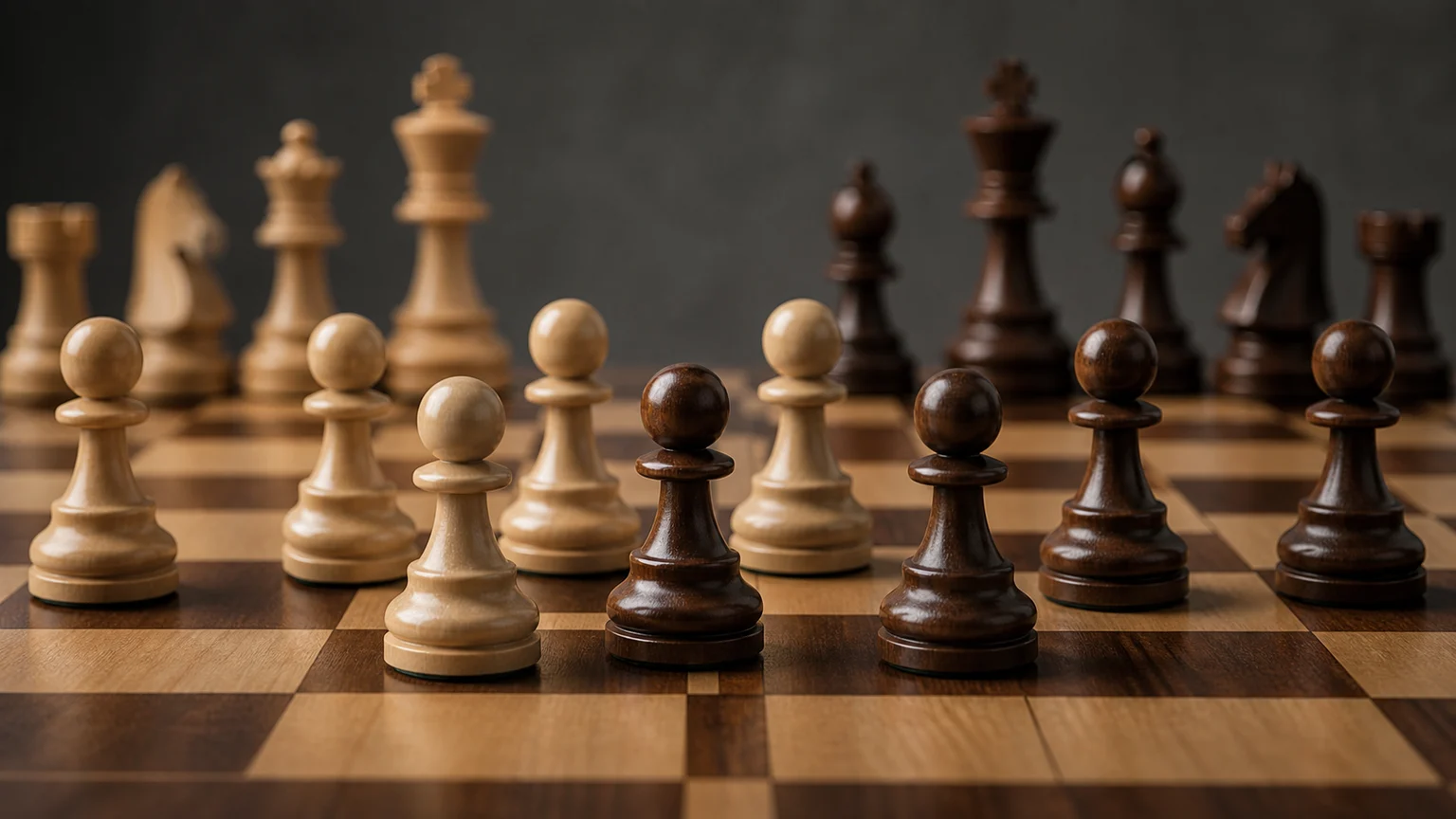
Pawn structures are the configuration of pawns that arises after the opening and determines the strategy of both sides for the entire middlegame. Each structure creates typical plans and weaknesses: the isolated d4 pawn gives activity, but is vulnerable in the endgame;the pawn chain determines the direction of the attack. Understanding 5-7 key structures allows you to play rapid rated games “according to plan”, without wasting time searching for a move from scratch.
Why pawn structures are the secret to growing your rating without cramming
Most chess advice for growing players comes down to two categories: “learn openings” and “decide tactics.” Both pieces of advice are correct, but incomplete. The opening ends around moves 10–15, tactics happen in specific positions - but what to do in between, in the “big” middlegame, where there is neither a clear plan from the opening theory nor obvious tactics?
The answer is a pawn structure. This is a concept that the classical chess school associates with Tarrasch, Nimzowitsch, Steinitz and subsequent positional theory: the configuration of pawns after the opening exchanges sets the standard plan for both sides. If you know the structure, you know where to place your knight, where a breakthrough awaits, which flank to attack.
This is especially valuable in rapid: instead of spending 3-4 minutes searching for a plan from scratch, you spend 30 seconds identifying the structure and immediately move on to implementing a standard plan. This is the “intuition” of strong players - not magic, but accumulated knowledge of structures.
Isolated d-pawn: double-edged sword
An isolated d-pawn (IPP, or "isolator") occurs when the pawn on d4 (or d5) loses the support of its neighboring pawns c and e. This is one of the most common structures that openings with 1.d4 produce after exchanges in the Queen's Gambit, Nimzo-Indian and a number of other systems.
Why IPF is strong: It controls squares c5, e5 (white d4) and creates space for active pieces - especially the knight on e5 or c5, and the bishop on the large diagonal. The side with the IPF must attack: its pawn is a charge, not ballast. In the middlegame, activity is more important than weakness.
Why IPF is weak: In the endgame, an isolated pawn is a target. When the pieces are exchanged, the opponent can concentrate the rooks on the d-file, block the pawn and methodically attack it with the “blocker on d5/d3 + rooks behind the blocker” maneuver.
Typical position with an isolated pawn structure (white):
8/pp2ppbp/4bnp1/2p5/3P4/2N1BN2/PP3PPP/R2QR1K1 w - - 0 1

Black is ready to blockade the d4 pawn with a knight on d5.
White's task is to build an attack before the blockade becomes secure.
Typical plan: Qd3, Rad1, Ne5, optional g4-g5 expansion.
Rule of Thumb: If you have IPF, attack immediately and don't force the endgame. If your opponent has IPF, block it with your knight and simplify the position.
Pawn chain: attack the base
Pawn chain - several pawns standing diagonally and supporting each other. A classic example: white pawns on e4 and d5 (or c4 and d5), forming an “arrow” towards the enemy position. Nimzowitsch and Tarrasch were the first to systematize the principle: the base of the chain (the backmost pawn) is its weakness, and the head (the front pawn) is the outpost of the attack.
The structure “pawn on d5, pawn on e4” for White (versus e6, d6 for Black – “French structure”) immediately indicates a plan: White presses on e5 and f6, Black attacks the base of the chain with the move c5-c4 (or b5-b4 depending on the configuration).Both know where to go - and don't waste time looking for a plan.
Practical application in rapid: once the position is established after the opening, the first question is “is there a pawn chain and who owns the space?” The answer gives direction for the next 10 moves.
Doubled pawns: not always a weakness
Doubled pawns (two pawns of the same color on the same file) have a reputation for being weak - and this is often true. But not always. Context determines everything.
When doubled pawns are a weakness:
- In the endgame: one of the pair of pawns is extra, “protects” the other, but does not create a passed pawn
- When they are isolated (no neighboring pawns for support)
- When the enemy has a powerful outpost on the field in front of them
When doubled pawns are an asset:
- In an open position: double c-pawns (e.g. c3+c4) control the central squares d5, d4, b5, b4 with double strength
- When dynamic compensation is received in return: for example, a pair of bishops or a half-open file
- In the middlegame with active pieces: space is more important than structural purity
A classic example: in the Nimzo-Indian Defense, White often gets doubled pawns c3+c4 after...Bxc3, bxc3. Compensation: a pair of bishops and control of the center. An experienced chess player knows: this is not a “weakness”, this is a different type of position.
| Structure | White standard plan | Black standard plan |
|---|---|---|
| IPF d4 for White | Attack, e5, Ne5 | Blockade d5, simplification |
| Pawn chain d5-e4 | Pressure on e5, f-attack | c5, attack of the base c4 |
| Double c3+c4 | Pressure in the center, pair of bishops | Blockade c4, attack pawn weakness |
| Pawn-fist e5 | Space, g4-g5 | Undermining f6 or d6 |
| Isolated Quartet | Defense, counterattack | Centralization, blockade |
Fist structure: how to use space
A "fist" is a leading pawn (usually on e5 or d5) that controls many of the opponent's squares and limits his pieces. This structure is typical for the French Defense (White with e5) or Caro-Kanna.
When you have a “fist” on e5, the space is used as follows: the knight on f3 goes to e4 via d2 or g5 via h3;a pawn assault on the kingside (g4-g5) is possible because the “fist” covers the center. An opponent with a "under pressure" position is forced to react - you dictate the pace.
Practical exercise: take any game from the base (for example, Mikhail Tal's games against the French defense) and track how a specific plan emerges specifically from the pawn structure on moves 12–15. This is the best way to “feel” the structure intuitively.
How to Learn Structures: A Practical Protocol
Understanding structures does not come from reading - it is built through playing and analyzing specific positions. Here is the working protocol:
Step 1: Choose one structure. Not five, just one. For example, IPF d4.
Step 2: Find 5-10 games with this structure. On Lichess, open an analysis of the opening where the IFA (Queen's Gambit, Variation Accepted) occurs. Select games with a participant rating of 2000+ to see high-quality examples.
Step 3: For each game, note the “moment of structure.” This is the move at which the IPF arose. Write down which plan the IPF side implemented in the next 10 moves.
Step 4: Play 10-15 games specifically in this structure. Choose an opening that produces it and play rated games with the goal of “implementing the standard plan.”
Step 5: After 2-3 weeks, next structure. Repeat.
After 2-3 months, you will have a working understanding of 3-4 key structures - and this is enough to increase your ranking by 100-150 points in rapid, simply due to a more meaningful plan in the middlegame.
Pawn weaknesses: how to create them and how to avoid them
Not all weaknesses are equally dangerous. Understanding the “hierarchy of weaknesses” is an important part of strategic thinking.
Permanent weaknesses (difficult or impossible to correct): a lagging pawn on a half-open file, an isolated pawn without compensation, a “hole” (a square without pawn cover that can be occupied by the opponent’s knight).These weaknesses must be avoided to be created without specific compensation.
Temporary weaknesses (can be corrected or compensated): a pawn that can be protected with pieces, a pawn island that can be compensated by activity. Such weaknesses are often tolerated for the sake of initiative.
Steinitz's rule of thumb (one of the founders of positional chess): do not create permanent weaknesses without gaining a specific equivalent advantage - material, positional or tempo.“Weakening the king’s pawn cover” in exchange for “queen activity” is possible;“weakening without gaining anything” is always bad.
The connection between opening and structure: choosing an opening as choosing a position
Understanding structures changes the attitude towards choosing an opening. Instead of asking “which debut is the best?”the right question is “what structures do I want to play in?”
If you understand closed positions with knights well, play openings that produce them (Caro-Kann, Berlin Defense, closed Spanish).If you like open positions with bishops, choose openings with early exchanges and open diagonals (Sicilian, open Spanish, accepted FG).
This does not mean that you need to give up studying theory. But the theory becomes much clearer when you understand the structure it creates, rather than just memorizing a sequence of moves.
Toguz Arena: pawn structures as an analogy
In Toguzkumalak there are no pawns in the chess sense, but the principle “the configuration of “small” elements determines the strategy” works there too: the arrangement of balls in holes creates typical situations with specific plans. An analytical approach to structures is a universal chess tool, and Toguz Arena already provides a practical environment for such a habit: games with friends and bots, ratings, game history and AI analysis. The chess direction will naturally expand this connection: played, saw the structure of the error, returned to the next game with a clearer plan.
Practical Toguz Arena links
- Practice from the shared play entry and review the resulting games instead of hunting for a chess-only route.
- Read the chess hub to connect pawn structures with openings, time controls and post-game analysis.
- Check the fair-play page when using rated practice as training evidence.
Sources and limitations
- FIDE Laws of Chess - rules context for legal positions, pieces and competition play.
- Glicko rating system overview - rating context for why better structural understanding can help decisions but cannot guarantee fixed points.
Limitation: pawn-structure study improves decision quality only through repeated practice and review. It is not a guaranteed rating shortcut.
Summary: pawn structures as a language of chess strategy
Pawn structures are the grammar of strategic chess. They turn finding a move from scratch into applying a known plan to a known situation. For rating growth, this means: less time in the middlegame, fewer mistakes due to lack of a plan, more quality decisions under time pressure.
Three main conclusions:
- Learn one structure at a time, through games and playing within it - not through reading theory
- IPF, pawn chain and doubled pawns are the three most common structures in real games;start with them
- Choosing an opening is a choice of structure: play in positions that make sense to you strategically