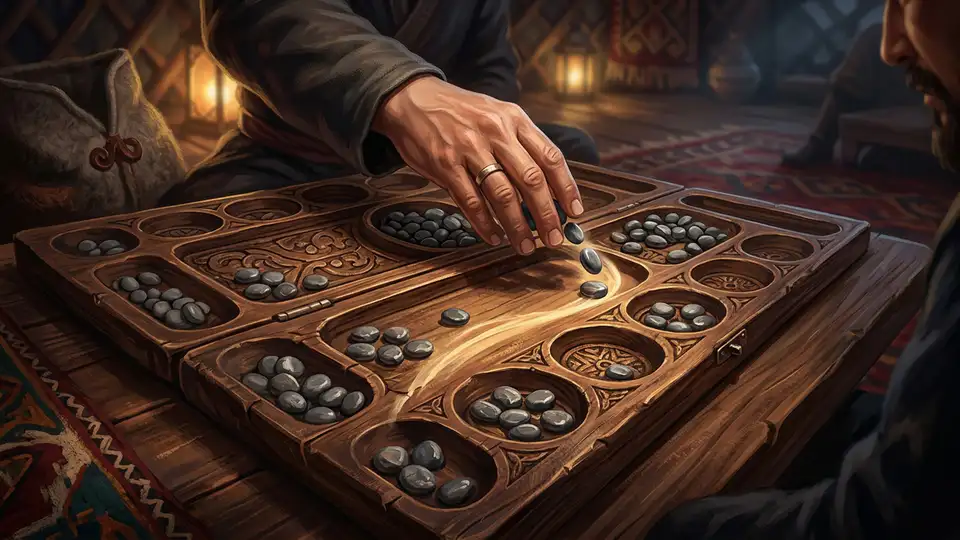
Toguz Arena positions its product around rated play, leagues, tournaments and AI review. Use this article as a platform guide, not as proof of live player volume or official federation rankings. For source checking and next steps, keep the wiki, federation source hub, events hub, play page and AI Trainer close by. The wider Togyz Kumalak ecosystem confirms the demand: Kazinform reported that the game is played in more than 50 countries, and online platforms were named as one of the tools helping players practice and compete across borders.
The global Togyz Kumalak community
A global player pool does three things for a traditional game. First, it keeps games available outside club hours. Second, it exposes players to unfamiliar styles. Third, it makes cultural preservation active rather than archival. The game is not only stored in a museum or a rulebook; it is played, reviewed and shared every day.
Other platforms show why this matters. PlayStrategy lists Togyzqumalaq beside many other strategy games and supports players, teams, forums, puzzles, analysis boards and tournaments. PlayOK's Togyzkumalak page advertises live opponents, rankings, statistics, profiles, contact lists, private messaging, game records and mobile support. Those are not Toguz Arena features by themselves, but they show what online mind-sport players expect: a complete competitive and social environment, not only a digital board.
Understanding rating systems
A rating is an estimate of playing strength. It is not a title, a personality score or a permanent label. It changes because the system compares your result with what was expected from the rating difference. FIDE's rating regulations are useful rating context, not proof that Toguz Arena follows FIDE calculations. The general lesson is still practical: expected score, rating difference and actual result all matter.
| Situation | What the rating system learns | Typical effect |
|---|---|---|
| You beat a much stronger player | Your previous rating may have underestimated you. | Higher gain. |
| You beat a much weaker player | The result was expected. | Small gain. |
| You lose to a much stronger player | The result was expected. | Small loss. |
| You lose to a much weaker player | Your current rating may be too high or form is unstable. | Larger loss. |
This is why rating anxiety is usually misplaced. A rating is useful because it makes matchmaking fairer and progress measurable. It is not useful if it makes you avoid strong opponents or stop reviewing losses.
Levels and divisions
The Toguz Arena leagues page previews a practical rating map for seasonal play: Bronze up to 1200, Silver 1200-1600, Gold 1600-2000, Diamond 2000+ and Legend for the elite circle. The league tiers are a public roadmap, not official sports titles, but they are helpful for training goals.
| Level | Main weakness to fix | Best training focus |
|---|---|---|
| Bronze | Rule confidence, last-stone counting, basic captures. | Short games, beginner bots, capture puzzles. |
| Silver | Unstable openings and missed opponent threats. | Review losses, learn common tuzdik patterns. |
| Gold | Converting advantages and avoiding time trouble. | Longer analysis, endgame practice, tournament formats. |
| Diamond | Small inaccuracies under pressure. | Opponent preparation, deep review and high-level events. |
| Legend | Consistency against elite styles. | Round robin preparation and detailed opening/endgame files. |
Finding the right opponent
The right opponent is not always the closest rating match. If you are learning rules, a slightly weaker or equal opponent keeps the game readable. If you are trying to improve quickly, a stronger opponent reveals weaknesses sooner. If you are preparing for tournaments, you need both: stable games against equals and stress tests against players above your rating.
Use time controls deliberately. Fast games train intuition and clock handling. Slower games train calculation and endgame discipline. Arena formats train recovery after mistakes. Swiss events train consistency across several rounds. Knockout events train pressure.
If you are still learning basic rules, start with the English rules guide before joining a rated pool. If you already know the rules but lose the thread in complex positions, pair live games with the move-counting guide and the middlegame guide.
Making the most of worldwide play
Global play becomes valuable when you review style differences. After each serious game, ask what the opponent did differently. Did they create tuzdik pressure earlier? Did they delay captures to control parity? Did they play faster in the endgame because they understood the stone race better?
Keep a simple opponent journal:
- country or region, if visible;
- time control;
- opening pattern;
- first critical moment;
- one idea to test in your next game.
That turns worldwide matchmaking into study, not just entertainment. You are not only collecting games; you are collecting strategic perspectives.
Why Toguz Arena is different
The strongest value of Toguz Arena is the combination: rated play, leagues, tournaments, AI review and a learning path around one specific game. General platforms can provide opponents, but a specialized platform can connect the game record to puzzles, coach feedback, league goals and culturally precise rules.
If you want to improve, do not treat each online match as isolated. Play, review, classify the mistake, train the pattern, then return to the global pool with one concrete correction.
Sources and product limits
- Toguz Arena Leagues page for roadmap-level tier, tournament and reward context. The public page uses "coming soon" and "planned" language for parts of the league system.
- Kazinform interview with Maksat Shotaev for 50+ countries and online-platform context.
- FIDE rating regulations for general expected-score rating logic. This is an analogy source, not a claim that Toguz Arena uses FIDE's exact formula.
- PlayStrategy Togyzqumalaq page and PlayOK Togyzkumalak page for online mind-sport feature context. These are comparison examples, not Toguz Arena feature guarantees.