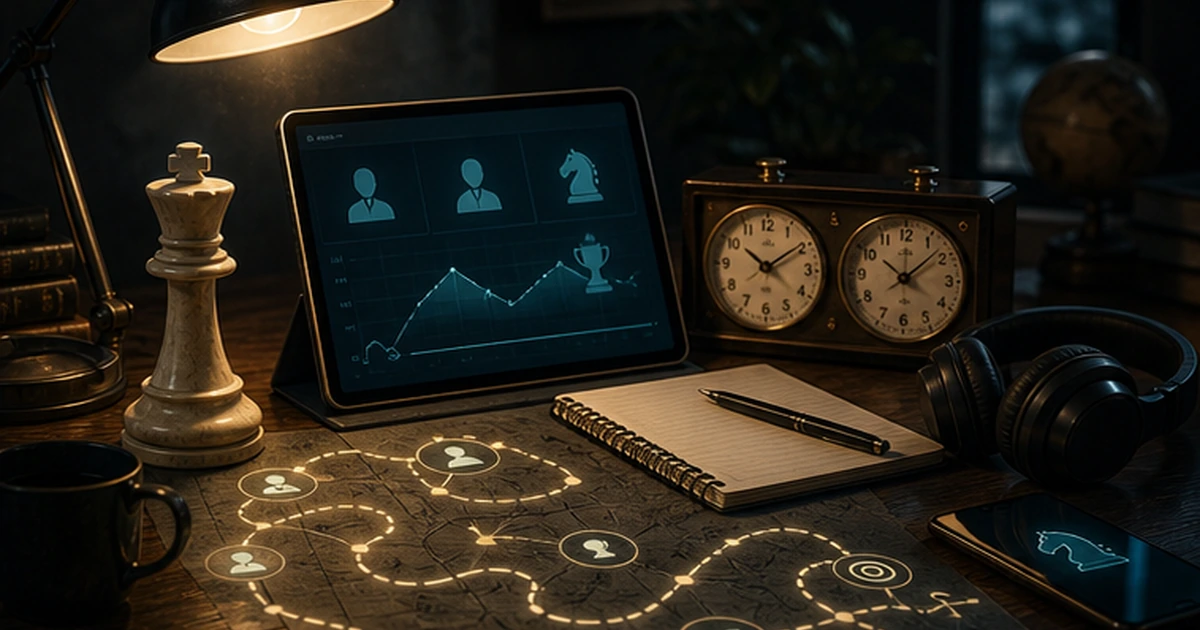
With large platforms hosting millions of players around the clock, you can still find a game at your level in seconds. This guide keeps the map practical: modes, time controls, rules and training paths, so your first session becomes a clear choice rather than a wall of buttons.
Look at the clock before you choose a mode. The same player can think clearly in rapid and collapse in bullet, so start with the format that trains the skill you actually need.

Why Play Chess Online?
Online chess removes the two biggest barriers to playing the game: finding a partner and finding the time. The largest commercial platform claims over 250 million players. The leading free open-source platform regularly hosts more than 96,000 concurrent players with over 41,000 games in progress, according to its live site counters.
You can play a three-minute blitz game during a coffee break, analyse a classical game over an evening, or start a correspondence match that unfolds over several days. The variety of formats means there is always a way to fit chess into your schedule — and opponents at every skill level are always online.
Play Modes — Who You Play Against
Every online chess platform offers several ways to play. Understanding the differences helps you choose the right mode for your mood and goals.
Rated vs. Casual Play. Most platforms let you toggle between rated games (which affect your visible rating) and casual games (no rating change). Beginners should start with casual play to get comfortable with the interface and time management. Once you feel ready, rated games provide a more competitive experience and a reliable measure of your progress.
Playing Against Friends. Major platforms let you challenge a friend by username or share a direct game link. You can set custom time controls for friendly matches, making this the best way to practice with someone you trust to give feedback.
Playing Against Bots and AI. Every platform includes AI opponents at varying difficulty levels. The largest commercial site offers bots "ranging in skill from Easy to Master," including themed bots with distinct playing styles. SparkChess goes further with six detailed AI characters: Cody (learning the basics, prone to blunders), Deon (knows the rules but falls into traps), Claire (fast and friendly — ideal for a coffee break), Boris (fast and aggressive), Guru (slow but deadly when he moves), and Alyx (a fully customizable android brain). Chess-Online offers Leela Chess Zero, a neural-network AI inspired by DeepMind's AlphaZero that plays in a creative, human-like style.
Bots are excellent training partners — they never tire, you can take back moves, and most platforms let you adjust their strength to match your level.
Tournaments. Several platforms feature arena tournaments (running around the clock, join any time), Swiss-system events, weekly prize events for titled players, and even FIDE-rated online tournaments. Tournaments are a great way to test your skills under structured conditions.
Time Controls — Speed of Play
Time controls determine how long each player has to make their moves. One leading free platform provides a useful map of the standard options:
| Time Control | Typical Settings | Total Play Time | Best For |
|---|---|---|---|
| Bullet | 1+0, 2+1 | Under 3 minutes | Reflex training, fun |
| Blitz | 3+0, 3+2, 5+0, 5+3 | 3–10 minutes | Most popular online format |
| Rapid | 10+0, 10+5, 15+10 | 10–40 minutes | Learning and improvement |
| Classical | 30+0, 30+20 | 60+ minutes | Deep practice, tournament prep |
| Correspondence | 1 move per 24–72h | Days to months | Across time zones, deep calculation |
The first number is base minutes; the second is increment seconds added per move. So "15+10" means 15 minutes for the game plus 10 seconds per move.
For beginners: start with Rapid (15+10). It gives enough time to think through tactics and check your calculations without the frantic pace of blitz. As you improve, try Blitz to train pattern recognition and intuition. Bullet is best left for warm-up or fun after you have a solid foundation. Classical and correspondence are excellent for deep study and endgame practice, especially if you are preparing for over-the-board tournaments.
How to Play Chess — Quick Rules Refresher
If you are new to chess or need a quick reminder, here are the essentials.
Objective and Setup. The goal is checkmate — trapping the opponent's king so it cannot escape capture. The board has 8 ranks and 8 files with alternating light and dark squares. Remember the orientation rule: "White on the right" — the corner square to each player's right should be a light square. The first rank from left to right: Rook, Knight, Bishop, Queen (on her own colour), King, Bishop, Knight, Rook. The second rank is filled with eight pawns. White moves first.
Piece Movement. The King moves one square in any direction and is the most critical piece — lose it and you lose the game. The Queen moves any number of squares in any single direction and is the most powerful piece. The Bishop moves diagonally any number of squares. The Knight moves in an L-shape (two squares in one direction, then one square perpendicular) and can jump over other pieces. The Rook moves any number of squares vertically or horizontally. Pawns move forward one square (or two on their first move), capture diagonally, and can promote to any piece when reaching the opposite end of the board.
Winning and Drawing. A game ends when a king is checkmated, a player resigns, or a draw is agreed. Common draw types include stalemate (no legal moves but the king is not in check) and threefold repetition (the same position occurs three times).
Rated Play and Fair Play
How Ratings Work. Online platforms use the Elo or Glicko rating system. Your rating increases when you win and decreases when you lose, with the amount depending on the rating difference between you and your opponent. New players typically start around 800–1200 and, depending on the platform's rating system, settle at their true level after roughly 20 games. World Chess stands out as the only platform offering FIDE Online ratings, meaning your online games can contribute to an internationally recognised rating.
The Fair-Play Rule. Using a chess engine (Stockfish, Leela Chess Zero, or any analysis software) during a live rated game is cheating. Platforms employ sophisticated anti-cheating detection — they analyse move patterns, compare them against known engine outputs, and flag accounts where the playing strength deviates suspiciously from their puzzle and game history. Penalties range from rating adjustment to permanent account suspension.
The Ethical Line is Clear. Studying with engines between games — analysing your completed games, exploring opening variations, or solving puzzles — is standard practice and essential for improvement. Using those same tools during a rated game is cheating. For correspondence (daily) chess, platform policies vary: the open-source site allows opening books in daily games, while other platforms have different rules. When in doubt, assume external assistance is not allowed and check the platform's terms.
For beginners: Do not worry about anti-cheating measures. If you play your own moves without external help, you have nothing to fear. Fair-play flags only activate on suspicious patterns that no beginner would trigger.
Post-Game Training — How to Improve After Every Game
The game is only half the experience. What you do after the game determines how quickly you improve.
Game Analysis. Every platform offers post-game analysis powered by a chess engine. The open-source site runs Stockfish 18 (one of the leading engines as of 2025) directly in your browser — free, unlimited, with multiple variation lines and an opening explorer. The largest commercial site offers game review with computer evaluation, though free users face analysis limits. The 365Chess analysis board also runs Stockfish 18 with engine evaluation, multiple lines, and both FEN and PGN import.
Tactics Puzzles. Puzzles are widely considered the fastest path to improvement. According to the open platform's own feed, its database has more than 6 million puzzles, organised by theme with modes like Puzzle Streak, Puzzle Storm, and Puzzle Racer. Other major sites also have dedicated puzzle sections, while Chess-Online states it offers approximately 5,000,000 puzzles in its database.
Lessons and Study Materials. Some platforms offer structured interactive lessons for all levels, from absolute beginner to advanced. Others focus on open learning sections with chess basics, coordinate training, practice positions, and shared study boards. SparkChess combines interactive lessons with "Epic Games" — a feature that lets you replay great historical games.
A simple improvement routine: play one Rapid game, analyse it immediately (especially the moves where the evaluation swung against you), then solve 10–15 themed puzzles. Repeat daily. This combination of practice, reflection, and targeted tactics training has helped more players improve than any other method.
Playing Chess on Any Device
Online chess works across desktop, tablet, and phone. Major chess platforms offer dedicated mobile apps for iOS and Android, synchronising your account — ratings, games, puzzles, and settings — across devices. If you prefer not to install anything, 247Chess and SparkChess run entirely in your browser with no download or registration required.
Most platforms support push notifications for correspondence moves, tournament alerts, and daily puzzle reminders. This means you can play a blitz game on your phone during a commute, review the analysis on your laptop in the evening, and make a correspondence move from your tablet the next morning — all from the same account.
Choosing Your Path — Next Steps for Online Chess Players
If you are just starting online chess, follow this simple progression:
- Pick a platform — the open-source site (completely free, no ads) or the largest commercial site (huge community, structured lessons) are both excellent starting points.
- Create a free account — You do not need to pay. All platforms have generous free tiers.
- Play 5 casual Rapid games (15+10) — Focus on not hanging pieces and checking your opponent's threats.
- Analyse each game — Use the platform's analysis board to find your mistakes. Pay special attention to the moves that changed the evaluation.
- Do 10 puzzles daily — Start with easy puzzles and increase difficulty as your tactics improve.
- Try a tournament — After 20–30 rated games, join an arena tournament on the open-source site or a daily tournament on the commercial site.
As you progress, add Blitz for pattern recognition, correspondence for deep calculation practice, and classical games for full tournament simulation. The most important habit is consistent analysis — playing without reviewing your games is like practising a musical instrument without listening to the recording.
Frequently Asked Questions
What is the best time control for a beginner in online chess?
Rapid (15+10) is the best starting point. It gives you enough time to think through tactics and consider your opponent's threats without the time pressure of Blitz or Bullet. Once you reach 1000+ rating, add Blitz to train pattern recognition.
Is it cheating to use a chess engine while playing online?
Using a chess engine during a live rated game is cheating and can lead to account suspension or a permanent ban. Using an engine to analyse your completed games, study openings, or solve puzzles between games is standard practice and encouraged for improvement.
Can I play chess online against my friends?
Yes. The largest commercial site, the open-source site, World Chess, and most platforms let you challenge a friend by username or share a direct game link. You can also set custom time controls for friendly matches, making it ideal for practice with a training partner.
Do I need to pay to play chess online?
No. The open-source site is completely free with no ads and no subscription. The largest commercial site, World Chess, and ICC offer free tiers with optional paid subscriptions for advanced features like detailed game reports and video lessons. 247Chess and SparkChess are also free to play.
What is the fastest way to improve at chess online?
The fastest improvement comes from combining three activities: playing longer time controls (Rapid or Classical), analysing every game you play (especially losses), and solving tactics puzzles daily (10–15 per day). This routine targets calculation, pattern recognition, and strategic understanding simultaneously.
Game Play Options Across Major Platforms
| Platform | vs. Random Opponent | vs. Friends | vs. Bots / AI | Tournaments | Correspondence |
|---|---|---|---|---|---|
| Large commercial site | ✓ Rated + Casual | ✓ | ✓ (Easy to Master) | ✓ (incl. Titled Tuesday) | ✓ |
| Open-source site | ✓ Rated + Casual | ✓ | ✓ (adjustable strength) | ✓ (Arena, Swiss, Simul) | ✓ |
| World Chess | ✓ Rated + Casual | ✓ | ✓ (AI) | ✓ (FIDE-rated) | — |
| SparkChess | ✓ (Multiplayer) | ✓ | ✓ (6 AI characters) | — | ✓ (24h/move) |
| ICC | ✓ (Play Now) | ✓ | ✓ | ✓ | ✓ |
| 247Chess | ✓ (Online) | ✓ (Invite) | ✓ (One Player) | — | — |
The board is digital, but the habit is old: make one move, notice one mistake, and come back a little calmer for the next game.
Sources
- Chess.com — Play Page (https://www.chess.com/play)
- Chess.com — Bots and Features (https://www.chess.com/)
- Lichess — Play and Training (https://lichess.org/)
- Lichess — Analysis Board (https://lichess.org/analysis)
- SparkChess — AI Characters and Modes (https://www.sparkchess.com/)
- World Chess — Official FIDE Platform (https://worldchess.com/)
- 247Chess — Beginner's Guide (https://www.247chess.com/)
- ICC — Internet Chess Club (https://www.chessclub.com/)