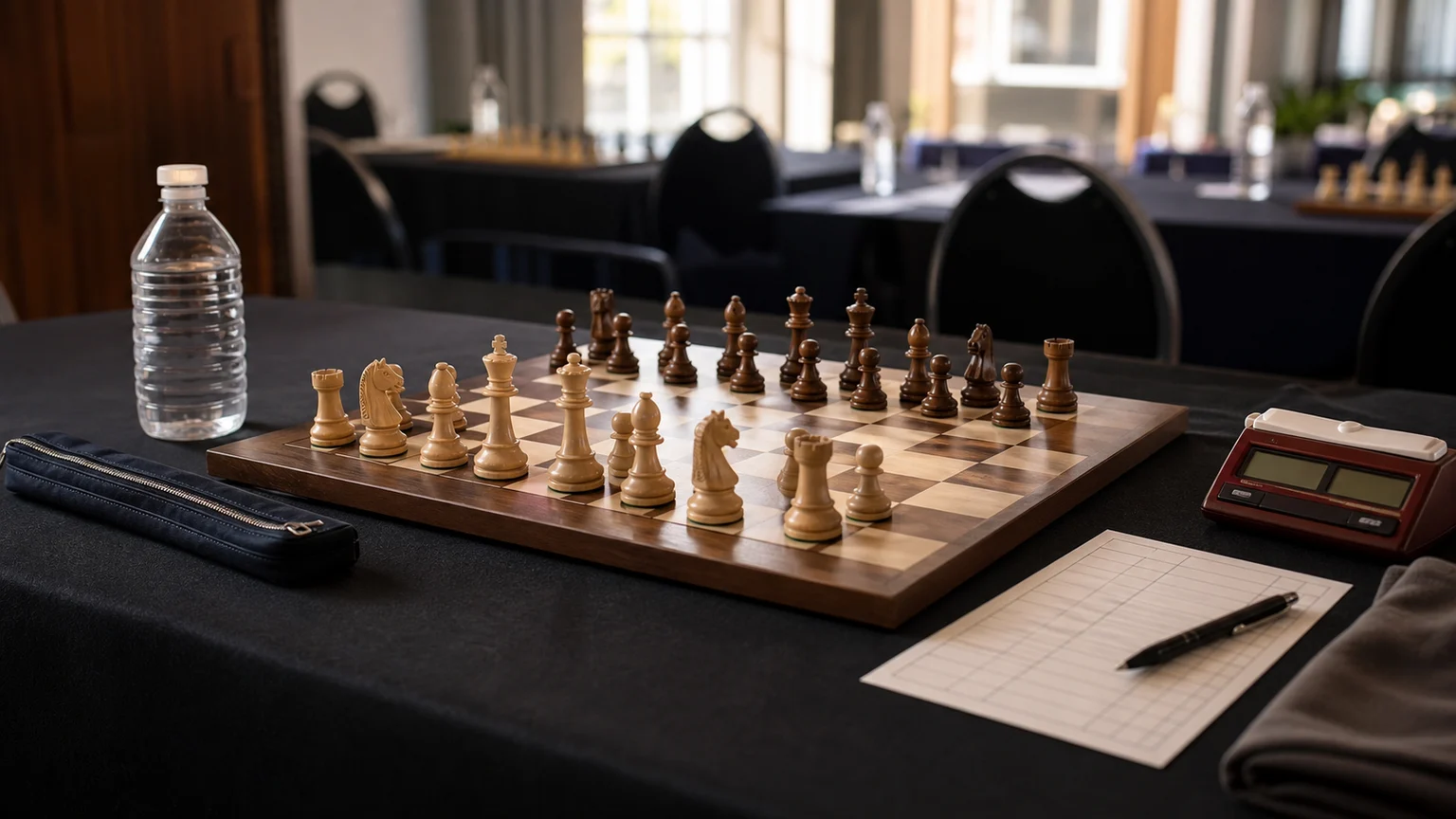
7 days before the tournament, focus on repetition rather than learning new things: go through the key lines of your opening repertoire, solve 10-15 tactical problems daily, work on 1-2 typical endgames. The day before - a light session without load. On the day of the tournament, arrive early, remember the rules of the format and do not change your plan at the last moment. Psychological readiness is more important than technical readiness.
The tournament starts before the first round
Serious preparation for a tournament is not a marathon of chess textbooks over the last two days. This is calm, systematic work in the last 7-10 days, which builds on the existing base and turns training habits into readiness for real pressure.
Most chess players make one mistake in the pre-tournament period: they try to learn something they don’t already know. Studying a new opening three days before the tournament, reading the chapter on rook endgames the evening before - these actions give a feeling of preparation, but do not give real readiness. New knowledge that is not consolidated by practice does not work under the pressure of a real party. They provoke uncertainty, not strength.
Correct pre-tournament logic is the opposite: repeat what you know until it becomes automatic. One well-studied opening variation is worth five hastily skimmed ones. One tactical topic solved 30 times is worth five topics solved 6 times. The tournament doesn't ask what you studied - it asks what you can do under pressure.
Rules, format and time control: figure it out in advance
Before thinking about openings, make sure you understand the rules of a particular tournament. Time control, the scoring system, rules of behavior at the board - all this should be known before the first round, and not found out during the process.
For offline tournaments (OTB) make sure you know the following:
- Time control (for example, 90 minutes + 30 seconds increment according to the standard FIDE classic format or other regulations for a specific event)
- Rules for touching a figure (touch-move): if you take it, go. Ignorance of this rule costs games
- Game recording protocol: in FIDE tournaments, notation is required up to a certain point of time pressure (check the specific regulations)
- How does the Swiss scoring system work if the tournament is Swiss: points, tiebreakers, color in circles
For online tournaments make sure you understand:
- Time control and increment availability
- Rules of conduct (platform fair play policy)
- Actions in case of technical failure (disconnect): each platform describes this situation differently
For FIDE rated tournaments, the latest rules are contained in the official FIDE Handbook (handbook.fide.com).For online events - in the regulations of a specific tournament or platform. Don’t rely on the fact that “it was like this last time”—the regulations are being updated.
Debut repertoire: what to repeat and what not to touch
The pre-tournament period is not the time for debut experiments. Your task: to strengthen what you already have, not to expand your repertoire.
What to repeat in 7 days:
- Main line for White: go through 10-15 moves in your favorite variation, make sure you haven’t forgotten the key ideas
- Main line for black against 1.e4 and 1.d4: similar
- Critical positions are points where your opponent can lead you off the prepared path: what to do if he deviates from theory on move 8?
What not to do:
- Do not learn a new opening from scratch 3–5 days before the tournament
- Do not touch variations that you have never played in practice - they will give you confidence in the book, but not at the board
- Don’t watch long video analyzes of openings: it’s better to play 3-4 short practice games in the right positions
A useful trick for 5-7 days: take 5-10 games from your tournament archive, find the moment where the opening ended (about move 10-15), and play the position further against yourself or the engine. This is not a theory - it is a “memory of hands” that works under pressure.
Tactics and endgame as daily hygiene
In the pre-tournament week, tactics are decided every day - not as a training session, but as a “brain warm-up”.10–15 tasks daily, no longer than 20–30 minutes. The goal is not to learn new tunes, but to keep the patterns sharp.
The endgame requires special attention because it is the one that most often destroys tournament games: a won position in the middlegame turns into a draw or defeat due to a technical error. In 7 days, it is enough to repeat one or two key endgame types for you. Priority recommendations:
- If you play classic/rapid, repeat the rook endgame (Lutsena’s or Philidor’s position depending on the level)
- Make sure you know the opposition and the square rule for a pawn endgame
- If your favorite openings often lead to a certain type of endgame, analyze it specifically
Seven-day preparation plan for the tournament:
| Day | Debut | Tactics | Endgame | Psychology |
|---|---|---|---|---|
| -7 | Repeat of White's main line | 15 problems | Review: Which Type Do You Often Have | — |
| -6 | Repeat of black's main line vs 1.e4 | 15 problems | Rook endgame: theory | — |
| -5 | Training games in the right structures | 15 problems | Rook endgame: practice vs bot | — |
| -4 | Review of critical positions and deviations | 10 tasks | Pawn endgame: opposition | — |
| -3 | Easy repetition: only familiar lines | 10 tasks | Pawn endgame: square rule | Relaxation Ritual |
| -2 | View 2-3 of your best games in this repertoire | 10 problems, easy | — | Easy training game |
| -1 | Don't touch chess or 30 minutes of easy tactics | — | — | Early sleep, rest |
| 0 | Arrive early. Don't change plan | — | — | One short ritual |
Physical and psychological preparation: without medical clichés
A chess tournament is an intellectual challenge that requires physical vigor. This is not abstract advice - it is a practical necessity: concentration, speed of calculation and resistance to stress directly depend on the quality of sleep, nutrition and physical condition.
No medical claims - just what is clear from common sense and experience in tournament practice:
Sleep. The last two days before a tournament are not the time for late analysis sessions.7-8 hours of sleep is more important than an additional option learned at midnight. The day before, go to bed at your usual time.
Nutrition. In long bursts (classic) the brain consumes significantly more energy than at rest. A light meal before the round, water near the board (where permitted by regulations) is the basic hygiene of a tournament player.
Pause between games. For several games a day (this is normal for Swiss tournaments) - leave the hall between rounds, take a short walk, let your head “reboot”.This is especially important after a tense game - analyzing immediately after a round puts you in a state of “thinking too much”, which interferes with the next game.
Checklist before the tournament
Below is a practical checklist for tournament day. Its task is to remove the “alarm noise” and make sure that the organizational part does not take away cognitive resources from the game.
Per day:
- [ ] Read the regulations again: time control, place, start of the first round
- [ ] Charge devices (for online tournaments: check connection)
- [ ] Prepare a notebook/notation form (for offline)
- [ ] Set an alarm clock with extra time: don’t be late for registration
On the day of the tournament:
- [ ] Arrive/log in 20–30 minutes before the start (registration, adaptation)
- [ ] Short ritual: 5-10 minutes of your favorite tactics or just close your eyes and remember the key idea of your opening
- [ ] Don’t analyze other people’s games between rounds if it throws you out of balance
- [ ] After each round - a short note: “what decided the game”
Online tournament: specifics of preparation
The online format adds several specific elements that are not present in OTB.
Technical preparation. Check the stability of the connection in advance - not at the start of the tour. If possible, use a wired connection instead of Wi-Fi. Close all unnecessary applications and browser tabs that burden your memory.
Space. Online does not mean “playing from bed with my phone.” Find a fixed place where you play chess: a comfortable chair, good lighting, a monitor or tablet at a comfortable height. Physical space affects psychological state.
Notifications. Turn off all notifications for the duration of the tournament - instant messengers, email, social networks. One missed move due to notification will reset the preparation.
What to do after the first round if everything didn’t go according to plan
The first round is often the most nervous - adaptation to the atmosphere of the tournament (even online), an unfamiliar opponent, a mistake in a familiar variation. It is important to maintain balance regardless of the outcome.
After a defeat in the first round: don't analyze the game deeply right now - just note one key point. The next game is more important. Tilt after the first loss ruins tournaments more often than the defeat itself.
After a victory: do not overestimate your strength. The first opponent could be weaker or in bad shape. Keep your work ethic.
Tournament rule: the result of the next round is more important than the result of the previous one. Always.
Toguz Arena as an environment for pre-tournament preparation
Toguz Arena is already suitable for developing competitive discipline: you can play with friends and bots, see the rating, store the history of games and analyze what you have played using AI. This is a strong basis for pre-tournament preparation: training does not end with the result, but turns into a cycle of “game - conclusion - next attempt”.
As the chess direction develops, this cycle can be supplemented with new modes, more accurate statistics and preparation scenarios for specific time control. In the article it sounds native: the platform already teaches how to work with ratings and analysis, and then it will provide even more tools for chess growth.
Practical Toguz Arena links
- Use the shared play entry for pre-tournament practice and post-game review habits.
- Open the chess hub for connected preparation topics: time controls, openings, tactics and analysis after losses.
- Read the fair-play page before treating online tournament preparation as rating proof.
Sources and limitations
- FIDE Rating Regulations - official context for rated tournament systems.
- FIDE Laws of Chess - rules context for legal tournament play.
Limitation: tournament regulations differ by organizer, platform and federation. Always read the event rules before relying on a preparation checklist.
Final: a series of prepared solutions
A tournament is not about one brilliant move or one learned line. This is a series of prepared decisions: opening, tactical, psychological, physical. Each of them is the result of work done before the first round.
The best tournaments in a chess player's memory are often not those where he played flawlessly. These are the ones where he was prepared - knew what to do when the position became unclear, and did not panic when the clock showed twenty minutes. Preparedness is not the absence of uncertainty. This is the ability to act within it.