What Is the Scandinavian Defense?
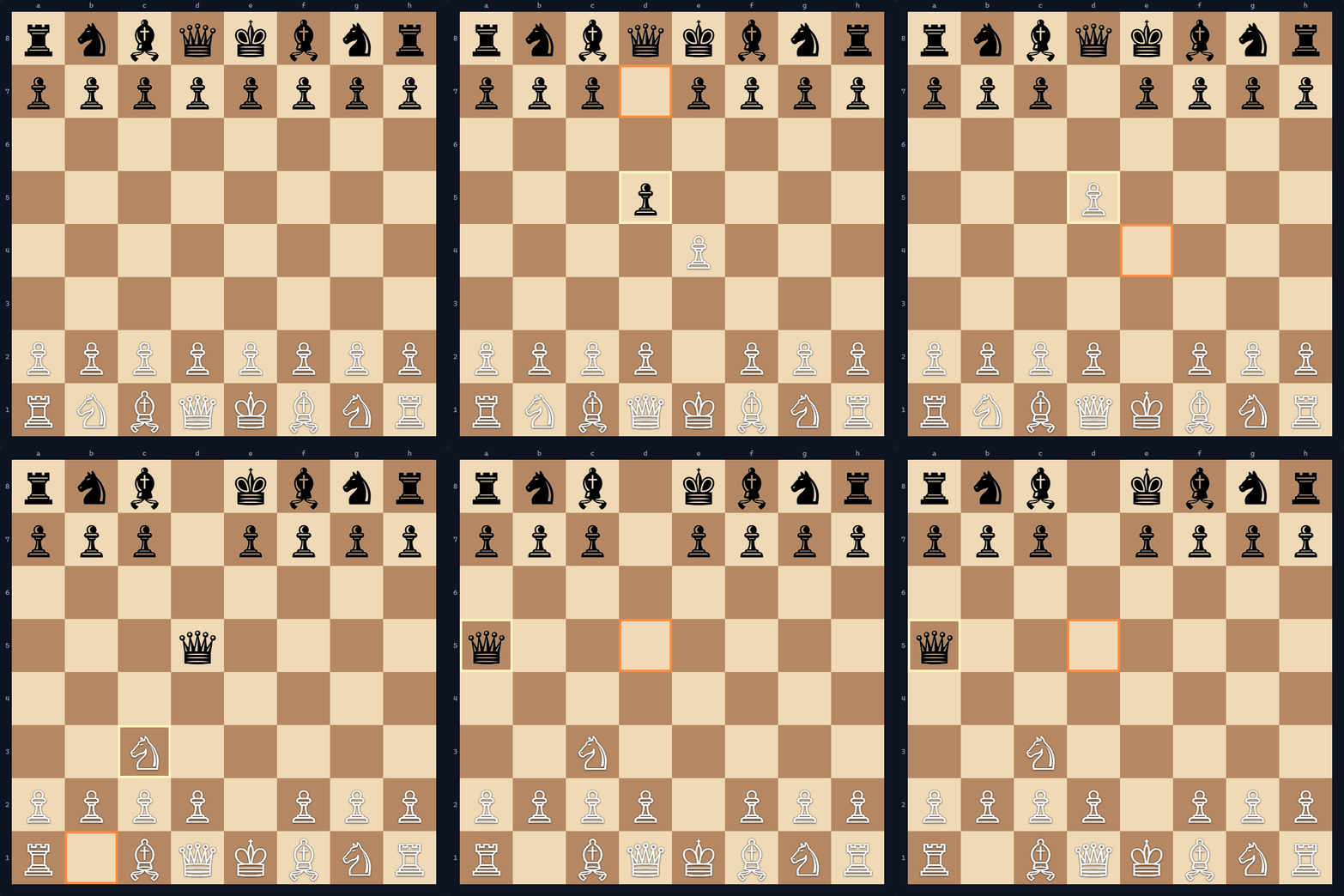
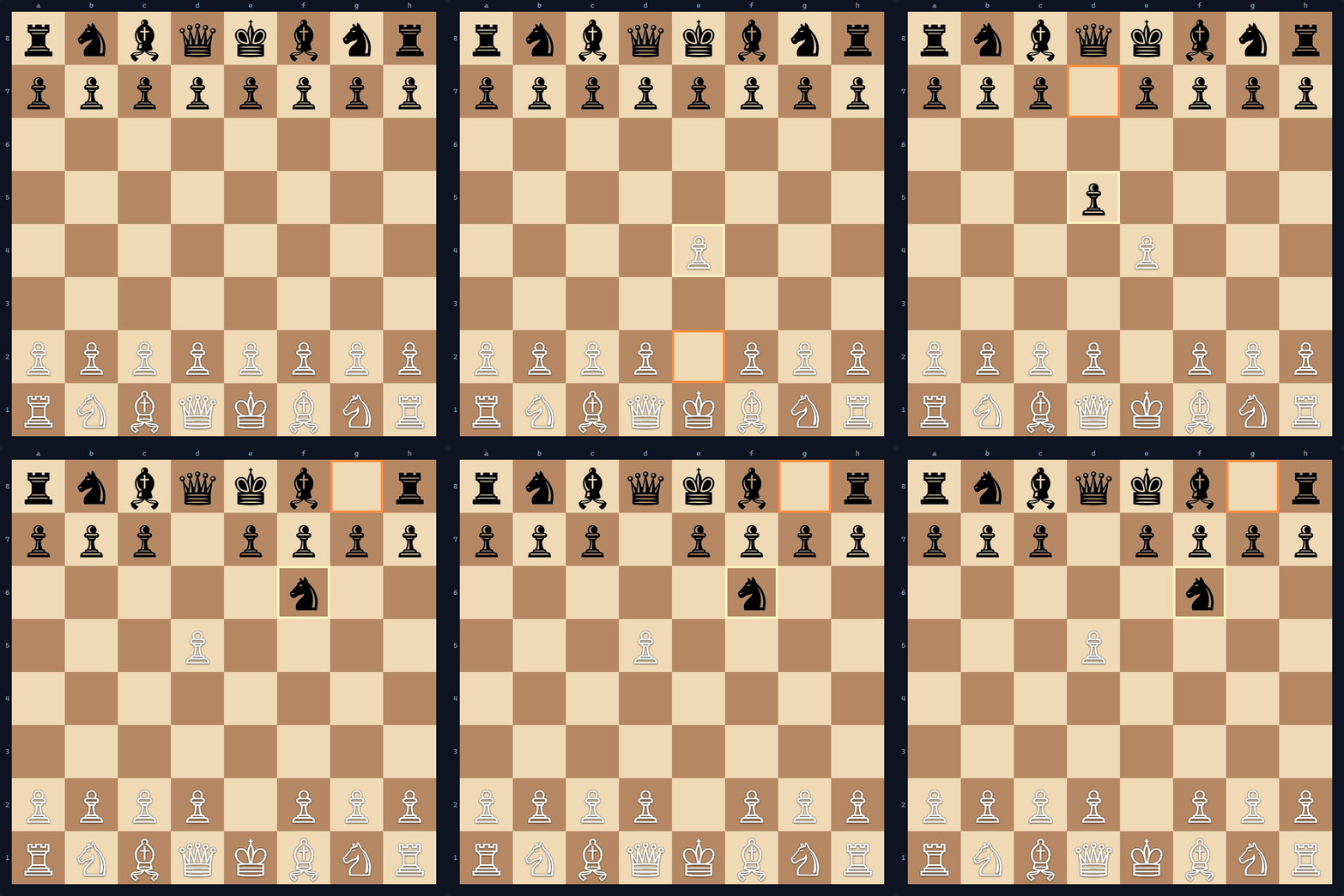
The Scandinavian Defense begins with 1.e4 d5. Also known historically as the Center-Counter Defense, it is Black's most direct answer to 1.e4. Unlike the Sicilian or French, where Black spends several moves shaping the pawn structure, the Scandinavian forces the structure Black wants by move two. According to the commercial platform's opening database, it is Black's seventh most popular response to 1.e4.
Black's idea is simple: challenge White's center pawn immediately. The move 1...d5 accomplishes two things at once — it attacks the e4 pawn and prevents White from playing many of the most common 1.e4 openings. After 1...d5, White can no longer play the Ruy Lopez (2.Bb5), the Italian Game (2.Bc4), or the Scotch Opening (2.Nf3 and 3.d4), as 365chess.com notes.
A rich history. The Scandinavian is arguably the oldest recorded chess opening. According to Chessable's blog, it has been around since at least 1475, when Narciso Vinyoles played it against Francesco di Castellvi. The House of Staunton blog connects the opening to the 1475 Valencian poem "Scachs d'amor." Centuries later, the Scandinavian debuted in a World Championship match in 1995 (Anand vs Kasparov).
Why Play the Scandinavian? Pros, Cons, and Comparisons
Every opening has trade-offs, and the Scandinavian is no exception. Here is what you gain — and what you give up.
What Black Gains
- Less theory. You face far fewer forcing lines than in the Sicilian Defense or the Caro-Kann. Chessreps.com lists "far less theory than the Sicilian" as a primary advantage. Chessable adds that there are "fewer variations for Black to learn" compared to the Caro-Kann.
- Bishop freedom. Unlike the Sicilian or French, Black's bishops do not get trapped behind pawns. As 365chess.com notes, "Black's Bishops usually do not get trapped behind their own pawns."
- Forced structure. You decide the structure, not White. Chessreps.com: "You force your structure on move one."
- Beginner-friendly. Multiple sources agree this is one of the easiest defenses to 1.e4.
What Black Gives Up
- Queen exposure. After 2...Qxd5, the black queen sits in the center, breaking the rule against early queen development. As 365chess.com notes, this invites 3.Nc3, gaining a tempo.
- Central space. White usually ends up with more space in the center, as the commercial platform notes.
- Less flexibility at master level. While fully sound, the Scandinavian is harder to play at the highest levels.
How It Compares
| Aspect | Scandinavian Defense | Caro-Kann Defense | Sicilian Defense |
|---|---|---|---|
| Theory to learn | Low | Moderate | Very high |
| Bishop freedom | High | Moderate | Low to moderate |
| Beginner suitability | Excellent | Good | Poor (too much theory) |
| Central control conceded | Some | Minimal | Minimal |
| White's favorite openings prevented | Ruy Lopez, Italian, Scotch | Ruy Lopez, Italian, Scotch | Nothing specific |
Bent Larsen, who scored a famous win with the Scandinavian against Anatoly Karpov in 1979, called the Scandinavian "an improved version of the Caro-Kann," according to Chessable. His reasoning: in both openings, Black ends up with no d-pawn and White with no e-pawn after ...dxe4 or exd5. The vital difference, Larsen noted, is that Black keeps the option of playing either ...c6 or ...c5 in the Scandinavian.
The Classic Approach: 2...Qxd5 and Three Queen Retreats
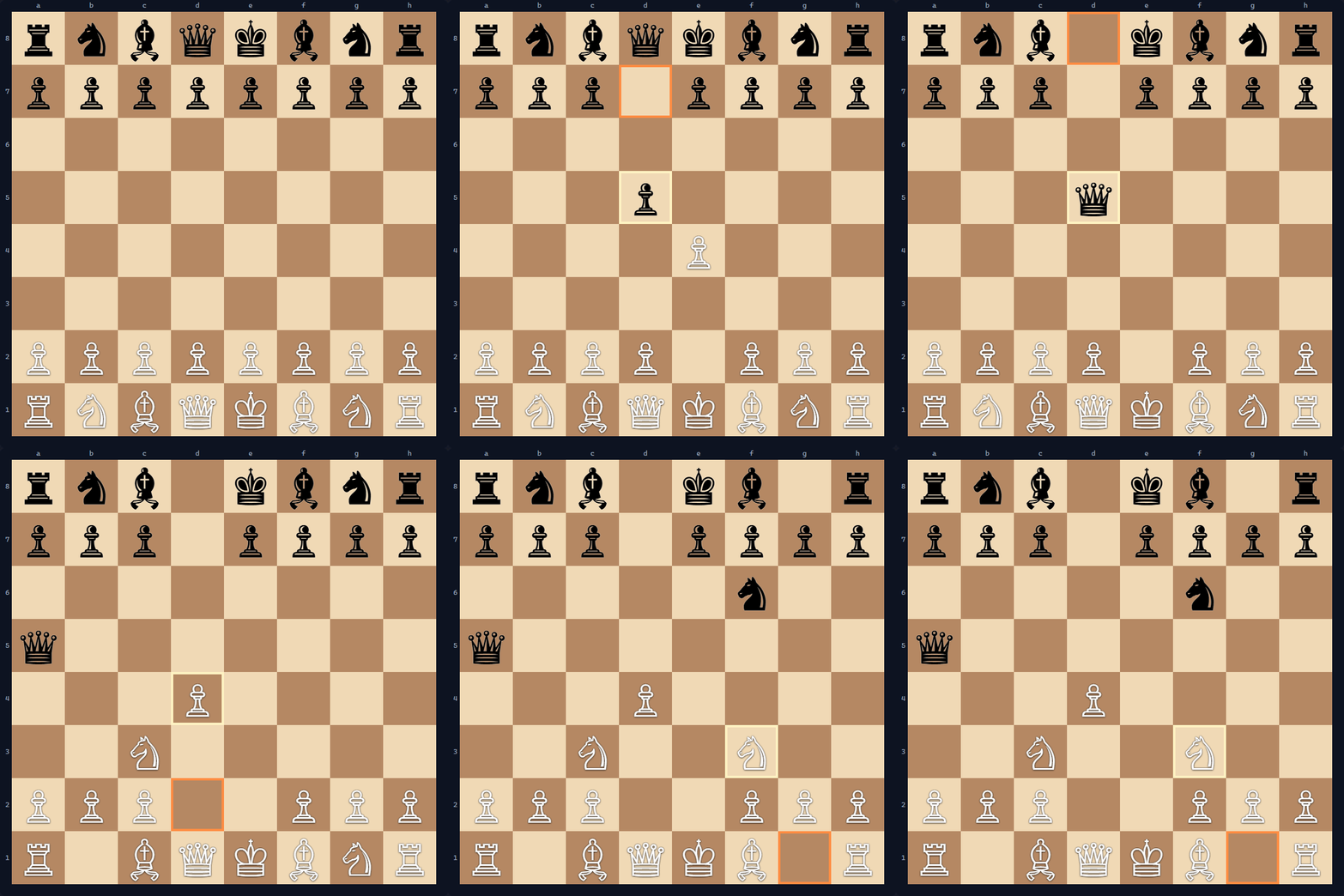
White's best and most common response to 1...d5 is 2.exd5 — capturing the pawn. On the open-source platform, 67% of games see White play this move. After the capture, Black's main recapture is 2...Qxd5, bringing the queen out early.
White immediately punishes this with 3.Nc3, attacking the queen. Now Black has three retreat squares, each leading to a different type of game.

| Retreat | Popularity | Activity Level | Key Idea | Top-Level Usage |
|---|---|---|---|---|
| 3...Qa5 (Mieses-Kotrč) | Most common | Active | Classic main line; ...c6 gives queen escape to c7 | Larsen vs Karpov (1979) |
| 3...Qd6 (Modern) | Increasing | Active | Supports center, prevents Bf4, flexible | Bologan; growing popularity |
| 3...Qd8 (Old Line) | Rare | Passive | Safe but slow; same structure as others | Carlsen vs Caruana (2014) |
All three are fully playable. As Chessable concludes: "After 2...Qxd5, all three of the queen moves, 3...Qa5, 3...Qd8, or 3...Qd6, offer black a playable position."
3...Qa5 — The Mieses-Kotrč Main Line
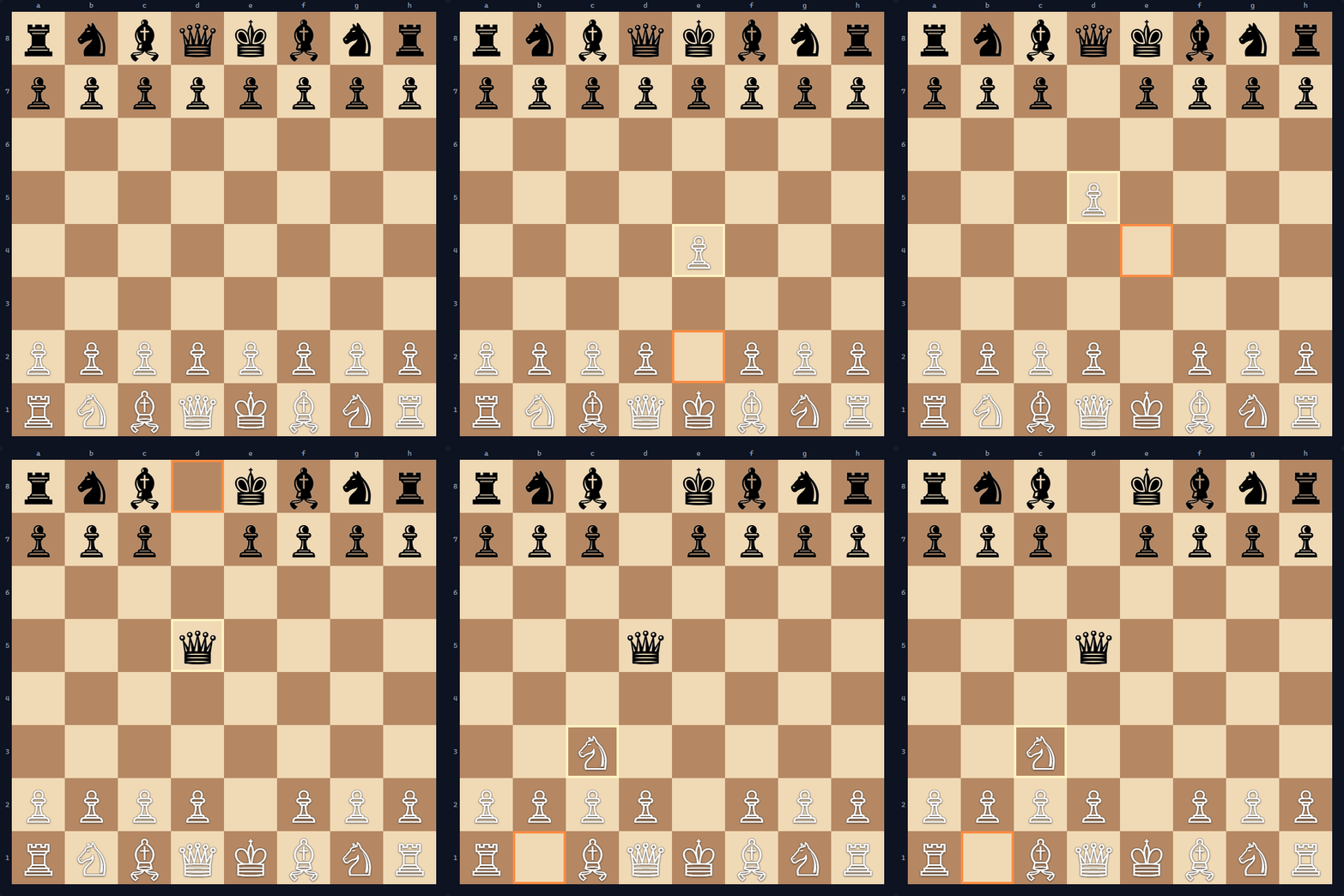
The retreat to a5 is the classical choice and the most common move. Black's setup revolves around the move ...c6, which gives the queen an escape route to c7 or d8. Black will develop the knights to f6 and d7, place the light-squared bishop on f5 or g4 (before closing the diagonal with ...e6), and castle short.
A typical main line runs:
1.e4 d5 2.exd5 Qxd5 3.Nc3 Qa5 4.d4 Nf6 5.Nf3 Bf5 6.Bd2 e6
At this point, White has several options. One common continuation, shown by 365chess.com, is 7.Bc4 — developing with an eye on f7. Another is 7.Ne4, heading for the "Queen Hunt" line where White tries to harass the black queen further. Chessreps.com gives the line 7.Ne4 Qb6 8.Nxf6+ gxf6 9.c3 Qxb2 — Black snatches a pawn but accepts doubled f-pawns.
According to Chessable, Black's strategic plan in the 3...Qa5 variation includes pressuring the d4-pawn via the semi-open d-file and seeking control of d5 with moves like ...b5 and ...Nb6. White's three main pawn breaks are d5, f5, and b5 — of these, d5 is the most dangerous, especially if the black king is still in the center.
Note that doubling Black's f-pawns after ...gxf6 (from Nxf6) is not necessarily bad. Chessable explains that the doubled pawns help Black keep control of the fourth rank, and the semi-open g-file may discourage White from castling short.
3...Qd6 — The Modern Approach
The retreat to d6 has grown in popularity over time. Sometimes called the Gubinsky-Melts Defense (though this naming appears primarily on Simplify Chess), this line offers Black a flexible, modern setup.
On d6, the queen "adds support to the central squares, prevents Bf4, and does not get in the way of queenside castling," according to Chessable. The commercial platform adds that the line is "generally more flexible and Black often obtains an imbalanced position including queenside castling."
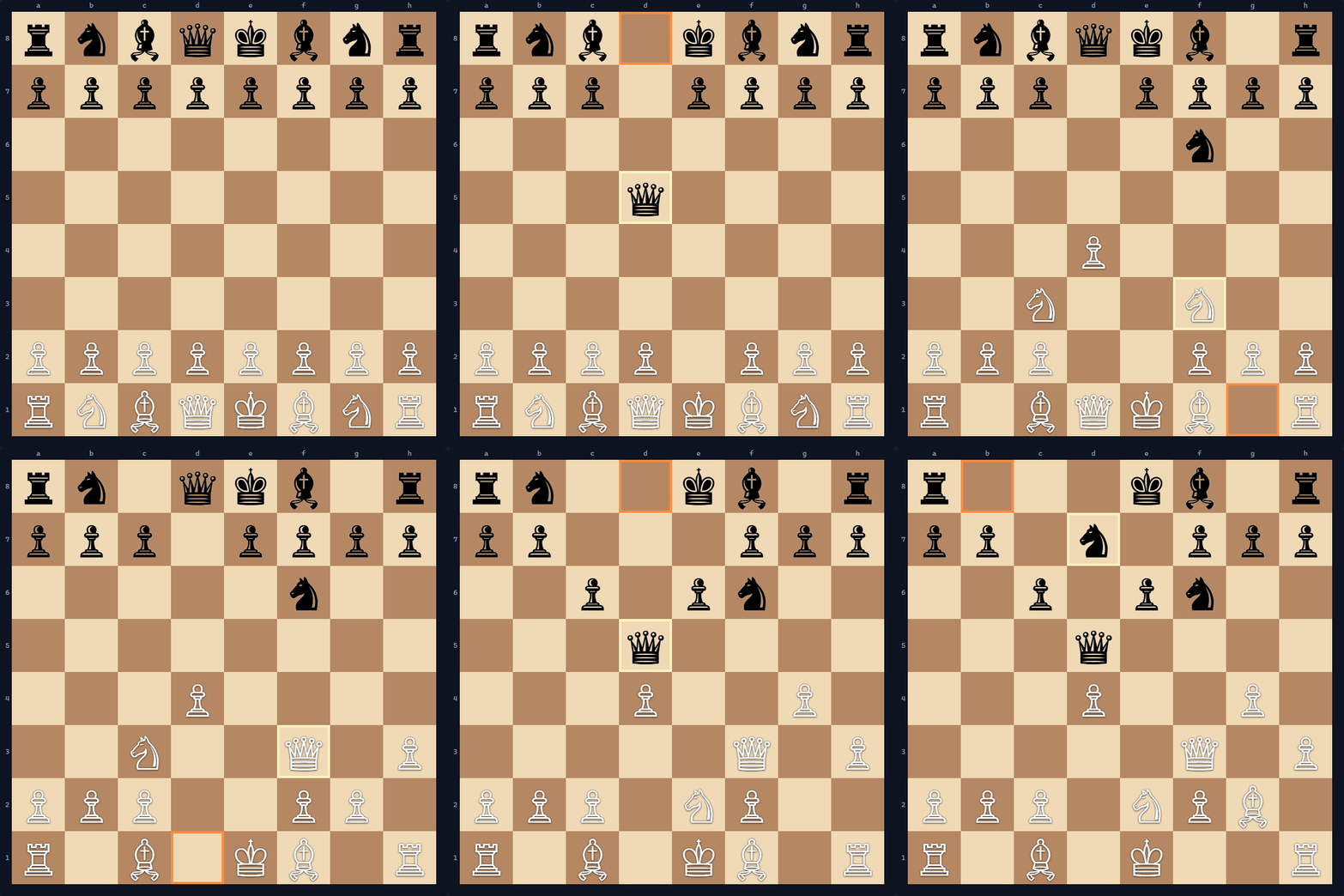
A typical continuation from 365chess.com:
1.e4 d5 2.exd5 Qxd5 3.Nc3 Qd6 4.d4 Nf6 5.Nf3 c6 6.Ne5 Nbd7 7.Nc4 Qc7
The knight sortie to e5 interferes with the black queen's control of f4, making Bf4 possible. Black handles this by exchanging knights — Chessable notes that "exchanges tend to favor the side with less space and work in favor of Black." According to Chessable, the move 10.h3 in this line has been used by GM Bologan "to win some excellent games."
3...Qd8 — The Old Line
The oldest queen retreat is the most passive — but it is still playable, and it has a famous champion. Black returns the queen to its starting square immediately, reasoning that if the queen on a5 is going to get driven back after Bd2 anyway, why not save time?
Chessable gives this sample line:
1.e4 d5 2.exd5 Qxd5 3.Nc3 Qd8 4.d4 Nf6 5.Nf3 Bg4 6.h3 Bxf3 7.Qxf3 c6 8.Ne2 e6 9.g4 Qd5 10.Bg2 Nbd7
The 3...Qd8 line is not played much nowadays, but it received a powerful endorsement when Magnus Carlsen used it against Fabiano Caruana at the 2014 Chess Olympiad and won a well-played endgame. Chessable notes that "foreshadowing their world championship match, Magnus Carlsen played 3...Qd8 against Fabiano Caruana at the Olympiad and won thanks to a well-played endgame."
According to Chessable, Black can also generate counterplay against White's early Bc4. For instance: 5.Bc4 a6 6.a4 (preventing ...b5) leaves the b4-square weak — Black can later play ...Nc6 and ...Nb4 to exploit it.
The Modern Variation: 2...Nf6
Instead of recapturing immediately with the queen, Black can play 2...Nf6 — developing first and delaying the recapture. This is the Modern Variation.
After 2.exd5 Nf6, White should not try to hold the d5 pawn. The main line:
1.e4 d5 2.exd5 Nf6 3.d4 Nxd5 4.Nf3 g6 5.c4 Nb6 6.Nc3 Bg7 7.c5 Nd5 8.Bc4 c6
Black adopts a kingside fianchetto with the bishop on g7. The knight bounces back to d5 after c5, and Black prepares to castle.
According to Chessable's analysis (single source), 2...Nf6 is not as effective as 2...Qxd5 — it allows White to establish a c4-d4 center easily, and the knight does not exert as much control as a queen on d5, a5, or d6. Chessable notes that GM Peter Svidler "shows quite clearly how to work up a dangerous attack with White" in this variation.
That said, 365chess.com treats 2...Nf6 as a fully legitimate main option. The choice depends on whether you are comfortable with a kingside fianchetto setup.
Who Should Play the Scandinavian Defense?
The Scandinavian is an excellent choice for a specific type of player. Here is how to decide if it fits your game.
Beginners and casual players. Wholesale Chess declares it the "best choice for beginners" with strongest statistics for players below 1200 Elo. Chessable says the Scandinavian is suitable for beginners because the strategies are easy to remember, and calls it "an excellent choice for busy chess players and beginners."
Ambitious club players up to 1800. The Scandinavian is sound and can be played confidently at all levels. According to WGM Jovanka Houska, as cited by Chessable, she credits the defense for helping her become a WGM. The model games consistently cited across sources — Larsen's 1979 win over Karpov, Carlsen's 2014 Olympiad win over Caruana, and Anand's 1995 World Championship debut against Kasparov — show the Scandinavian holds its own at the highest levels.
For club players: what to actually learn first. Start with the 3...Qa5 main line — it is the most popular and most tested. Learn the setup with ...c6, ...Nf6, ...Bf5, ...e6, and the typical plan of pressuring d4. Once you are comfortable with the classical approach, add the 3...Qd6 line for variety; it leads to different types of positions and gives White a new set of problems to solve.
Frequently Asked Questions
Is the Scandinavian Defense good for beginners? Yes. Chessreps.com calls it "one of the easiest defenses to 1.e4." Chessable finds it suitable for beginners because the strategies are easy to remember, with minimal must-know theory.
Does bringing the queen out early lose time? White gains one tempo with 3.Nc3, but the trade-off is sound. The open-source platform opening explorer notes the Scandinavian is "one notable exception" to the rule against early queen development.
Is the Scandinavian Defense sound at high level? Yes. Larsen beat Karpov with it in 1979. Carlsen used 3...Qd8 to defeat Caruana at the 2014 Olympiad. Anand played it against Kasparov in the 1995 World Championship.
How is the Scandinavian different from the Caro-Kann? The Caro-Kann prepares with 1...c6; the Scandinavian plays ...d5 immediately. Larsen called the Scandinavian an "improved version of the Caro-Kann" because Black keeps the option of ...c5.
What if White does not take on d5? As Chessreps.com states, "2.exd5 is overwhelmingly the main move" (67% on the open-source platform). Other moves like 2.Nc3 or 2.e5 are playable but, as the commercial platform notes, "give Black an immediately equal position."
Final Verdict. The Scandinavian Defense is a sound, beginner-friendly opening with a pedigree stretching back over five centuries. It bypasses mountains of 1.e4 theory while giving Black active piece play and clear strategic plans. The trade-off — one tempo lost to White's 3.Nc3 — is a fair price for rapid development, bishop freedom, and a structure you control.
As Chessable puts it: "Surprisingly the recapture with 2...Qxd5 offers black better prospects than the classical development with 2...Nf6 in the Scandinavian Defense."
Whether you are a beginner looking for a reliable weapon against 1.e4 or an experienced club player wanting variety in your repertoire, the Scandinavian Defense deserves serious consideration.
Ready to add the Scandinavian to your repertoire? Explore our full guide at
Sources
- Chessable Blog — "Scandinavian Defense" (https://www.chessable.com/blog/scandinavian-defense/)
- 365chess.com — "Scandinavian Defense" (https://www.365chess.com/chess-openings/Scandinavian-Defense)
- Chess.com — "Scandinavian Defense" (https://www.chess.com/openings/Scandinavian-Defense)
- Chessreps.com — "Scandinavian Defense" (https://www.chessreps.com/opening/scandinavian-defense)
- Lichess Opening Explorer — "Scandinavian Defense" (https://lichess.org/opening/Scandinavian_Defense)
- Simplify Chess — "Scandinavian Defense" (https://simplifychess.com/scandinavian-defense/index.html)
- Wholesale Chess Blog — "Scandinavian Defense Modern Variation" (https://www.wholesalechess.com/blogs/chess-openings/the-scandinavian-defense-modern-variation)
- House of Staunton Blog — "The Scandinavian Defense" (https://www.houseofstaunton.com/blogs/chess-openings/the-scandinavian-defense)