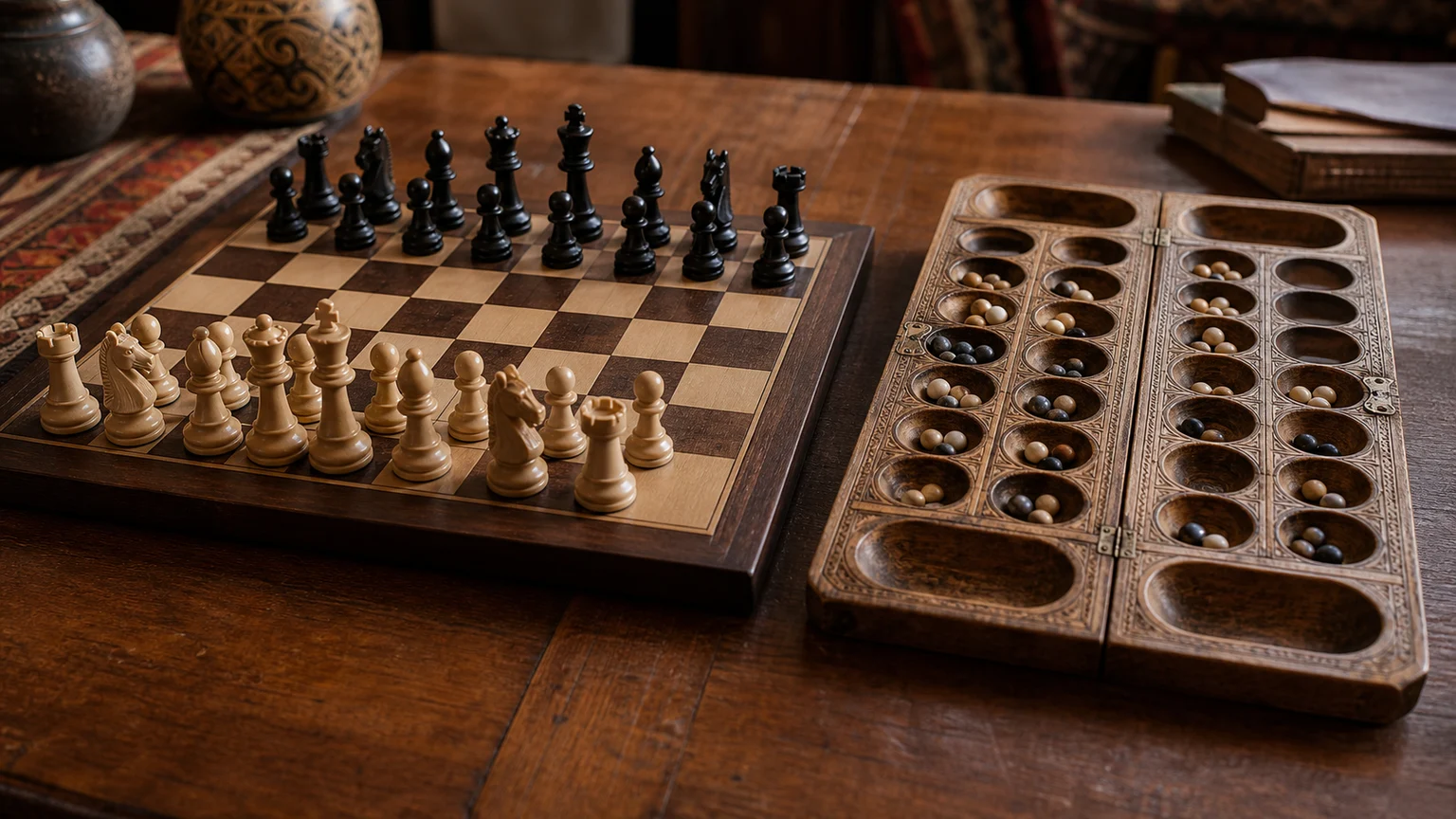
Chess and togyzkumalak develop overlapping but not identical skills. General: Strategic planning, pace management, position assessment and mental toughness. Various: chess - geometry of threats and forms, togyzkumalak - resource accounting and numerical intuition. A player who practices both games develops a broader analytical profile - but each must be trained in its own language.
One board teaches you to see the field, the other teaches you to hear the number
When a chess player sees togyzkumalak for the first time, he usually thinks: “this is easier.” There are no pieces, the rules are shorter, the board is symmetrical. But after a few games he understands: “this is different.” Managing 81 stones in nine holes, the instant consequences of each move for the entire distribution chain - it's not simpler, it's different.
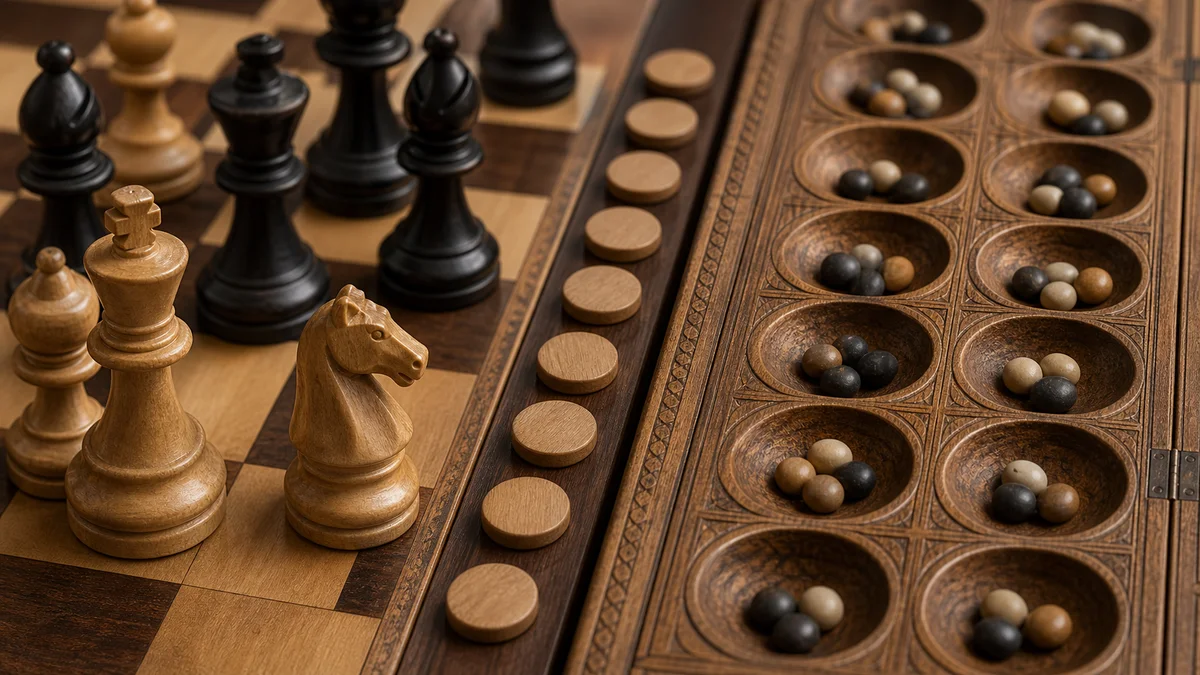
The opposite is true for a togyzkumalak player who sits down to play chess: 32 pieces with different moves, threats across several verticals, diagonals, lines - this is not more difficult in the abstract sense, it is a different type of complexity. Chess requires geometric thinking: do I see the trajectory of the threat? Togyzkumalak requires numerical thinking: what will happen to the distribution if I leave here?
It's this difference that makes cross-training between games an interesting tool. Not because one game “trains” the other directly, but because they engage different facets of what we call “analytical thinking.” A chess player who has mastered togyzkumalak begins to count resources differently in the endgame. A togyzkumalak player who understands chess begins to see longer chains of cause and effect.
Chess: geometry of threats
Chess thinking is built around three basic questions: where the pieces are, what trajectories they control, and what threats are created through those trajectories. This is a geometric language: threats exist in the space of the board, and they need to be seen “by eye” - without recalculating from scratch every time.
That is why chess training is built around patterns: a fork, a pin, an open check - these are not rules, these are visual configurations that an experienced player recognizes in a split second. The accumulation of these patterns is “chess intuition.”
What chess trains especially well:

- Long-term planning through several interconnected moves
- Assessing the position based on several parameters simultaneously (material, space, king safety, piece activity)
- Accurate calculation of options in tactical positions
- Management of a limited resource (pieces cannot be “added”) - each exchange is irreversible
Togyzkumalak: resource, pace and score
Togyzkumalak is a mankala family game developed in Kazakh culture. Each player's nine holes, the initial number of stones in each hole, and the rules of capture and distribution create a system where each move is a wave of redistribution that changes the context for the next.
Unlike chess, where resources are finite and diminishing (pieces are removed), togyzkumalak is a game of flows: stones move rather than disappear (until captured).This requires a different type of thinking: not “what am I losing” (chess question), but “where is the resource going” (togyzkumalak question).
What togyzkumalak train especially well:
- Numerical intuition: quickly calculate what will happen with a given distribution
- Tempo sense: every move changes the situation for both players at the same time
- Managing several “threads” at the same time - an analogue of multi-pass planning
- Psychological resistance to rapidly changing positions: in togyzkumalak the situation changes faster than in most chess positions
What carries over between games
Some skills do transfer from one game to another - not automatically, but with deliberate practice.
Well tolerated:
Strategic planning. The ability to think 3-5 moves ahead, taking into account the opponent’s reaction - this skill is universal. A chess player, accustomed to building long cause-and-effect chains, also applies this in togyzkumalak.
Mental stability. Tilt management, stopping after a series of losses, ritual between games - all this works the same in both games. Psychological patterns of competitive play are universal.
The skill of analysis after a game. The habit of returning to the game and looking for key moments does not depend on the rules of a particular game. This is a metacognitive skill that enhances learning in any strategy game.
Time management. If you have learned not to panic under time pressure in chess blitz, this skill is also useful in fast togyzkumalak formats.
What doesn't carry over and why it's important
Honesty is critical here: overestimating cross-transfer leads to poor allocation of training time.
Not directly transferable:
Threat patterns. Tactical motifs of chess (fork, pin, open check) do not have a direct analogue in togyzkumalak. An experienced chess player, sitting down at togyzkumalak, does not see “forks” - because they are not there. You need to learn the tactics of togyzkumalak from scratch.
Numerical intuition of distributions. Quick calculation of what will happen during a given move in togyzkumalak is a separate skill not related to chess calculation. Chess calculation is linear (move → answer → move);calculation in Togyzkumalak is cyclical (distribution → new configuration).
Opening theory. Opening knowledge of chess is completely inapplicable. Each game has its own “beginning theory” - and they need to be studied separately.
Conclusion: Cross-training is useful for developing general strategic abilities and mental toughness, but does not replace specific practice in each game.
Practical weekly cross-training plan
Below is a realistic plan for a chess player who wants to add togyzkumalak (or vice versa) without sacrificing progress in the main game.
| Day | Main game | Cross-training | Total time |
|---|---|---|---|
| Monday | Chess: 3 rated games + analysis | — | 60–80 min |
| Tuesday | Chess: tactics 15 problems | Togyzkumalak: 2–3 training games | 50–60 min |
| Wednesday | Chess: opening repeat | Togyzkumalak: learning basic principles | 40–50 min |
| Thursday | Chess: 3 rated games + analysis | — | 60–80 min |
| Friday | Togyzkumalak: 3–4 rating games | — | 50–60 min |
| Saturday | Chess: endgame + one analysis | Togyzkumalak: analysis of one lost game | 70–80 min |
| Sunday | Relaxation or light tasks of one of the games | — | Optional |
Important principle: Do not reduce your time on the main game by cross-training in the first 2-3 months. Add togyzkumalak as a supplement, not a replacement. First - stable progress in the main game, then - expansion of practice.
General analytical profile: why play multiple games
Beyond specific skills, there's a deeper argument for multi-game practice: different games teach you to think about "strategy play" in different ways - and this broadens the overall pattern of understanding.
A player who knows only chess thinks of strategy as a "position in space." A player who knows togyzkumalak thinks of strategy as a “flow of resources.” Both are right - their models are just different. Someone who knows both games has a richer strategic language: he can think in both spatial position and resource flow. This makes him a more adaptive thinker—not just at the board.
This is not a claim to academic rigor: there is not enough concrete research to prove that playing togyzkumalak improves chess ratings. But the practical logic is clear: different strategic challenges develop different aspects of the same analytical apparatus.
Toguz Arena as an environment for cross-game development
Toguz Arena was originally created as a platform for several intellectual games, and this is already visible in the user scenario: games with friends and bots, rating profile, game history, AI analysis and recommendations after the game. For the topic of cross-game development, this is strong self-promotion without exaggeration: the player does not just try different rules, but accumulates the habit of thinking, comparing solutions and returning to mistakes.
This creates a unique context: a chess player, already familiar with the platform through togyzkumalak, comes to the chess direction with a ready-made account and understanding of the ecosystem. A togyzkumalak player interested in chess should not go to another platform - everything is in one place, and there will be even more modes, analytics and connections between games. This format is especially useful for audiences who value a variety of strategic challenges.
Final: two games are like two languages of one habit of thinking
Nimzowitsch wrote about chess: “My systems.” The togyzkumalaka player thinks about his distribution and capture systems. These are different words - but behind them there is one thing: the desire to understand what is happening on the board before the opponent understands it.
When you play two games, you're not just practicing two sets of rules. You expand your vocabulary of understanding—you learn to notice different types of structure, different types of planning, different types of error. And at some point, returning to the chessboard after a game of togyzkumalak, you may notice something in a position that you hadn’t noticed before - not because you’ve become better at chess, but because you’ve started to think a little more broadly.
Practical Toguz Arena links
- Use the shared play entry to switch between supported games without inventing a separate chess-only URL.
- Read the chess hub when you want chess-specific rating, tactic and review guidance.
- Check chess fair-play notes before mixing engine review, practice games and rating goals.
Sources and limitations
- FIDE Laws of Chess are the baseline reference for chess rules and legal move context.
- UNESCO's Togyzqumalaq / Toguz Korgool / Toguz Kumalak listing is the cultural-heritage reference for the Toguz-family side of this comparison.
- Limitation: cross-training is framed as an editorial training hypothesis; this page does not claim that playing one game automatically improves official rating in the other.