Games against the computer are useful for practicing specific skills: studying endgames, testing opening lines, practicing defense under pressure. But they don’t replace playing against people: bots don’t make psychological mistakes, don’t create real pressure, and don’t teach you how to exploit your opponent’s weaknesses—only their own. To grow your rating, you need regular play against people, and a bot is a specialized tool for specific tasks.
Computer as a training partner: what has changed in 30 years
In 1996, Garry Kasparov lost his first game to the Deep Blue computer. It seemed historically significant. Today, any smartphone with a free application runs an engine that plays much better than the Deep Blue of its time. The chess engine has ceased to be a specialized research tool and has become a daily training tool for chess players of any level.
This has opened up enormous opportunities: now everyone can check any of their moves, get an accurate analysis of a position, and play with a partner at 3 am. But along with the opportunities come specific pitfalls: many players begin to think that “training with a computer” = “increasing rating,” although this equation only works if applied correctly.
Key Understanding: The computer is not an adversary, it is a tool. The question is not “is it worth playing with a computer,” but “for what specific task should I use a computer?”
When a bot really helps your rankings
Studying the endgame against the engine is the most effective way
The endgame is the only phase of chess where the computer has “absolute” knowledge bases: a tablebase for all positions up to 7 pieces inclusive. This means that in a game of rook versus rook and pawn, the computer always knows the exact outcome for optimal play.
Practical application: take a typical endgame that you don't know how to play (for example, "king and pawn versus king"), set it on the board against a tablebase-level engine, and play with white until you win. The engine will not allow itself to lose, which means you get accurate feedback: “this path leads to a draw, this path leads to victory.” This is more effective than any textbook.
Recommended sequence for studying endgames with the engine:
1. Rook + King vs King (basic mating pattern)
2. Queen vs Rook (advantage conversion)
3. King + pawn vs King (opposition, opposition square rule)
4. Opposite-color bishops (drawish tendencies)
Checking opening variations
The engine is the optimal tool for testing specific opening lines: “if I play e4 e5, Nf3, d4 - what will happen in 10 moves if both sides play better?” This is not about “memorization”, but about understanding what positions a specific plan leads to.
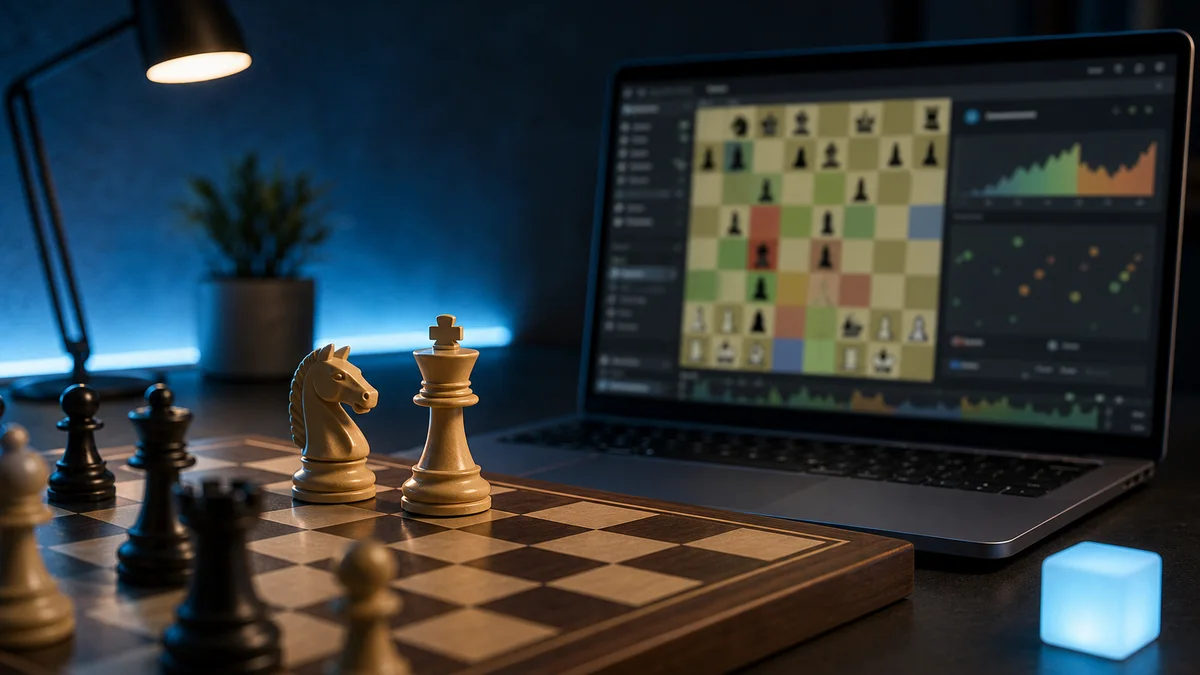
The correct way to work with opening variations through the engine: do not just look at the evaluation, but try to find the move yourself, then compare it with the computer proposal. The gap between “my move” and “the engine’s move” is information about your understanding of the position.
Defending difficult positions
Defense training is a specific skill that is difficult to practice in games with live people: you need to get there by accident, and the attack may be incorrect. With a computer, you can deliberately set yourself a difficult defensive position and train it precisely - the engine always attacks optimally, which means you learn to defend against the best possible attack.
When a bot interferes with rankings
Complete replacement of parties against people
The most common mistake: playing exclusively or predominantly against the computer, avoiding live games. This creates several problems at the same time.
There is no psychological pressure. The bot does not get nervous, does not play worse over time, and does not make impulsive moves. The skill of playing under psychological pressure - “how not to fail when the enemy is bluffing with a victim, and you are not sure whether it is correct” - does not develop against the computer.
Don't learn to exploit other people's mistakes. Computers make mistakes rarely and predictably (only at lower levels, and these mistakes are not typical for humans).A huge part of real chess is the ability to notice an opponent’s weakness and brutally exploit it. Against people, you learn to see human mistakes. Against a bot - no.
The “chess nose” does not develop. Intuition in chess is the accumulated experience of positions that you have seen and correctly assessed. Games against the computer are statistically more likely to end up in positions that are atypical of real games: the computer plays optimally, and its optimal moves are sometimes counterintuitive to humans. By playing only against a bot, you “train your intuition” on a non-representative sample of positions.
Playing at a high engine level without a training goal
Losing every game to Stockfish at the maximum level is not training, it is psychologically destructive. If you lose every time without understanding why, you are not learning, you are only gaining negative experience.
Rule: The engine level for practice games should be such that you win about 40-60% of the games. This provides enough pressure while still leaving space to pursue your own ideas.
Correct integration: how to use the engine in the training process
Below is a practical model for using a computer that actually supports rating growth.
Model “bot as analysis, person as party”
All rating parties are against the people. After each game - analysis with the engine (not during).This is the gold standard: live games create a real experience, the engine explains what happened.
Specific analysis protocol:
- Play a game against a person
- Before opening the engine: go through the game yourself, noting moves that seemed unobvious
- Open the engine: check only the marked moves (not the whole game)
- Write down one main conclusion: “I didn’t see Y at position X—next time I’ll look for Y.”
Specialized training sessions
Once a week: training session for a specific skill against a bot.
- Monday: endgame against tablebase
- Thursday: opening analysis with an engine (not games - analysis of variations)
The open-source and commercial platforms: ready-made tools for working correctly with bots
The open-source platform offers a “Practice” mode where you can set a position and practice a specific endgame. The commercial platform has Lessons, Puzzles, and engine-backed review tools, but some of the advanced features may vary depending on the plan. Both resources provide input into the correct model of working with the engine - not as a constant opponent, but as a training tool.
Engine levels: how to choose the right difficulty
Most platforms provide several levels of engine strength. The choice of level is critical:
| Engine level | ELO equivalent | For whom | Goal |
|---|---|---|---|
| Level 1–3 | < 1000 | Beginners | Learning the basic rules, checkmate in 1-2 moves |
| Level 4-6 | 1000–1400 | Beginners | Practice elementary tactics |
| Level 7-8 | 1400–1800 | Intermediate | Pressure while still being able to win |
| Level 9–10 | > 1800 | Advanced | Maximum Pressure Training |
| Stockfish full | 3500+ | Analysis | Only analysis of games |
Rule of thumb: start your training series at a level where you win 60% of your games. When the win percentage increases to 70–75%, raise the level.
Bots with human styles: a specific tool
Some platforms offer bots that imitate the style of famous chess players: the "Magnus Carlsen bot" on the commercial platform, or bots with specific weaknesses (for example, "a bot that plays weakly in the endgame").These tools are more interesting than just an engine because they simulate human play patterns - including predictable weaknesses.
However, you need to understand the limitation: even the “Magnus Carlsen bot” is a statistical model, and not the actual behavior of a grandmaster. There is training value, but it is lower than a game against a real person of comparable level.
FEN position for training against the engine
One of the most useful techniques is to take a specific position from your lost games and play it with the engine several times, trying out different continuations.
Example: an isolated d-pawn position for training
FEN: r1bqkb1r/pp2pppp/2np1n2/3p4/3PP3/2N2N2/PPP2PPP/R1BQKB1R w KQkq d6 0 6

Task: White has central tension.
Training goal — find a plan for White against the computer
that maintains tension without an immediate exchange.
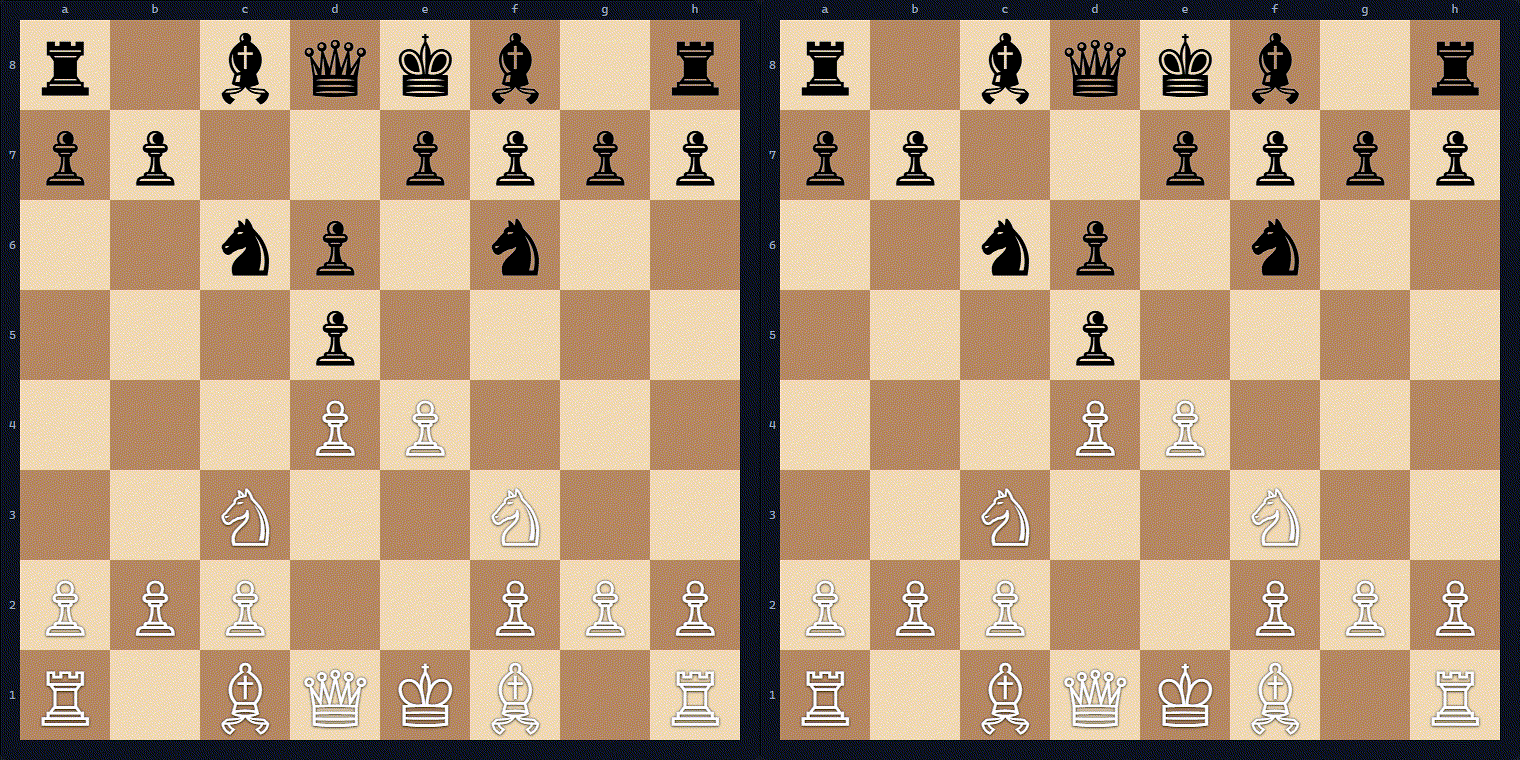
This method (“playing from position”) is much more effective than games from the initial position because it allows you to concentrate on the specific type of positions that are difficult for you.
Toguz Arena: computer training modes
On Toguz Arena you can already play with bots, invite friends, view the history of games, monitor the rating and return to the analysis with the AI. Therefore, an article about training against a computer can lead natively to the platform: the bot provides a safe training environment, the rating adds context for progress, and the AI review helps to understand which mistakes are repeated.
The chess direction will develop this logic further: more levels, more training scenarios, more connections between the game and analysis. It is important not to promise unconfirmed details of the engine, but to sell an already clear habit: played with a bot, saved the game, disassembled it and came back stronger.
Bottom line: a bot is a tool, not a replacement
The computer opponent is a powerful training tool when used correctly and a trap when used incorrectly. The boundary passes through the understanding of the goal: the bot is suitable for learning techniques, checking options and practicing specific positions. For psychological training, development of intuition and real progress in the rating, you need live opponents.
Three main conclusions:
- Optimal model: rated games against people + specialized training sessions with a bot
- The level of the engine is important: a bot that is too strong demotivates and does not train;you need a level with 40–60% wins
- Analysis of games with the engine after the game is the most valuable use of a computer for rating growth
Practical Toguz Arena links
- Start from the shared play entry when you want a live or bot practice session inside the platform flow.
- Use the chess hub for related rating, tactics, review and time-control guides.
- Read the chess fair-play page before using any engine during rated or competitive play.
Sources and limitations
- Stockfish is the public engine reference used here for computer-analysis context.
- Lichess fair-play guidance and Chess.com fair-play rules are external examples of engine-use boundaries in online chess.
- Limitation: bot levels and Elo-equivalent labels are platform-specific approximations; they are not official FIDE ratings and do not guarantee rating growth.