The game is lost not with one move, but with habit
Chess mistakes rarely appear out of nowhere. They are usually preceded by a chain of microscopic concessions: an overexertion of the queen, a hasty pawn advance that creates perpetual weakness around the king, or a lazy reluctance to count the opponent's short answer. You yourself are preparing the ground for a future disaster, and the opponent can only reach out and take away what you poorly defended.
To stop the drain of rating points, you need to learn to recognize your mental and positional traps before your hand makes a fatal move. Each player has their own unique "pattern" of errors. Someone breaks under the pressure of the clock, someone changes pieces without any benefit, and someone rushes to attack, forgetting about the safety of their own king. Understanding these vulnerabilities is the first step to a strong and stable ranking.
What mistakes most often take away your rating
The main mistakes that take away the rating in online chess are inattention immediately after leaving the opening, automatic exchanges without positional gain, the creation of irreversible pawn weaknesses and inability to manage time (time trouble).To stop giving away points, you need to draw up a personal error map, check the safety of each move using the “two seconds” principle, and analyze lost games without computer analysis at the first stage.
The most effective way to deal with errors is to catalog them. As long as you treat a yawn as an accidental misunderstanding, you are doomed to repeat it again and again. As soon as you name a mistake (“blunder of an overloaded piece”), your brain begins scanning the board for similar threats.
Below is a detailed breakdown of five of the most common and destructive mistakes that thousands of online players make every day.
Figure yawn after a successful opening
This mistake is purely psychological in nature. You played your first 10 moves perfectly: you captured the center, moved your pieces to active squares, and castled on time. The computer shows a pleasant advantage of plus one pawn. Having relaxed and believing in an easy victory, you make a quick developmental move, completely losing sight of the fact that your opponent has rearranged his pieces and launched a hidden double blow.
The position after the opening requires maximum concentration. The phase of standard moves according to a template has ended, and a specific tactical struggle begins, where the cost of one inaccurate movement increases many times over.
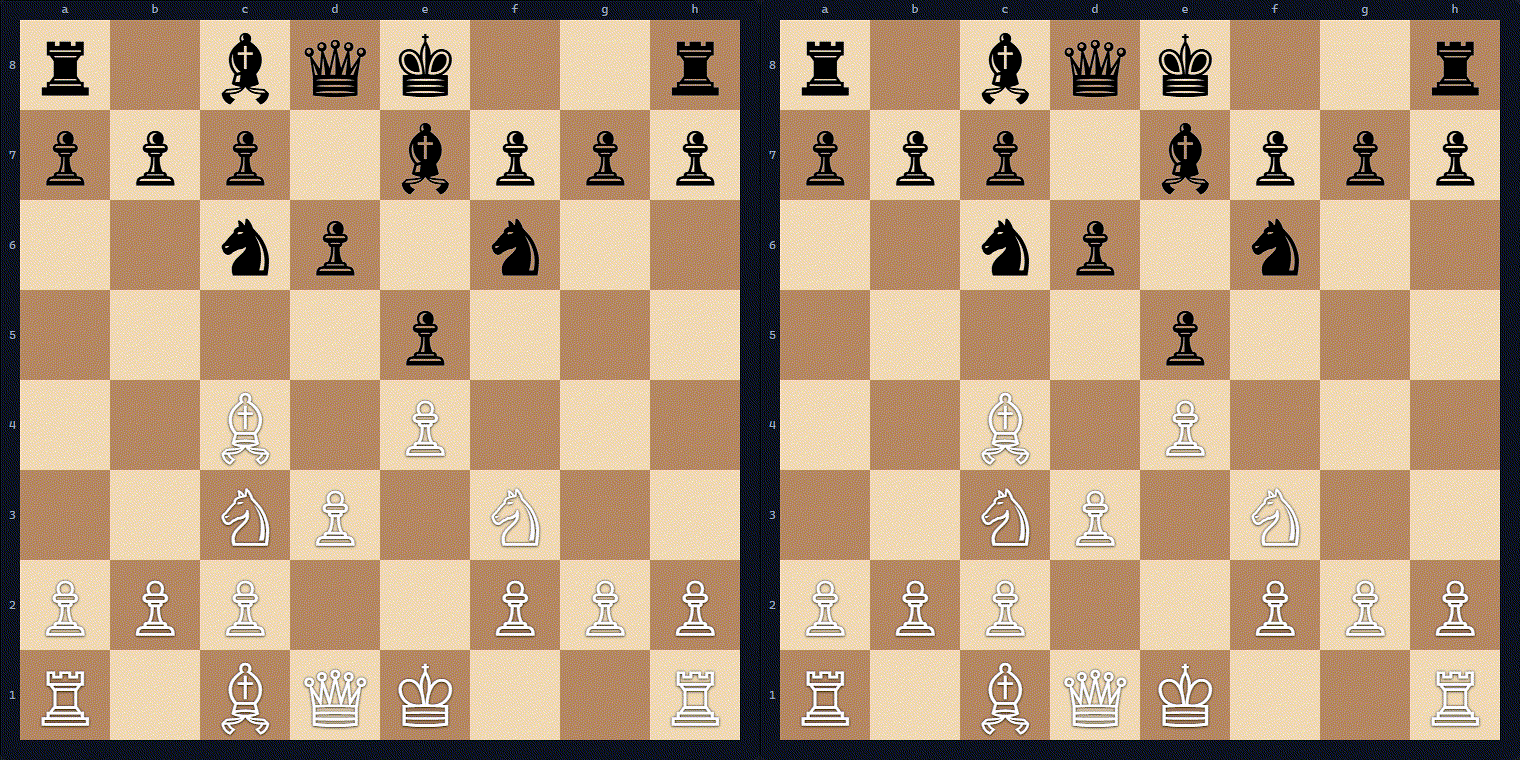
An example of a position where hasty development leads to disaster:
- FEN-position:
r1bqk2r/ppp1bppp/2np1n2/4p3/2B1P3/2NP1N2/PPP2PPP/R1BQK2R w KQkq - 1 6(White has completed the development of the knights and bishop, but must be careful not to allow the opponent’s standard attack). - Explanation of the position: White can play in a formulaic manner, but in such structures you always need to monitor the opponent’s move d6-d5 or the knights’ attacks on b4/d4. Any haste will destroy the opening advantage created.
Automatic exchange without the question “what’s left?”
Newbies love to change. As soon as an opponent’s figure appears on the horizon, attacking our bishop or knight, an impulse is triggered in the head: “We need to beat to simplify the position.” As a result, in two seconds several active pieces disappear from the board, and the game goes into the endgame. The trouble is that after this exchange the opponent's position becomes better, and your remaining pieces lose all prospects.
Before each exchange, ask yourself the question: whose piece was more active? If you exchange your passive bishop, locked by your own pawns, for your opponent's active knight, that's a win. But if you give up your long-range bishop, which controls the open diagonal, for the sake of exchanging for a knight that was on the edge of the board, you are voluntarily giving up a positional advantage.
Never hit a piece just because you can. Remember the old chess rule: “Tension on the board is better than hasty exchange.” Force your opponent to waste tempos on capturing your pieces.
A pawn move that creates a permanent weakness
Pawns are the only pieces on the chessboard that cannot move backwards. Each pawn move is an irreversible decision that forever changes the landscape of the position. By pushing a pawn forward to drive away a pesky opponent's piece, you gain immediate benefit, but you leave a hole behind the pawn - a "weak square" that your pieces will never be able to defend again.
The opponent instantly exploits this weakness by placing his horse there as an outpost. It will be impossible to pick him out of there, and he will terrorize your entire position until the very end of the game.
Hasty movements of pawns around their own king are especially dangerous. Moves like f3 or g3 unnecessarily weaken the king's castle, opening up diagonals for enemy queens and bishops. Learn to defend positions with pieces, leaving the pawn structure monolithic.
Chasing checkmate without development
This mistake is typical for aggressive players who want to finish the game in 15 moves. Immediately after the opening, they throw their queen deep into the opponent's rear, hoping to deliver a quick "children's checkmate" or fork. Your opponent can easily defend with simple developmental moves, while simultaneously attacking your queen and forcing him to waste precious time running across the board.
As a result, by the 12th move, the opponent has developed all his pieces and the king is safe, and your queen has made 6 moves, the remaining pieces are on the initial squares, and castling is impossible.
 [Chasing mate without development]
        |
        V
 [Quick queen sortie] ---> [Easy neutralization with tempo] ---> [Lost tempos while the queen escapes]
                                                                                |
                                                                                V
 [Result: opponent fully developed and castled, you are underdeveloped and under pressure] <----------------+
Chess does not tolerate disrespect for the laws of development. Until you have brought out the minor pieces and secured your king, any attack is doomed to failure and will only lead to a quick counterattack by your opponent.
Time pressure as a separate opponent
You can play like a young Garry Kasparov for the first 20 moves, finding the most difficult positional maneuvers and winning a pawn. But if you spent 9 minutes out of 10 available on these thoughts, you will finish the rest of the game in seconds. In time pressure mode, the logic turns off, your fingers begin to tremble, and you yawn first on the won pawn, then on the piece, and ultimately lose the game in time.
Time pressure is not an accident, but a consequence of the inability to manage your time. You spend too many minutes on obvious decisions in the opening or try to calculate options 5 moves ahead in positions where you need to make a simple development move.
Learn to play at an even tempo. If the position is calm, make your move in 15-20 seconds. Spend precious minutes only at critical points in the game, when the fate of a tactical complication or transition to the endgame is at stake.
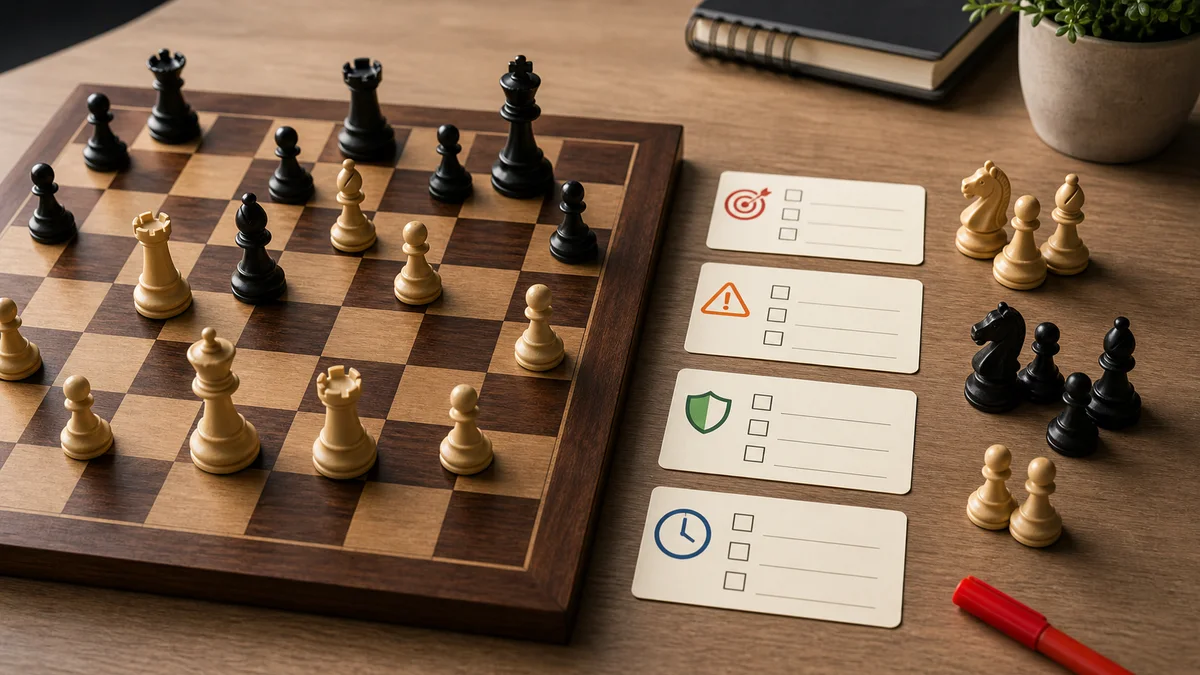
Error map after the game
To systematize the fight against your weak points, create a personal “fault map”.This is a simple table in which you will record the reasons for your defeats. An example of such a map is presented below:
| Game situation | Typical yawn | Why did this happen (reason) | How to fix (training) |
|---|---|---|---|
| Debut | Early queen attack, loss of tempo | Desire to checkmate quickly, ignoring development | Ban on queen moves in the first 8 moves (except defense) |
| Middlegame | Exchange of an active piece for a passive one | Too lazy to count options, fear of tactical tension | Rule: “don’t hit first without a specific benefit” |
| Endgame | Losing a pawn ending | Ignoring the king's activity, opposition blunders | Learning the Rules of Square and Opposition of Kings |
| Time pressure | Falling flag in a won position | Hovering over simple moves, playing without increment | Transition to time controls with added seconds (15+10) |
How to turn a mistake into a training topic
Once your error map accumulates 5-6 similar entries (for example, “yawned a bunch”), this topic becomes your top priority for the next week. Open the tactical simulator and select tasks specifically related to the “link” topic. Solve 50 problems on that particular motif until your eyes automatically see it on the board.
Don't try to fix all the errors at once. Focus on one problem per week. This targeted approach will allow you to quickly close the deepest holes in your game, and your rating will immediately respond with growth.
Final: Find out your repeating pattern
Each of our chess games is a mirror of our character. Impatient players miss pieces in the attack, indecisive ones go into deep defense and suffocate without space, and overly emotional players break down after the first unsuccessful move. Chess teaches us composure and honesty with ourselves.
Recognizing your repeating pattern of mistakes is the key to growth. Don't be afraid of yawns and don't be ashamed of defeats. Each game lost due to a stupid mistake is not a reason for frustration, but a valuable drawing showing exactly where you need to strengthen the foundation of your chess skills. Treat mistakes as the best teachers, and they will definitely lead you to new rating heights.
Practical Toguz Arena links
- Use the shared play entry to collect real games instead of guessing your weak points from memory.
- Read the chess hub for follow-up articles on tactics, tilt, rating systems and bot practice.
- Review the chess fair-play page before using engines or outside notes in rated contexts.
Sources and limitations
- FIDE Laws of Chess are the rule reference for legal positions, checkmates, draws and game conduct.
- Mark Glickman's Glicko system overview is the rating-context source for interpreting progress across multiple games.
- Limitation: the error map is a training worksheet, not a diagnostic model and not a guaranteed rating-growth method.