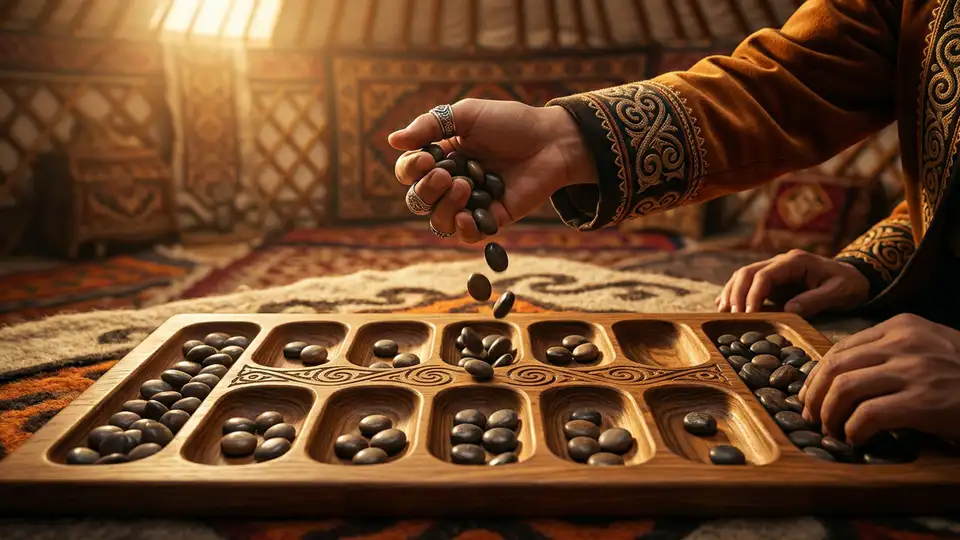
Togyz Kumalak Rules: Complete Beginner Guide
Choose a non-empty pit on your side, sow the stones counter-clockwise, track the final stone, and capture the opponent's pit if that final stone makes its count even. The special rule is tuzdyk: when your final stone makes an opponent's pit contain exactly 3 stones, that pit can become your permanent collecting pit, with restrictions.
You may also see the game written as Togyzqumalaq, togyz kumalak, toғыз құмалақ, or compared with Kyrgyz Toguz Korgool. This guide covers the Kazakh 2x9 version with 162 stones, even-count captures, tuzdyk, and the atsyz kalu endgame.
Board Setup

Text Board Diagram
The screenshot shows the board visually, but a crawlable text diagram makes the setup easier to quote, translate, and learn. Each player has 9 otaus, and each kazan is a separate store for captured stones.
| Area | Otau order | What beginners should count |
|---|---|---|
| Opponent side | Otaus 9, 8, 7, 6, 5, 4, 3, 2, 1 | If your final stone makes an opponent pit even, those stones are captured. |
| Your side | Otaus 1, 2, 3, 4, 5, 6, 7, 8, 9 | Your move starts only from a non-empty otau on your own side. |
| Kazans | The opponent's kazan and your kazan sit outside the 18 otaus | 82 stones wins; 81:81 is a draw. |
| Opening count | 9 stones in each of the 18 otaus | There are 162 stones total, so half of the game is 81. |
From this diagram, every rule reduces to one practical question: where will the final stone land after sowing? That final pit decides a quiet move, a capture, a tuzdyk, or the path toward the endgame.
- Each player controls 9 otaus.
- Each otau starts with 9 stones.
- Captured stones go to your kazan.
- The game has 162 stones in total.
How a Move Works
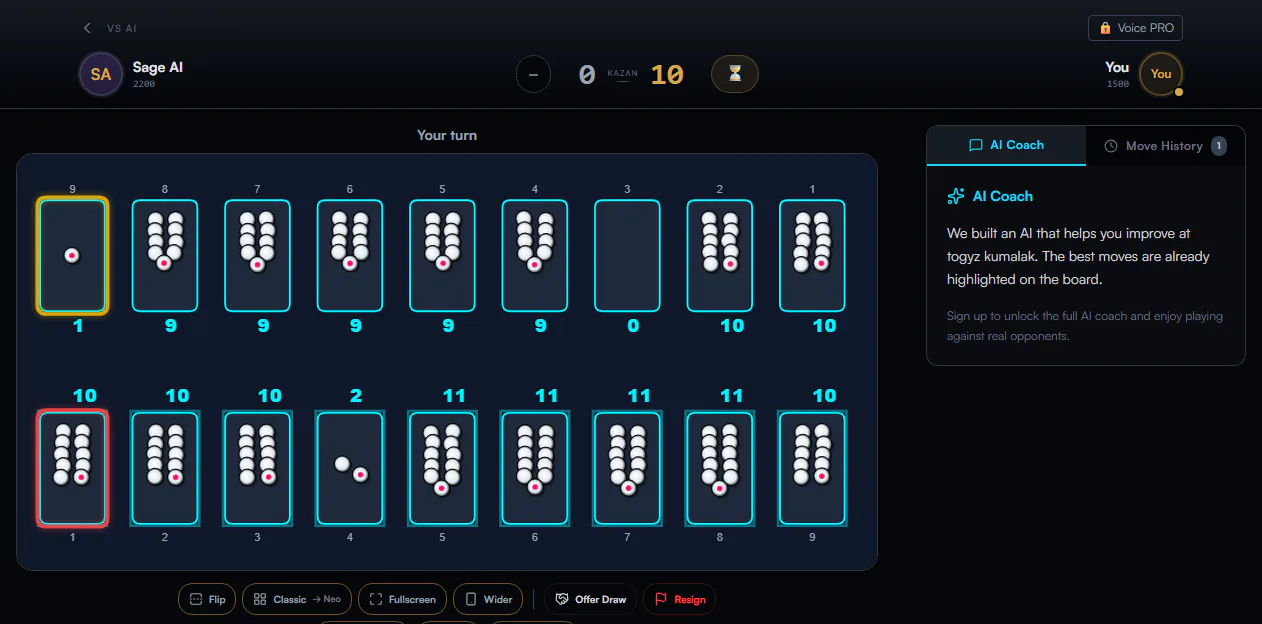
- Choose one non-empty pit on your side.
- Pick up the stones.
- If there is more than one stone, leave one in the starting pit and sow the rest one by one counter-clockwise.
- If there is only one stone, move it to the next pit.
AI Coach tip: before clicking, say where the final stone will land. That habit prevents most beginner mistakes.
Capturing
If your final stone lands in an opponent's pit and makes the number of stones there even, you capture all stones from that pit into your kazan. This is why counting the final stone matters more than simply moving the largest pit.
Example: an opponent pit has 5 stones. Your final stone lands there and makes 6, so you capture all 6. If the pit had 2 and becomes 3, the position may create a tuzdyk opportunity instead of a normal even capture.
Tuzdyk

If your final stone lands in an opponent's pit and makes exactly 3 stones, you may declare a tuzdyk. From then on, stones that land in that pit go to your kazan. You cannot create a tuzdyk in the opponent's 9th pit, and you cannot place it symmetrically to the opponent's tuzdyk.
Do not treat tuzdyk as an automatic bonus. It is a long-term positional decision: a strong tuzdyk changes future sowing routes, but a weak one can give the opponent better captures and safer endgame timing.
Atsyz Kalu and the Endgame
If a player has no stones left in all 9 otaus, they cannot move. This is called atsyz kalu. The opponent collects the stones remaining on their own side, and the final score is counted. 82+ wins; 81:81 is a draw.
This is why the last phase is not only about taking the largest capture. You must count whether emptying your side gives the opponent a final sweep, whether your kazan already has enough stones, and whether the remaining stones can still change the result.
Beginner Mistakes
- Moving the biggest pit without counting the landing pit.
- Creating a tuzdyk too early.
- Ignoring the 9th pit.
- Counting your move but not the opponent's reply.
- Forgetting the endgame count when the board becomes empty.
How to Practice Online

Start with a bot game on Toguz Arena, then open the review and look for the first major evaluation swing. Move that position into the Training Ground and compare two candidate moves. This turns rules into skill faster than rereading definitions.
Worked Example
Imagine your 4th pit contains 6 stones. You pick them up, leave one in the starting pit, and sow the rest into pits 5, 6, 7, 8, and 9. The final stone lands on your side, so there is no capture. In another position, the final stone lands in an opponent pit containing 5 stones; it becomes 6, so you capture all 6.
How to Learn the Rules Fast
Do not start with openings. Start with the final stone. In every move, predict the landing pit before you click. Then add captures. Then add tuzdyk. Only after that should you study champion games and deeper strategy.
Rules in 60 Seconds
- The game starts with 9 stones in each of 18 pits.
- On your turn, choose one non-empty pit on your side.
- Sow the stones counter-clockwise; the final stone decides capture or tuzdyk.
- Capture when the final stone makes an opponent pit even.
- Create one tuzdyk when the final stone makes an opponent pit exactly 3, except in restricted pits.
- Win by collecting 82 or more stones in your kazan.
FAQ
Is Togyz Kumalak the same as Kalah?
No. Both are mancala-family games, but Togyz Kumalak uses a 2x9 board, 162 stones, even captures, tuzdyk, and a different endgame.
How long does it take to learn?
The basic rules can be learned in one short session. Playing well takes much longer because every move changes multiple pits and future parity.
Can I play on mobile?
Yes. Toguz Arena works in a mobile browser, and the PWA route keeps your games, rating, and review history on the same account.
What to Study Next
After the rules, study three themes in order: parity, tuzdyk timing, and endgame counting. Do not start with memorized openings. A memorized opening collapses quickly if you cannot count the final stone or understand why a tuzdyk is good.
On Toguz Arena, the simplest next step is to play one bot game and review only the first mistake. That gives you a concrete position instead of abstract theory.
Sources for Rule Checking
- PlayStrategy: Togyzqumalaq rules for setup, sowing, 82-stone win condition, captures, tuzdyk, and restrictions.
- UNESCO ICH: Togyzqumalaq, Toguz Korgool, Mangala/Göçürme for cultural context, spelling variants, and intangible-heritage status.
- Kazinform interview with Maksat Shotaev for current international and online-platform context.
- Toguz Arena federations and source hub for a maintained internal map of organizations, UNESCO references, and follow-up reading.
- Toguz Arena Wiki for a longer rules glossary, tuzdyk explanation, and links to playable practice modes.
Related Practice
- How to play Togyz Kumalak online — a step-by-step practice path.
- What is Togyz Kumalak? — history, names, and beginner context.
- AI Trainer — test one position after your first game.
- Play in the browser — start a bot or live game after reading the rules.