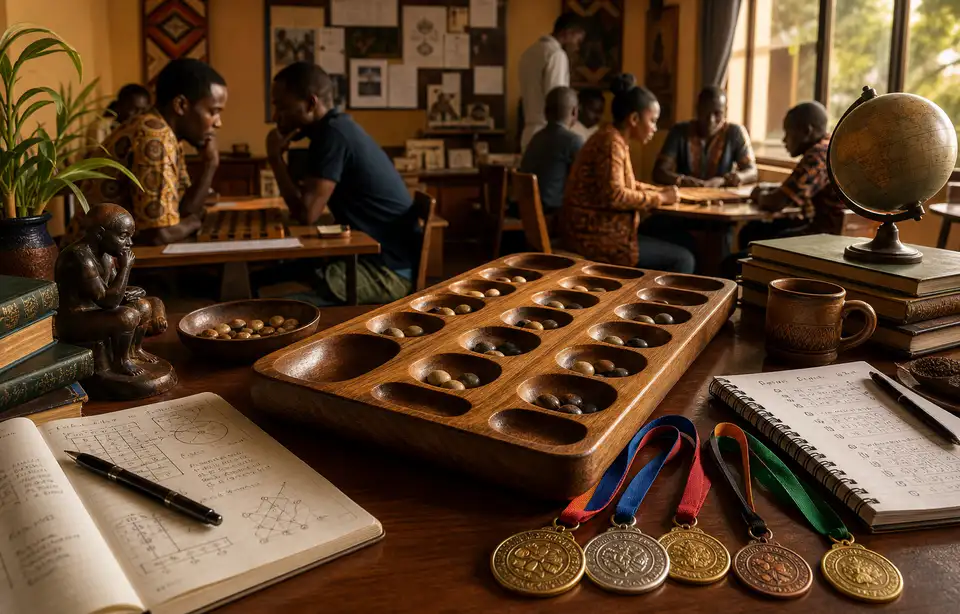
Kalah is not organized around one confirmed public world federation in the sources checked for this article. A safer answer is that modern Kalah is held together by William J. Champion's patent trail, classroom use, AI research, online platforms, community archives, and playable sites such as Toguz Arena Kalah. Treat this page as a source map, not as a claim of official authority.
So the question “who develops Kalah?” cannot be answered with one logo. The game is supported by manufacturers, schools, university courses, artificial-intelligence researchers, Board Game Arena, BoardGameGeek, and small online communities. Instead of one vertical federation, Kalah has a distributed network.
That is the useful answer for players and researchers: if you are looking for Kalah organizations, tournaments or research, look for platforms, schools, archives and computer-science research, not one governing body.
The commercial root: William Champion and Kalah Game Company
Modern Kalah is associated with William Julius Champion Jr., who developed the game in the 1940s. The strongest public record in this article is US Patent 2,720,362: it lists William J. Champion as inventor, uses the Kalah or Mop-up board framing, and records a 1951 filing with a 1955 publication.
Mancala World and BoardGameGeek add secondary community context around Kalah Game Company, the patent history, and educational promotion in the United States. This matters because Kalah was not documented as an ancient unchanged tradition; it was shaped as an adapted product inside the much older mancala family.
That explains why there is no universal official ruleset. Different places vary the number of stones, the capture rule, the end condition, and the pie rule. Board Game Arena explicitly lists variants such as pie rule, empty capture, and starts with 3, 4, 5, or 6 stones per pit.
Schools and universities: Kalah as an algorithm lab
The main institution of Kalah today is not a federation, but education. The game is useful for teaching decision trees, heuristics, minimax, search depth, and first-move advantage. The MDPI review of Kalah research presents it as a popular mancala variant and as a benchmark for comparing heuristic and tree-search algorithms.
University work reinforces that role. Trevon J. Hunter's 2021 Andrews University thesis treats mancala as a field for adversarial-search algorithms, comparing approaches to building a competitive game AI and asking how those lessons might apply to other game-solving problems. For Kalah, that matters more than medals: the game survives in courses, lab projects, and repositories.
In that sense, Kalah is closer to computer science than to classical sport. Its board is simple enough for a classroom, yet rich enough for research. The standard 6x4 position space is large, and the first-player advantage forces a serious discussion about rule balance.
Online platforms and communities
Board Game Arena supports Kalah with several rule options. BoardGameGeek stores the game page, versions, files, discussions, and links. For the mass audience, that can matter more than a federation stamp: people can find rules, play a game, and compare variants.
On Toguz Arena, Kalah is also a useful gateway into the mancala family. A player can begin with Kalah online, read the English Kalah hub, check the complete Kalah rules, and then compare Kalah with Oware, Mangala, or Togyz Kumalak.
If you are checking sources rather than choosing a game, keep the trail separate: use the Kalah history article for the patent story, the source hub for federation context, the knowledge base for rules vocabulary, the AI trainer for practice review, and events for Toguz Arena activity rather than Kalah world-governance claims.
Are there Kalah tournaments?
There are Kalah competitions, especially in schools, clubs, online platforms and local communities, but they do not form a single international championship calendar. Treat every “Kalah tournament” result as local unless the organizer, ruleset, date and bracket are visible.
Before citing a Kalah event, check three details: which rules variant was used, whether the event was offline or online, and whether the result page is still public. That prevents a common citation mistake: presenting a school event or platform table as if it were a world governing-body record.
- For players: use online platforms and local clubs to find practical games.
- For teachers: treat classroom tournaments as learning events, not official sport records.
- For writers: cite the exact organizer and ruleset before making tournament claims.
Who really supports Kalah
| Environment | Function | What it gives the game |
|---|---|---|
| Manufacturers and commercial sets | Mass distribution | Make the game visible as “mancala” to families and schools |
| Schools | First learning | Counting, arithmetic, and last-stone planning |
| Universities and researchers | Algorithms and game theory | Minimax, heuristics, and first-move balance studies |
| Board Game Arena | Online practice | Games, variants, and easy access to opponents |
| BoardGameGeek and Mancala World | Community archive | History, versions, links, discussion, and reference material |
What is confirmed, and what is not
| Claim area | Status in this article | How to read it |
|---|---|---|
| Champion patent trail | Confirmed from patent record | Use it for modern Kalah standardization, not for ancient-origin claims |
| One international Kalah federation | Not confirmed in inspected sources | Do not invent one logo or authority layer |
| Board Game Arena variants | Confirmed from platform rules page | Good evidence that online Kalah rule options vary |
| AI and university research | Confirmed from MDPI and Andrews sources | Use for research/education context, not for product-strength claims |
| Toguz Arena role | Playable training platform | Practice Kalah here, but do not treat the site as an official Kalah federation |
Weakness or advantage?
The lack of a federation makes Kalah less formally strict than Togyz Kumalak or Turkish Mangala. But it also makes the game flexible. It fits a classroom, a board-game website, a programming course, and a family set with equal ease.
The key is not to present Kalah as an ancient African tradition. Its real value is different: it is a modern, approachable, widely distributed gateway into mancala thinking. From there, players can choose sport, cultural history, or algorithmic experimentation.
Sources and fact-check notes
- US Patent 2,720,362 - primary source for the Champion patent trail and Kalah or Mop-up board description.
- MDPI: Review of Kalah Game Research - research context for Kalah algorithms, heuristics and game-tree search.
- Andrews University: The Exploration and Analysis of Mancala from an AI Perspective - university thesis context for mancala AI and adversarial search.
- Board Game Arena: Gamehelp Kalah - platform rules and variant options such as pie rule, empty capture and starting-stone counts.
- Mancala World: Kalah - secondary community chronology; not used as a primary authority for official governance.
- BoardGameGeek: Kalah - community archive for versions, discussions and board-game context.
Limit: this article describes what the inspected public sources support. It is not legal research into every country, club or local tournament organizer. If you need a specific event rule, use that event's published regulations.