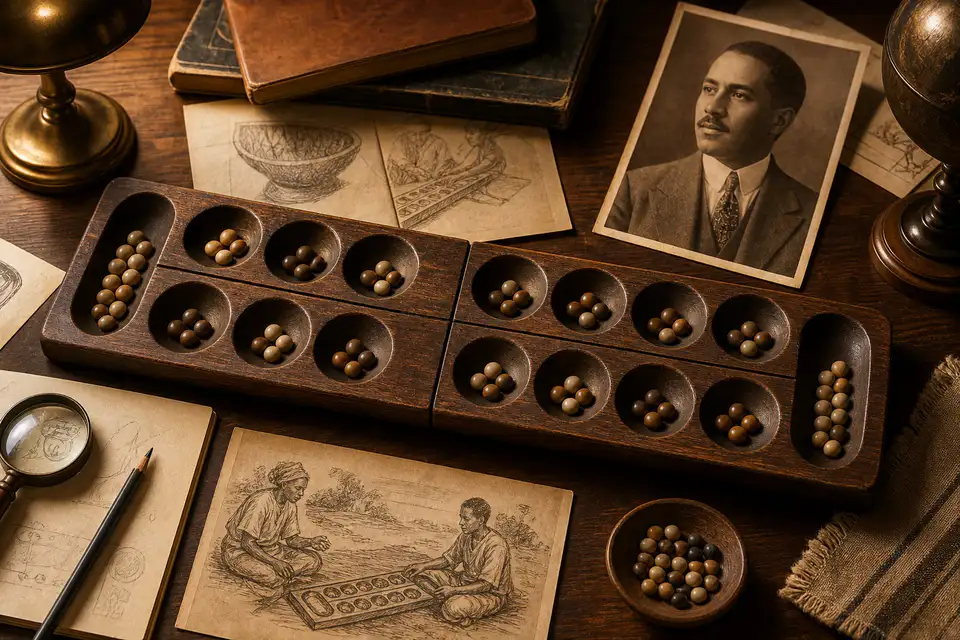
Who invented Kalah?
The name most safely attached to modern Kalah is William J. Champion. His name appears on U.S. patent records for the Kalah board and for a game counter used with Kalah or Mop-up. That does not prove every popular story about how he first encountered mancala, but it does give the article a primary-source starting point.
For a player, the practical point is simple: Kalah is part of the wider mancala family, but it is also a standardized modern product. Traditional mancala games such as Oware, Bao, Congklak, Sungka and others have their own boards, capture rules, social settings and names. Kalah is the variant many English-language players meet first because it became easy to package, teach and play on a 6x2 board with two stores.
This distinction matters for reader trust. Saying "mancala is ancient" can be broadly true at the family level; saying "Kalah itself is ancient" is not the careful version. The article below separates the patent-backed facts, the secondary chronology, and the claims that still need stronger verification.
What the patent trail proves
The utility patent record is the strongest source on the page. U.S. patent US2720362A lists William J. Champion of Mystic, Connecticut, gives an application date of November 21, 1951, and shows the patent date as October 11, 1955. The document describes a new and improved board for Kalah or Mop-up with two rows of pits and larger bowls, or kalahs, at the ends.
The design-patent trail is also useful because it gives a visual source for the board as a product. A public Wikimedia Commons record for U.S. patent D165,634 identifies a Kalah game board design dated January 8, 1952, with William J. Champion as author. That source is not a full history of the game, but it supports the narrow statement that Champion had a protected board design by 1952.
The patent trail does not prove every later classroom, trademark or phone-game story. It proves a narrower but stronger claim: Kalah became a named, standardized, patent-documented mancala product in the early 1950s. That is enough to explain why the game can feel traditional while still being modern in its commercial form.
Source timeline
| Date | Source-backed event | What we can safely say |
|---|---|---|
| November 21, 1951 | Application date listed on US2720362A | Champion had filed a utility patent for a Kalah or Mop-up game counter. |
| January 8, 1952 | Design patent record D165,634 | A Kalah game board design is publicly associated with William J. Champion. |
| October 11, 1955 | US2720362A patent date | The utility patent record anchors the standardized Kalah board/rules product. |
| 2000 | Irving, Donkers and Uiterwijk, "Solving Kalah" | Several Kalah starting configurations up to six holes and five counters per hole were solved. |
This timeline is intentionally conservative. It leaves out attractive details that appear in secondary or community histories when the article cannot verify them against a stronger source. The result is less colorful than the old version, but it is much safer for a trust-sensitive history page.
What secondary histories add
Secondary summaries often say that Champion developed Kalah in the 1940s and that the game was commercialized before the 1955 patent date. Chessprogramming.org's Kalah page, for example, presents a compact chronology with the 1940 development date, later patent dates, and computer-game context. That is useful as a research pointer, but it should not be treated as the same kind of evidence as the patent record.
The safe phrasing is therefore: "secondary histories associate Kalah with Champion's 1940s development work; the primary public record used here begins with the 1951 filing, the 1952 design-patent record and the 1955 utility patent." That wording tells the reader what is known, what is inferred from secondary sources, and where the hard source trail begins.
This page also avoids a few popular claims until stronger sources are attached: exact school-tournament details, exact retail prices, exact naming motives, and phone-game distribution anecdotes. They may be true, but they should not carry the main article unless the source packet can cite a reliable primary or near-primary record.
Kalah versus the older mancala family
Kalah belongs to the mancala family because it uses sowing: a player takes seeds from one pit and drops them one by one around the board. That shared mechanism connects it to many older games, but the family resemblance should not erase the differences. Kalah uses two stores, rewards some last-seed moves with another turn, and uses a simple empty-pit capture rule that makes it especially easy to teach.
That makes Kalah a strong beginner game and a useful online practice format. It also means it should be compared carefully with Oware, Mangala, Bao and Bestemshe. A reader looking for a traditional West African capture game may want Oware rules. A reader looking for Turkish Mangala should start with Mangala practice. A reader who wants the standard store-race version can go directly to play Kalah online.
For the broad family view, use the Mancala rules family guide. For a detailed Kalah tutorial, use the complete Kalah rules guide or the shorter Kalah board-game rules article.
What the solved-game fact means
Kalah is also important in computer-game research. The paper "Solving Kalah" by Geoffrey Irving, Jeroen Donkers and Jos Uiterwijk reports that several Kalah starting configurations were solved up to six holes and five counters per hole. Maastricht University's publication record and Geoffrey Irving's own page both describe the same limited scope.
The important word is "several." This page should not claim that every Kalah variant, every seed count or every casual house-rule version has been solved. The reliable claim is narrower: research has solved multiple standard-sized starting configurations, and that makes Kalah a useful example when discussing how computers analyze mancala-family games.
If you are interested in the AI angle, continue with How Computers Play Mancala. If you want to feel the solved-game pressure as a player, start with a few games against a bot and watch how quickly extra turns decide the store race.
Why the naming question confuses users
Many players use "mancala" and "Kalah" as if they were the same word. That happens because Kalah became one of the easiest store-based variants to package, sell and teach in English-speaking contexts. Search behavior follows that habit: someone searches for "mancala online" and often expects the Kalah board.
The clearer explanation is: mancala is the family; Kalah is one modern member of that family. Some pages on Toguz Arena therefore use both words in headings and internal links, but the rules pages keep the distinction visible. That protects the reader from learning Kalah and then assuming every other mancala game works the same way.
The same distinction also helps with comparisons. See Kalah vs Oware and Kalah vs Mangala if you want to understand why similar-looking sowing games create very different decisions.
How to use this history when you play
History should change how you read the board. Kalah is not just an old-looking wooden board; it is a clean store-race design. The rules make every extra turn feel valuable, and the empty-pit capture rule rewards counting exact landing squares. That is why beginners often improve faster by learning a few board patterns than by memorizing a long cultural story.
For club players: treat Kalah history as a warning against vague "ancient game" claims. Treat Kalah practice as a concrete race: count the last seed, protect loaded pits, and look for extra-turn chains before you chase captures.
When you are ready to play, open the Kalah board. If you prefer to compare first, use the broader Kalah article hub or the family guide.
Sources and fact-check notes
- Google Patents: US2720362A, Game Counter - primary patent record for the Kalah or Mop-up board/rules product.
- Wikimedia Commons: Kalah game board from U.S. patent D165,634 - public visual record for the 1952 board design.
- Maastricht University: Solving Kalah - publication record for the 2000 ICGA Journal paper.
- Geoffrey Irving: Solving Kalah - author-hosted page with abstract and publication details.
- Chessprogramming.org: Kalah - secondary chronology useful for research leads, not treated as the primary proof layer.
This article intentionally does not assert unsourced school-tournament records, exact retail-price ranges, phone-game distribution claims, or exact naming motives. Those details can be restored only if a future source packet attaches stronger evidence.
Frequently Asked Questions
Who invented Kalah?
William J. Champion is the inventor name supported by the public patent trail. The safest evidence is the 1952 design-patent record and the 1955 U.S. utility patent for a Kalah or Mop-up game counter. Secondary histories often place his development work in the 1940s, but the patent trail is the main source used here.
Is Kalah an ancient game?
Kalah is part of the older mancala family, but Kalah itself should be described as a modern commercial variant. Mancala is the family name for many sowing games; Kalah is one standardized store-based member of that family.
What does the Kalah patent prove?
The patent record proves a narrow but important point: William J. Champion filed for a Kalah or Mop-up game counter in 1951, and the U.S. utility patent was issued in 1955. A separate design-patent record supports the board-design trail in 1952.
Is Kalah solved by computers?
Several Kalah starting configurations up to six holes and five counters per hole were solved in the 2000 ICGA Journal paper "Solving Kalah." That does not mean every Kalah variant or every house-rule setup is solved.
Why is Kalah sometimes just called mancala?
In English-language casual play, Kalah became one of the most familiar store-based mancala variants. Many people therefore use "mancala" when they mean the Kalah board. The more accurate wording is: mancala is the family, Kalah is one modern member.

-2.png)