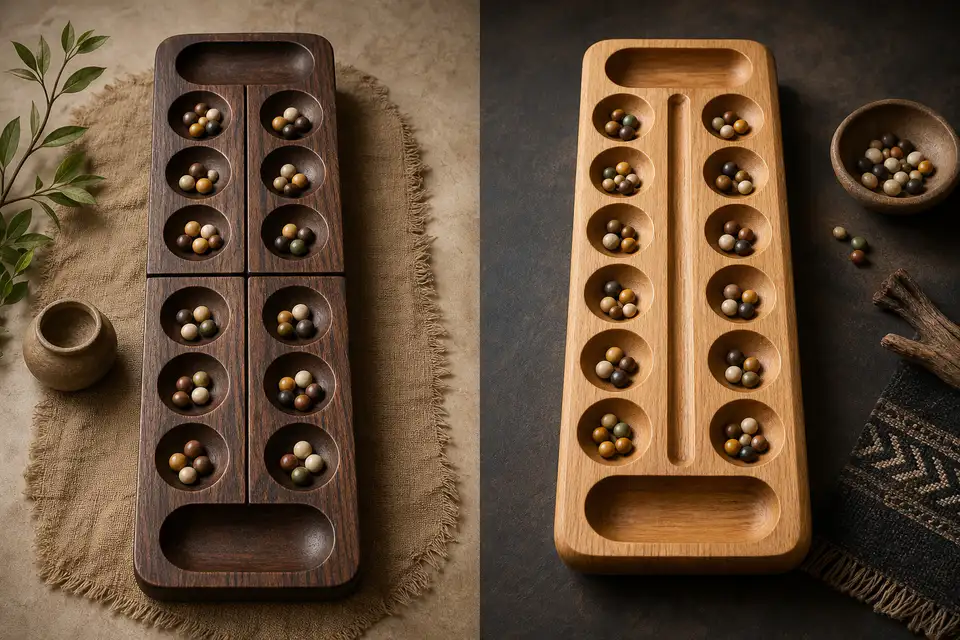
If you are choosing your first mancala game, start with the rule rhythm, not the board shape. A Kalah game feels like a store race with bonus turns. A Mangala game feels like a treasury race where even numbers and empty pits can flip a position in one move.
Reader shortcut: choose Kalah if you want the cleanest beginner route into stores, bonus moves and empty-pit captures. Choose Mangala if you want a Turkish mancala ruleset where the final stone, even captures and treasury timing are the whole story.
Kalah vs Mangala: same small board, different questions
The easiest mistake is to treat both games as "mancala with stores". That is close enough to recognize the family, but not close enough to play well. Both games reward counting, but they reward different counting habits.
In Kalah, the beginner's first breakthrough is simple: count whether the last seed lands in your own store. If it does, you move again. If it lands in an empty pit on your side, you may capture the opposite stones. Most early tactics come from those two outcomes.
In Mangala, the same last-stone discipline matters, but the consequences are broader. The last stone can land in your treasury, create an even capture in an opponent pit, fall into your own empty pit for an opposite capture, or simply hand the move over. That makes Mangala feel more tactical from the first few games.
At a glance: what changes first
Use this table before you start switching between the games. It keeps the comparison practical: not "which game is better", but "what must I stop assuming when I move from one board to the other?"
| Question | Kalah | Turkish Mangala |
|---|---|---|
| Common beginner board | Two rows of six holes, two stores, usually four counters per hole. | Two rows of six pits, two treasuries, 48 stones, usually four per pit. |
| Main tempo rule | Last seed in your store gives another move. | Last stone in your treasury gives another move. |
| Capture feel | Empty own pit captures the opposite opponent stones plus the last seed. | Even-number captures on opponent side plus empty-pit captures on own side. |
| Beginner question | Can I land in my store or on my own empty pit? | Where does the last stone land, and did I make an even number? |
| Best first lesson | Bonus turns and empty-pit traps. | Last-stone count, even capture and endgame sweep. |
Notice the overlap. Both games punish careless sowing. Both games use a visible scoring area. Both games become easier when you name the landing pit before you move. The difference is that Mangala makes the opponent-side count more sensitive because even totals can immediately become captures.
How Kalah creates tempo
The Kalah rule source by Irving, Donkers and Uiterwijk describes a 6x2 board with two stores, usually four counters in each hole. A move chooses a non-empty hole on your side, sows counter-clockwise, includes your own store and skips the opponent's store.
The central Kalah moment is the store landing. If your last counter lands in your own store, you move again. That extra move is not just a point. It is initiative: you can clear a pit safely, line up another store landing, or deny the opponent the timing they wanted.
The second Kalah moment is the empty-pit capture. If your last counter lands in an empty hole on your side, the opposite opponent stones and your last counter go into your store. A beginner sees a capture. A better player sees the move before it: which pit must be emptied first so the capture square exists?
How Mangala creates tactical traps
Mangala sources describe a similar-looking 2x6 setup with 48 stones and two treasuries. The move rhythm differs from Kalah in a crucial way: public Turkish rule explainers describe leaving one stone in the starting pit when sowing from a multi-stone pit, while one-stone moves simply move the stone to the next pit.
After that, everything depends on the final stone. If it reaches your treasury, you play again. If it lands on the opponent side and makes that pit even, those stones go to your treasury. If it lands in your empty pit and the opposite pit contains opponent stones, you capture both sides into the treasury.
This is why Mangala often feels sharper for a new player who already knows Kalah. The board says "same family"; the position says "check the parity". A move that looks harmless can turn a pit from odd to even and hand the other player a capture on the next turn.
Beginner decision matrix
There is no universal first choice. Choose the game based on what you want to train this week. If you are teaching a child or introducing a casual player, Kalah is often easier to explain in one sitting. If the player already likes tactical traps, Mangala gives them more immediate capture variety.
| Your goal | Start with | Why |
|---|---|---|
| Learn the mancala family with the least friction | Kalah | The store race and bonus move are easy to see after one slow demonstration. |
| Practice counting the final stone every move | Either | Both games train this habit, but Mangala punishes parity mistakes faster. |
| Study tactical capture traps | Mangala | Even capture plus empty-pit capture creates more beginner-visible tactical swings. |
| Prepare for broader mancala comparison articles | Kalah, then Mangala | Kalah gives the clean baseline; Mangala shows how similar boards diverge. |
| Play a Turkish heritage ruleset | Mangala | GSDF and Turkish Ministry pages support the Turkish cultural context. |
For most readers, the clean route is: play two slow Kalah games, then two slow Mangala games. Do not try to win quickly. Try to say one sentence before every move: "my last stone lands here, so the result is..."
Six-game practice drill
This drill is deliberately small. It is better to play six games with one observation in mind than twenty games where every loss feels mysterious.
- Kalah game 1: before every move, predict only whether the last seed lands in your store.
- Kalah game 2: add empty-pit captures. Mark the move where a capture square was prepared one turn earlier.
- Mangala game 1: ignore winning and count only the final stone.
- Mangala game 2: pause after every opponent-side landing and ask whether the pit became even.
- Comparison game: switch back to Kalah and notice which Mangala habits do not apply.
- Review game: choose the variant you enjoyed more and write down one rule that changed your decision-making.
Experienced players do this naturally. They do not ask, "which pit has the most stones?" first. They ask where the move ends, what it gives away, and whether the reply is stronger than the capture they are about to take.
Culture, authority and source caveats
Kalah and Mangala need different trust language. Kalah is a modern standardized game in the mancala family, and the safest source path for this comparison is the Champion patent plus the Irving, Donkers and Uiterwijk rules paper. That does not make Kalah an official federation sport on Toguz Arena.
Mangala has a stronger public heritage and institution layer. GSDF presents Mangala as a Turkish intelligence and strategy game and notes its 2020 UNESCO intangible heritage listing in a multinational file with Togyzqumalaq and Toguz Korgool. The Turkish Ministry page gives broader Mangala/Gocurme cultural context.
The caveat is important: Toguz Arena is a playable training platform, not an official GSDF, UNESCO or ministry rules authority. Use the platform to practice the logic, but use organizer documents for tournaments and current federation events.
Where to play and what to read next
Start on the board, then read the rule page that matches the mistake you made. If you missed bonus turns, open Kalah on Toguz Arena and then read the complete Kalah rules. If you missed even captures, open Mangala on Toguz Arena and then read Mangala against the computer.
For broader family orientation, use the Mancala rules family guide. For another close comparison, read Kalah vs Oware. For product-side browsing, use the Kalah hub and Mangala hub.
- Play now: Kalah board or Mangala board.
- Learn rules: Kalah rules and Mangala rules/practice.
- Compare variants: Kalah vs Oware and Mancala family guide.
- Check sources: use the federations and sources hub for heritage and organization context.
Sources and fact-check notes
This comparison uses Kalah sources for Kalah facts and Mangala sources for Mangala facts. Kalah rule details come from Irving, Donkers and Uiterwijk's Solving Kalah, while the historical patent context uses US Patent 2,720,362.
Mangala rule details are checked against mangala.com.tr's beginner rule explainer and the Kazinform World Nomad Games explainer. Mangala heritage context is checked against the GSDF Mangala page, the Turkish Ministry culture page and the UNESCO ICH entry.
FAQ
Is Mangala the same as Kalah?
No. Both can use a 2x6 mancala-style board with a scoring area, but Kalah focuses on store bonus turns and empty-pit captures, while Turkish Mangala adds even captures and a different sowing rhythm.
Which game is easier for beginners?
Kalah is usually easier as a first explanation because the store race is visible. Mangala is still beginner-friendly, but it asks the player to watch even captures and empty-pit traps earlier.
Which one should I play on Toguz Arena first?
Play Kalah first if you want the clean baseline. Play Mangala first if you specifically want Turkish mancala or a faster tactical lesson around even captures.