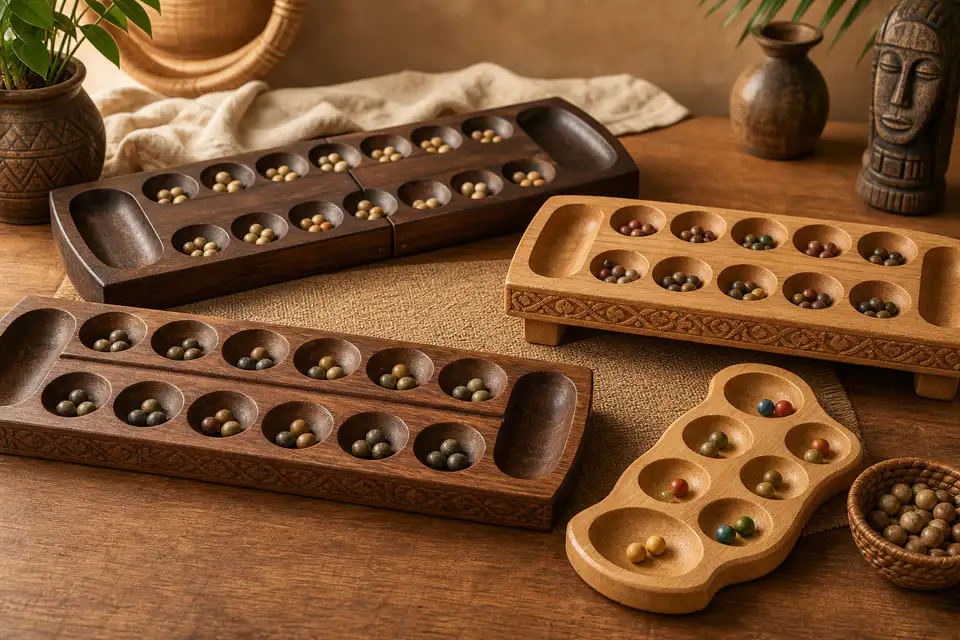
If you arrived here after searching "mancala rules", the useful first question is not "what is the single rule?" It is: which ruleset are you about to play? A Kalah player races for stores and bonus turns. An Oware player must feed the opponent. A Togyz Kumalak player counts long routes and watches for tuzdyk. The board may look related, but the position asks a different question.
This guide is the orientation page. Use it to choose the right variant, then open the dedicated rules page or playable board. For deeper detail, the longer complete Mancala family guide keeps a fuller source-backed comparison, while the variant pages below handle exact rules.
Mancala rules are plural, not one hidden standard
The safest way to understand mancala is to treat it as a family name. Many games share sowing, counting and capture ideas, but the exact rulebook changes by variant. That is why a casual "mancala" board on one site may behave like Kalah, while another source may describe Oware, Mangala or a Central Asian game such as Togyz Kumalak.
This matters for learning and actual play. A beginner who reads a generic rule page can easily carry the wrong habit into the wrong game: expecting a store in Oware, expecting a feeding rule in Kalah, or missing tuzdyk in Togyz Kumalak. The result is not just a small wording problem. It changes legal moves and strategy.
So the first practical rule is simple: name the game before learning the rules. On Toguz Arena, the family is useful because you can move from the article to the board: open Kalah, Oware, Mangala, Bestemshe or the main Togyz Kumalak experience and feel how the same sowing gesture changes.
The shared move: sowing seeds and reading the last seed
Most mancala-family games begin with the same physical idea. Choose one of your pits, pick up the contents and sow them one by one along a fixed path. That is why the family feels easy to start: the hand movement is visible, repeatable and teachable even with beans, shells, stones or a drawn board.
The hard part is the last seed. In one variant, the last seed gives an extra turn. In another, it captures an opponent pit. In another, it creates a permanent scoring trap. A good player does not ask only "how many seeds can I take?" The better question is: where does my last seed land, and what answer am I giving back?
- Name the variant. Do not start from a generic rule memory.
- Count the path. Before moving, say where the last seed will land.
- Check the landing rule. Store, capture, feeding, even count or tuzdyk may all matter.
- Look at the reply. A move that wins seeds can still give the opponent a stronger position.
Five entry points in the family
The table below is not a global popularity ranking and it is not a claim that every local rule agrees with every row. It is a practical map for the games a Toguz Arena reader is most likely to meet while moving between rules pages, online boards and comparison articles.
| Game | Typical board | What changes the rules | Best first use |
|---|---|---|---|
| Kalah | 6x2 pits with two stores | Bonus turns from your store and empty-pit captures | Fastest beginner entry into "mancala rules" |
| Oware / Awale | 6x2 pits without stores | Capturing twos or threes, backward chains and feeding the opponent | Players who want a stricter no-store strategy game |
| Mangala | Usually explained as a 6x2 Turkish branch in beginner guides | Treasury tempo and capture rules that differ from Kalah | Readers separating Turkish Mangala from generic mancala |
| Bestemshe | Compact 5x2 teaching board | Short games, fast counting and a bridge toward Togyz Kumalak | Parents, teachers and learners who need a smaller board |
| Togyz Kumalak | 9x2 pits with 162 stones | Long counting, even captures and tuzdyk | Players ready for the deeper Central Asian calculation game |
Use Kalah if you want the simplest first session. Use Oware if you want to learn why a capture can be wrong when it starves the opponent. Use Bestemshe when the goal is teaching. Use Mangala when you are specifically studying the Turkish branch. Use Togyz Kumalak when you want a larger strategic game with more memory and positional pressure.
For exact rules, go to the dedicated pages: Kalah rules, Oware / Awale rules, Togyz Kumalak rules, or the localized game hubs for Kalah, Oware, Bestemshe and Mangala.
Which Mancala game should you learn first?
If you are teaching yourself or a child, start with the board that creates the least confusion. Kalah usually works best for an English-language beginner because the stores are visible, the bonus turn is memorable and the game ends quickly enough to replay. It is not the whole family, but it is a clean doorway.
If you already know Kalah, Oware is the best correction to your habits. It removes the store race and asks you to think about feeding, legal replies and capture chains. The same sowing motion now becomes a question of balance: how do you win seeds without killing the position too early?
For classroom or family teaching, Bestemshe is useful because the board is smaller. For cultural and rules comparison, Mangala and Togyz Kumalak show why regional branches deserve their own pages instead of being reduced to one generic "mancala" explanation.
- Start with Kalah if this is your first sowing game.
- Move to Oware when you want feeding, defense and capture-chain discipline.
- Use Bestemshe when teaching counting or preparing for larger Kazakh sowing games.
- Compare Mangala when you specifically want the Turkish mancala branch.
- Choose Togyz Kumalak when you want longer routes, tuzdyk and deeper calculation.
Common beginner mistake: copying rules across variants
Key thought: a move is only "good" inside one ruleset. The same last seed can mean bonus turn in one game, capture in another and nothing special in a third.
The most common beginner mistake is not bad counting. It is importing a rule from the last variant you played. A Kalah player may search for a store in Oware. An Oware player may overvalue feeding ideas in a game where stores decide tempo. A Togyz Kumalak learner may forget that tuzdyk is not a generic mancala rule.
When you switch games, reset three questions: what is the board, what does the landing pit do, and how does scoring end? Those three questions prevent most family-level confusion. They also make articles easier to read because each page can focus on the exact variant instead of repeating generic sowing language.
Experienced players use this reset naturally. They look at the board shape first, then at the last-seed rule, then at the opponent's reply. If you build that habit early, the family stops feeling like a mess of names and starts feeling like a set of related tactical languages.
From rules page to live board on Toguz Arena
Reading a rules page is useful, but mancala rules become clear when the board answers back. After reading a section, open the matching playable route, make a slow move and watch where the last seed lands. One real position usually teaches more than five abstract sentences.
On Toguz Arena, use the article as the map and the board as the test. Open Kalah for the quickest loop, Oware for feeding and capture chains, Mangala for the Turkish branch, and Bestemshe for a compact teaching board. If you want the deeper route, start from the main Togyz Kumalak experience and then use the wiki and source hub for context.
An account is not needed to understand the rules, but it makes repeated practice easier: saved sessions, friend invitations, and a clearer path from reading into play. Treat the first game as a lab. Your goal is not to win immediately; it is to predict the last seed before the move is made.
Sources, limits and next practice
This page intentionally avoids exact antiquity, global variant-count or popularity claims unless a source supports the exact wording. Mancala history is broad, and a family guide should not turn uncertain folklore into public claims. For cultural context and rule verification, use the source links below.
- William J. Champion Kalah patent - source trail for the modern Kalah board/game apparatus.
- Irving, Donkers and Uiterwijk Kalah paper - Kalah rule definitions and solved-configuration context.
- PlayStrategy Oware rules, Auale Oware guide and Oware Society Abapa rules - capture, feeding and local-rule context.
- PlayStrategy Bestemshe rules - compact board and winning-threshold reference.
- UNESCO ICH listing - cultural context for Togyzqumalaq, Toguz Korgool and Mangala/Gocurme.
- Toguz Arena source hub - internal map of federation, UNESCO and trust links without claiming official affiliation.
Toguz Arena does not claim official endorsement by UNESCO, national federations or the listed external rule projects. The source links are here so you can verify context, choose the right ruleset and then move to the board with fewer wrong assumptions.
FAQ
Is Mancala one game or many games?
Mancala is a family of sowing games, not one universal ruleset. Kalah, Oware, Mangala, Bestemshe and Togyz Kumalak share the act of sowing seeds or stones, but they differ in board size, stores, captures, feeding rules, tuzdyk and scoring.
What is the easiest Mancala game to learn first?
Kalah is usually the easiest first entry because the board has visible stores, the bonus turn is memorable and the capture rule is direct. It is a good first game, but it should not be treated as the rulebook for the whole mancala family.
Why do Oware rules feel different from Kalah rules?
Oware has no scoring stores and uses capture rules based on opponent pits containing two or three seeds. It also has feeding and starvation principles, so a capture that looks profitable can be illegal or strategically wrong if it leaves the opponent unable to move.
Is Bestemshe just a children's version of Togyz Kumalak?
Bestemshe is best treated as a compact learning bridge. Its smaller 5x2 board makes counting and last-seed prediction easier to teach, but exact wording and classroom claims should be checked against source material and native Kazakh terminology review.
Where should I go after reading Mancala rules?
Pick one variant and play a slow first game. On Toguz Arena, start with Kalah for the fastest practice loop, Oware for no-store capture discipline, Bestemshe for short teaching games, Mangala for Turkish mancala context or Togyz Kumalak for deeper calculation.
Now choose one ruleset and make a real move. The family starts to make sense when your hand, the last seed and the opponent's reply all point to the same board.