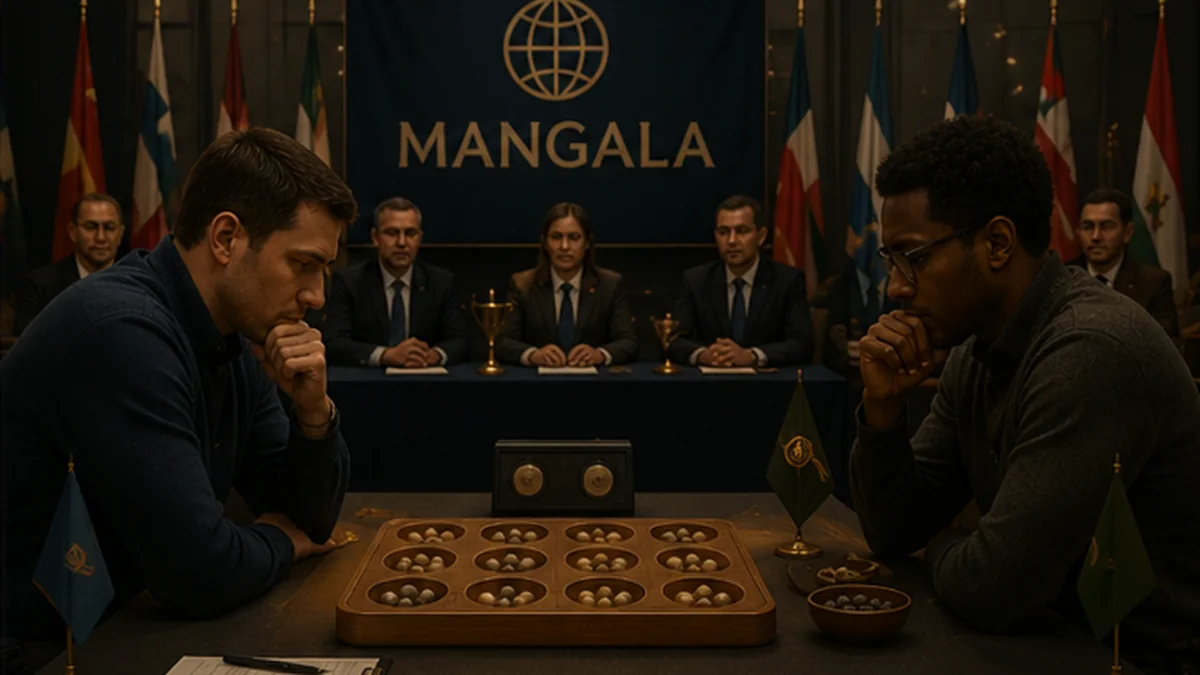
Mangala looks simple until the last stone starts deciding everything. One move gives you another turn because the final stone falls into your treasury. The next move hands the opponent an even capture. A third move leaves a pit empty and turns the opposite pit into a trap.
That is why the best way to learn Mangala is not to memorize a dry rule list. Keep the rules beside you, open the board, and play slowly enough to ask the same question before every move: where will the last stone land?
What Mangala is, and what it is not
Mangala belongs to the wider mancala family, but it is not just "generic mancala". The Turkish ruleset usually described online uses six pits on each side, one treasury for each player and 48 stones. That makes it look close to Kalah at first glance, yet the capture logic gives the game a different rhythm.
The Turkish Ministry culture page describes Mangala/Gocurme as a traditional intelligence and strategy game that can be played on special boards or improvised pits. GSDF also presents Mangala as a Turkish intelligence and strategy game and links it to the 2020 UNESCO intangible heritage listing shared with Togyzqumalaq and Toguz Korgool.
For a player, the important takeaway is practical: Mangala rewards counting, tempo and capture timing. If you already know Kalah, do not assume the same tactics transfer automatically. If you know Togyz Kumalak, expect a shorter 2x6 game without tuzdyk, but with the same need to visualize a sowing path before touching the stones.
Board setup: 12 pits, two treasuries, 48 stones
A common modern Mangala setup has two rows of six small pits. Each player controls the six pits nearest to them, and each player has a larger treasury, often called a store or hazine, for captured stones.
| Element | Common Mangala setup | Why it matters in play |
|---|---|---|
| Small pits | 12 total, six per player | Your legal moves normally start from your own six pits. |
| Stones | 48 total, four in each small pit at the start | Four-stone openings make last-stone counting visible from move one. |
| Treasuries | Two large scoring pits | Captured stones go here; the larger treasury count wins. |
| Goal | Collect more stones than the opponent | Every tempo decision is still about final material count. |
At the start, the treasuries are empty. A player who reaches 25 stones has usually crossed the winning line in a 48-stone set, but tournament or local scoring can add set rules, match points or draw handling. If you play in an event, always check the organizer's rule sheet.
How a Mangala turn works
A turn begins by choosing a non-empty pit on your own side. In the common Turkish description, you take the stones from that pit, leave the first stone in the pit you picked, and continue sowing one stone at a time around the board. If there is only one stone in the selected pit, that stone simply moves to the next pit.
- Choose a non-empty pit on your side.
- Pick up the stones from that pit.
- Distribute one stone at a time along the sowing path.
- Watch where the final stone lands.
- Resolve the result: extra turn, capture, empty-pit capture or normal handover.
That sequence is why a bot game helps. You can replay the same idea without pressure, count the final landing point, then immediately test whether a different pit changes the result. A printed rule list cannot give that feedback.
The rules that decide most games
The first rule to internalize is the treasury tempo. If your last stone lands in your own treasury, you play again. Beginners often see this as a small bonus, but in practice it can chain into a second threat: you keep the move and force the opponent to answer your next sowing path.
The second rule is even capture. If your final stone lands in an opponent pit and makes the number of stones in that pit even, you take those stones into your treasury. Look one move ahead: sometimes a move that captures two stones now also leaves a bigger even capture for the opponent.
The third rule is the empty-pit capture. If your last stone lands in an empty pit on your own side and the opposite pit contains opponent stones, you capture the opposite stones and your own last stone. This is where Mangala stops being a counting drill and becomes a trap game.
Practical rule: before you move, count the last stone; after you move, ask what even number you just created for your opponent.
Four beginner positions to notice
You do not need opening theory to start. You need a small set of motifs that tell you what to look for. Treat these as training labels, not official combination names.
| Motif | What to look for | Training question |
|---|---|---|
| Last-stone count | A pit whose stones land exactly in your treasury | Do I keep the move? |
| Even-capture bait | An opponent pit that can become 2, 4, 6 or 8 | Am I taking stones, or feeding a bigger reply? |
| Empty-pit trap | An empty pit on your side facing a loaded opponent pit | Can I land there with the last stone? |
| Endgame sweep | One side is close to running out of stones | Who benefits if the set ends now? |
Experienced players do not just count their own reward. They count the opponent's reply. In a bot game, pause after every capture and ask: did the move improve my treasury, or did it leave my side too empty?
How Mangala differs from Kalah, Oware and Togyz Kumalak
All mancala games share sowing and capture, but the rules change the psychology of the board. Kalah is often the easiest entry point for broad "play mancala online" searches. Oware trains feeding and multi-pit captures. Togyz Kumalak and Toguz Korgool add a deeper 9-pit board and tuzdyk logic. Mangala sits in a different place: short, tactical and built around treasury tempo plus even capture.
| Game | Board | Training focus |
|---|---|---|
| Kalah | 6x2 pits, two stores and 48 stones | Bonus turn into the store and empty-pit capture. |
| Oware | 6x2 pits, no built-in stores on the board | Capturing two or three seeds and feeding the opponent. |
| Mangala | 6x2 pits, two treasuries and 48 stones | Last stone into treasury, even capture, empty-pit threats. |
| Bestemshe | Compact 5x2 board | Short lessons and a bridge toward Togyz Kumalak thinking. |
| Togyz Kumalak | 9x2 pits and 162 stones | Long counting, even capture and tuzdyk strategy. |
If you are choosing your first game, start where your intent is clearest. Choose Mangala when you want a Turkish mancala ruleset with fast tactical feedback. Choose Kalah when you want the most familiar web-mancala entry, then use Kalah vs Mangala to see exactly where the similar boards diverge. Choose Togyz Kumalak when you want the deeper Central Asian game.
Practice Mangala on Toguz Arena
On Toguz Arena you can open Mangala online in the browser, start against a bot, then move toward friend invitations or live online games. The useful part is not that the bot magically teaches everything. It is that the board lets you test a rule immediately after reading it.
Use the first ten games as a counting lab:
- In games 1-3, count only the final stone before every move.
- In games 4-6, add even-capture threats on the opponent's side.
- In games 7-8, deliberately look for empty-pit captures.
- In games 9-10, watch the endgame: which side runs out first, and who receives the remaining stones?
Then move sideways through the library: read the Mangala hub, compare the wider Mancala rules family guide, and use AI Trainer or the knowledge base when you want to connect one position with the broader strategy vocabulary.
Sources and fact-checking
This page uses public sources for rule and heritage context. GSDF's Mangala branch page and competition-instruction notice support the Turkish federation/trust layer. The Turkish Ministry culture page describes Mangala/Gocurme cultural context, and the UNESCO page supports the 2020 ICH listing.
For concrete beginner rules, this page also checks the public rule explainer at mangala.com.tr and the English-language Kazinform World Nomad Games explainer. Limitation: Toguz Arena is a playable training platform, not an official GSDF, UNESCO or ministry rules authority. For tournaments, follow the organizer's current regulation.
FAQ
Can I play Mangala against the computer for free?
Yes. You can open Mangala in the browser on Toguz Arena and train against a bot. An account helps save progress, return from mobile and invite friends.
Is Mangala the same as Kalah?
No. Both use a 2x6 mancala-style board with stores, but Mangala is the Turkish ruleset with its own treasury tempo, even-capture logic and cultural context.
What should I learn first?
Learn to count the last stone first. Then add treasury extra turns, even captures, empty-pit captures and endgame sweeps. Those four ideas explain most beginner mistakes.