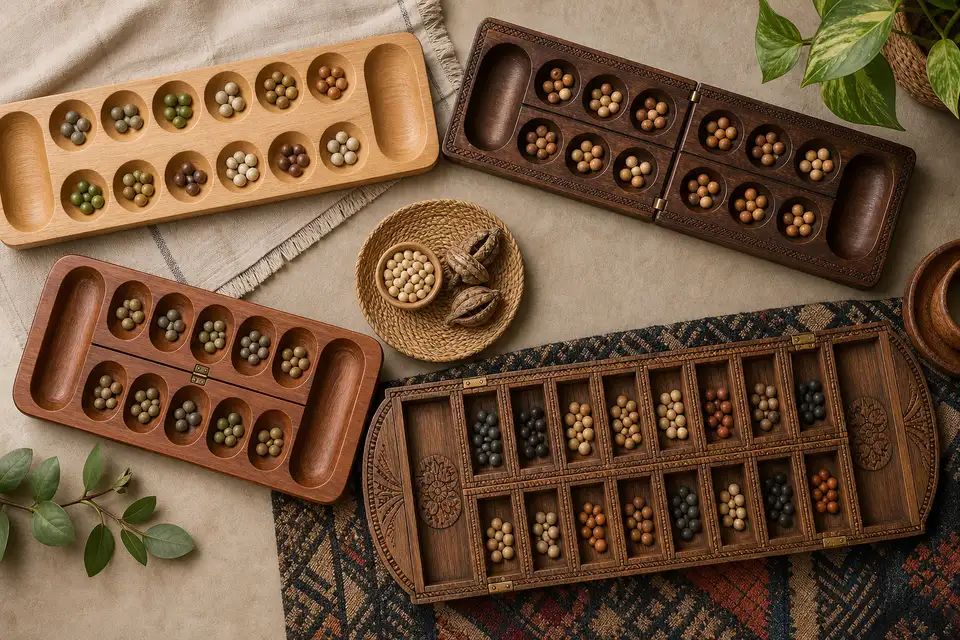
- Kalah
- 6x2 board + 2 stores, 48 seeds. Bonus turn if last seed lands in your store. Capture if last seed lands in your empty pit opposite opponent's seeds. Win: more than 24 seeds.
- Oware (Awale)
- 6x2 board, no stores, 48 seeds. Capture if last seed makes opponent's pit exactly 2 or 3 — chain backward. Feeding rule: must leave opponent a legal move. Win: more than 24 seeds.
- Mangala
- 6x2 board + 2 treasuries, 48 stones. Last stone in treasury grants extra turn. Capture even-numbered opponent pits. Win: more stones in treasury.
- Togyz Kumalak
- 9x2 board + 2 kazans, 162 stones (9 per pit). One stone stays in start pit. Capture even-numbered opponent pits. Tuzdyk: if pit becomes exactly 3, it becomes your permanent trap. Win: 82+ stones.
- Bestemshe
- 5x2 compact board, 50 stones (5 per pit). Same rules as Togyz but faster. Win: 26+ stones. "Bes" means five in Kazakh — the children's training ground.
Mancala: a family of sowing games, not one ruleset
Mancala games are often described as ancient and geographically widespread. Exact dates, origin stories and variant counts differ by source, so this guide avoids presenting a single dramatic number as settled fact. The safer practical approach is to treat mancala as a living game family and verify each variant on its own terms.
For a practical first comparison, this guide uses five entry points that readers commonly meet in rules pages, classrooms, online play or cultural references: Kalah, Oware, Mangala, Togyz Kumalak and Bestemshe. They are not presented as a ranked global popularity list; they are useful because each one teaches a different rule pattern.
Kalah: a modern standardized entry point
Board and setup
Kalah uses a 6×2 board: each player controls six small pits and one store (the larger pit on your right). Start with 4 seeds in each of the 12 pits — 48 seeds total. Stores begin empty.
How to move
Pick up all seeds from one of your pits. Sow them one by one counter-clockwise into the following pits and your own store. Skip the opponent's store entirely.
Bonus turn and capture
If the last seed lands in your store, you earn an extra turn — chain these for tempo swings. If the last seed lands in an empty pit on your side and the pit directly opposite holds seeds, you capture both your last seed and all the opponent's seeds into your store.
Winning
The game ends when one player has no legal moves. The opponent collects any remaining seeds. The player with more than 24 of the 48 seeds wins.
A surprising origin
Despite feeling ancient, Kalah is a modern standardized branch of the wider mancala family. The important practical point is not the marketing story, but the rule shape: stores, bonus turns and empty-pit captures make it the easiest entry point for many new players. Read the full Kalah rules →
Oware: the West African no-store branch
Board and setup
Oware uses a 6×2 board with no stores. Start with 4 seeds in each of 12 pits — 48 seeds total. Captured seeds are set aside permanently.
Capture and feeding
Sow seeds from one pit. If the last seed lands in an opponent's pit and that pit now contains exactly 2 or 3 seeds, capture them — then check the previous pit backward for the same count. Crucially, you cannot leave the opponent with zero seeds; you must feed them a move. This rule transforms Oware from a capture game into a relational one: you must sustain the opponent's ability to play while trying to win.
Winning
The player who captured more than 24 seeds wins. Oware is often learned socially and played in repeated games, but local habits differ. For rules learning, the key point is the feeding rule and the 2-or-3 capture chain, not an unsupported universal story about how every community plays.
Cultural weight
Oware is strongly associated with West African play culture and diaspora variants. Because cultural history can be retold with different local names and traditions, this guide focuses on what a player must verify first: the no-store board, 2-3 capture chain and feeding rule. Read the full Oware rules →
Mangala: the Turkish treasury branch
Board and setup
Mangala follows a 6×2 layout with two treasuries. Start with 4 stones in each pit — 48 stones total.
Move and capture
Take all stones from one pit, drop them one by one including into your treasury. If the last stone lands in your treasury, take another turn. If it lands in an opponent's pit and the count becomes even, capture all stones from that pit.
Winning
The player with more stones in their treasury wins.
From palaces to pixels
Mangala is the Turkish branch most readers should separate from Kalah and Togyz Kumalak. It uses treasuries and even-number captures, so the tempo feels different even when the board size looks familiar. For source-backed Turkish institutional context, use the dedicated Mangala organization and rules pages rather than treating every mancala rule as interchangeable. Read the full Mangala guide →
Togyz Kumalak: the 9-pit Central Asian branch
Board and setup
Togyz Kumalak uses a 9×2 board with 9 stones per pit — 162 stones total. Each player has a kazan.
Move
Take all stones from one pit except one — one stone stays behind. Sow the rest one by one. The board never fully empties until endgame.
Capture and tuzdyk
If the last stone lands in an opponent's pit and that pit now holds an even number, capture all stones. If the count becomes exactly 3, the pit becomes a tuzdyk — your permanent scoring trap. The opponent can never play from it, and all future stones landing there go to you. A player may own at most one tuzdyk per game.
Winning
The game ends when one player has collected 82 or more stones. Serious games can take time because long routes, even captures and tuzdyk timing must be calculated carefully.
National treasure
UNESCO lists Togyzqumalaq, Toguz Korgool and Mangala/Göçürme together as intangible cultural heritage connected with Kazakhstan, Kyrgyzstan and Türkiye. That source is useful for cultural context, while rule details should still be checked in dedicated rule guides. Read the full Togyz Kumalak guide →
Bestemshe: the five-stone classroom
Bestemshe shrinks Togyz Kumalak rules onto a 5×2 board with 50 stones. "Bes" means five in Kazakh, and the smaller board makes counting, capture checks and route prediction easier to teach. Win by capturing 26 or more stones. On Toguz Arena, Bestemshe works as a quick-practice mode before the full 9-pit game. Read the full Bestemshe guide →
Comparison table
| Game | Board | Stones | Key mechanic | Origin | Difficulty |
|---|---|---|---|---|---|
| Kalah | 6×2 + 2 stores | 48 | Bonus turn from store; empty-pit capture | USA, 1940 | Beginner |
| Oware | 6×2, no stores | 48 | 2-3 capture chain; feeding rule | West African tradition | Intermediate |
| Mangala | 6×2 + 2 treasuries | 48 | Treasury bonus turn; even-number capture | Turkish tradition | Beginner |
| Togyz Kumalak | 9×2 + 2 kazans | 162 | One stone stays; tuzdyk trap; even capture | Kazakh/Central Asian tradition | Advanced |
| Bestemshe | 5×2 | 50 | Compact Togyz rules; five stones | Kazakh training variant | Beginner-Intermediate |
Players around the world: how real people experience mancala
One of the most useful things about mancala is that the board can be simple. A paper sketch, small bowls, beans, seeds or stones can teach the sowing rhythm before a player ever buys a carved board. That accessibility matters for classrooms, families and online practice because the rule idea is visible immediately.
Entry points vary widely. Some players start with Kalah because the board is familiar; others come through Oware, Mangala, Bestemshe or Togyz Kumalak. The practical lesson is the same: learn one ruleset cleanly, then compare variants deliberately instead of assuming all mancala games work the same way.
Which game should I start with?
Start with Kalah if you have never played a mancala game. The bonus-turn rule is intuitive, and games often stay short. Move to Oware once you want the strategic depth of capture chains and the feeding rule. Try Mangala for the Turkish variant's treasury tempo. Move to Bestemshe, then Togyz Kumalak when you want the larger 9-pit calculation problem: memory, route planning and tuzdyk timing matter more on the bigger board.
On Toguz Arena, use bot practice, friend invitations or live games where the variant is available. Switch deliberately and notice how the same sowing gesture changes meaning under different rule sets.
Sources and fact-check notes
This page is a family-level rules guide. It intentionally avoids exact antiquity, variant-count or popularity claims unless the exact claim is tied to a checkable source. Use the links below for rule and cultural context, and use the dedicated variant guides for detail.
- UNESCO: Togyzqumalaq, Toguz Korgool, Mangala/Göçürme - cultural heritage context for the Central Asian/Turkish branch.
- Toguz Arena federation and UNESCO source hub - source map and project disclaimer.
- Mancala games online guide - play/practice context across variants.
- Togyz Kumalak rules - 9-pit rule details.
- Toguz Korgool rules - Kyrgyz naming and practice route.
Toguz Arena does not claim official endorsement by UNESCO, the World Togyzqumalaq Federation or national federations. Source links are included so readers can verify context before trusting a rules comparison.
Frequently Asked Questions
Is Mancala one game or many?
Mancala is a family of many sowing games spread across multiple regions. The term "mancala" often refers to Kalah in English-language casual play, but Oware, Mangala, Togyz Kumalak, and Bestemshe are distinct games with different boards, capture rules, and cultural contexts.
How old is Mancala?
Mancala games are ancient and widespread, but exact dates differ by source and by what counts as a board, a pit row or a ruleset. For educational pages, it is safer to say that mancala is an old family of sowing games and cite the exact source when making a dated claim.
What is the easiest mancala game for beginners?
Kalah is the easiest entry point: 6×2 board, simple bonus turns, and straightforward captures. Bestemshe is also beginner-friendly and serves as a bridge to the deeper Togyz Kumalak.
How is Togyz Kumalak different from other mancala games?
Togyz Kumalak uses a 9×2 board and 162 stones. One stone always stays in the starting pit. The tuzdyk rule creates permanent scoring traps owned by each player. UNESCO lists the Togyzqumalaq / Toguz Korgool / Mangala-Göçürme tradition as intangible cultural heritage.
Can I play all these mancala games online for free?
Yes. Toguz Arena offers browser play for the mancala-family variants supported on the platform. No download is required. An account can help preserve progress and make later practice easier.
Why are there so many different Mancala rules?
Mancala rules differ because the family developed across many communities and materials. Each variant adapts the shared sowing mechanic to local habits and strategic preferences. Some variants emphasize speed, others feeding rules, and others long counting routes.
Ready to try? Open a mancala-family game on Toguz Arena, choose a variant, and turn reading into a real position on the board.