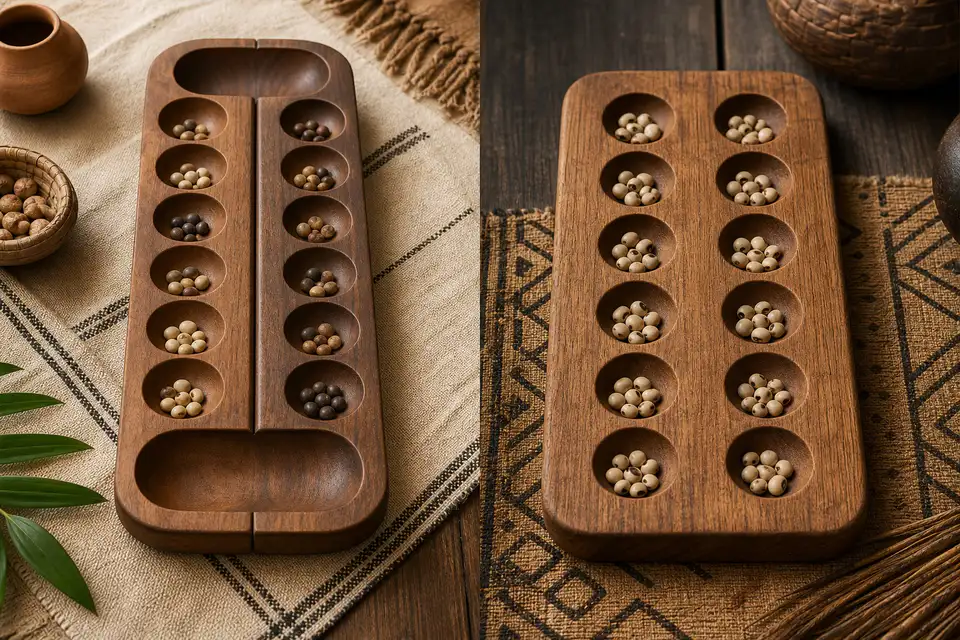
Kalah vs Oware: two games that only look similar at first
At first glance, Kalah and Oware look like twins. Both can use a 6x2 board with 48 seeds, and both ask you to pick up seeds from one pit and sow them one by one. The difference appears after a few moves: Kalah is a race toward your own store, while Oware asks you to manage the opponent's ability to keep playing.
This page avoids folklore-style claims about world records, television audiences or exact national championship scale unless a checkable source is provided. The safe comparison is already useful: the two rulesets create different decisions even before you talk about culture, tournaments or computer analysis.
Reader shortcut: if you want the fastest first win condition to understand, start with Kalah. If you want the same 6x2 board to feel like a negotiation with the opponent's next move, start Oware after that.
Rules side-by-side: what changes, and why it matters
In Kalah, each player has a store. If your last seed lands in your own store, you get another turn. If your last seed lands in an empty pit on your side, you capture the opposite pit. These two rules make Kalah quick to teach and satisfying for children, because bonus turns feel immediately rewarding.
Oware has no stores. Captured seeds are removed from the board and kept aside. The usual Abapa-family capture pattern is more precise: if the last seed lands in an opponent's pit and that pit now holds exactly two or three seeds, those seeds can be captured; in common rule descriptions, the capture can continue backward through adjacent opponent pits that also contain two or three.
The most important practical difference is the feeding rule. In Oware, you generally cannot make a move that leaves the opponent with no seeds if another legal move can feed them. That turns the game from a simple race into a balance problem: you want captures, but you also have to keep the game alive.
| Aspect | Kalah | Oware / Awale |
|---|---|---|
| Common board | 6x2 plus two stores | 6x2, usually no stores |
| Main beginner hook | Bonus turns from the store | Feeding rule and 2-or-3 captures |
| Capture idea | Last seed in your empty pit captures the opposite pit | Last seed creates 2 or 3 in an opponent pit, with possible backward captures |
| What it teaches first | Counting, store tempo, capture setup | Counting, restraint, opponent mobility, capture timing |
| Best first audience | Absolute beginners and younger players | Players who want a deeper counting game after learning sowing |
Which game is harder?
Kalah can become tactically sharp because bonus turns chain together. A player who sees a store landing three moves ahead can change the entire score. But the same directness also makes Kalah easier to explain: a new player can see where the score goes.
Oware is harder for many adults because a tempting capture can be illegal or strategically poor if it starves the opponent or leaves your own side fragile. The feeding rule forces a different kind of calculation: not only "what do I take?" but "what board do I leave?"
Player test: in Kalah, ask "can I land in my store or set up an empty-pit capture?" In Oware, ask "does this move feed the opponent, and what capture chain will I leave behind?"
Computer-game research adds one useful fact without needing to exaggerate it. Irving, Donkers and Uiterwijk published work on solving standard Kalah variants, which is relevant to Kalah's computational history. This page does not turn that into a claim that every family board, house rule or casual app is strategically trivial.
Which should you play first?
Start with Kalah if you are teaching a child or a complete beginner. The game gives immediate feedback: a store fills, a bonus turn happens, a capture is visible. After three short games, most players understand the basic sowing rhythm.
Move to Oware when you want the same physical gesture to become more subtle. The 2-or-3 capture rule, the feeding rule and the no-store structure force you to compare your move with the opponent's future options. It is a strong second game after Kalah because it shows that "mancala" is a family, not one rulebook.
A practical learning path is simple: play three Kalah games to learn route counting, then three Oware games to learn restraint and feeding. After that, choose by taste. If you like fast tempo and bonus-turn chains, stay with Kalah. If you like patient counting and opponent-mobility puzzles, spend more time with Oware.
| Beginner decision | Choose Kalah if... | Choose Oware if... |
|---|---|---|
| You are teaching the first game | The player needs visible scoring and quick rewards. | The player already understands sowing and wants a deeper puzzle. |
| You want the main tactic quickly | Bonus turns and empty-pit captures should be obvious within minutes. | Capture chains and feeding should be part of the lesson. |
| You are choosing a practice route | Start with route counting, store tempo and direct captures. | Move into opponent mobility, restraint and endgame seed control. |
Practice Supported Mancala Variants
On Toguz Arena, use the supported mancala variants as practice environments rather than as proof of official tournament status. A platform can help you learn rules, review mistakes and invite friends; official championships, title norms and national ranking systems should be checked from their own sources.
For a quick comparison, do not read both rulebooks passively. Play a short six-game drill and write down which question you asked before each move.
- Play two Kalah games while looking only for store landings and extra turns.
- Play one Kalah game while deliberately setting up an empty-pit capture.
- Play two Oware games while checking whether each move feeds the opponent.
- Play one Oware game while tracking the final seed and possible backward capture chain.
- Compare the notes: Kalah should feel like tempo and scoring; Oware should feel like mobility and restraint.
- Then pick the variant that made you ask better questions, not the one that looked simpler on the board.
- Play Kalah in the browser - good for bonus-turn and store-tempo practice.
- Play Oware in the browser - good for feeding-rule and capture-timing practice.
- Read the Mancala family rules guide - compare Kalah, Oware, Mangala, Togyz Kumalak and Bestemshe.
Sources and fact-check notes
This comparison intentionally avoids unsupported records such as exact fastest games, longest games, national championship attendance, top ELO numbers or broadcast claims. Add those only when a primary tournament source, federation source or archived event result supports the exact statement.
- Irving, Donkers and Uiterwijk: Solving Kalah - computational context for standard Kalah variants.
- Oware Society: Oware Abapa rules - rule context for captures and feeding.
- PlayStrategy: Oware rules - modern online rules reference.
- Auale: How to Play Oware - accessible walkthrough for setup, sowing, capture and endgame rules.
- Toguz Arena federation and source hub - source map and platform disclaimer.
Frequently Asked Questions
Which mancala game is better for beginners?
Kalah is usually easier for absolute beginners because stores, bonus turns and empty-pit captures are visible quickly. Oware is a better second step once the player understands sowing and wants a deeper counting game.
Why does Oware feel harder than Kalah?
Oware has no stores and uses a feeding rule. You must think about the opponent's future legal moves as well as your own captures, so the calculation is less direct than Kalah's store-tempo race.
Can I play Kalah and Oware on the same platform?
Yes, if both variants are enabled on the platform. On Toguz Arena, use the Kalah and Oware practice surfaces to compare the rules in real games and decide which style fits you.