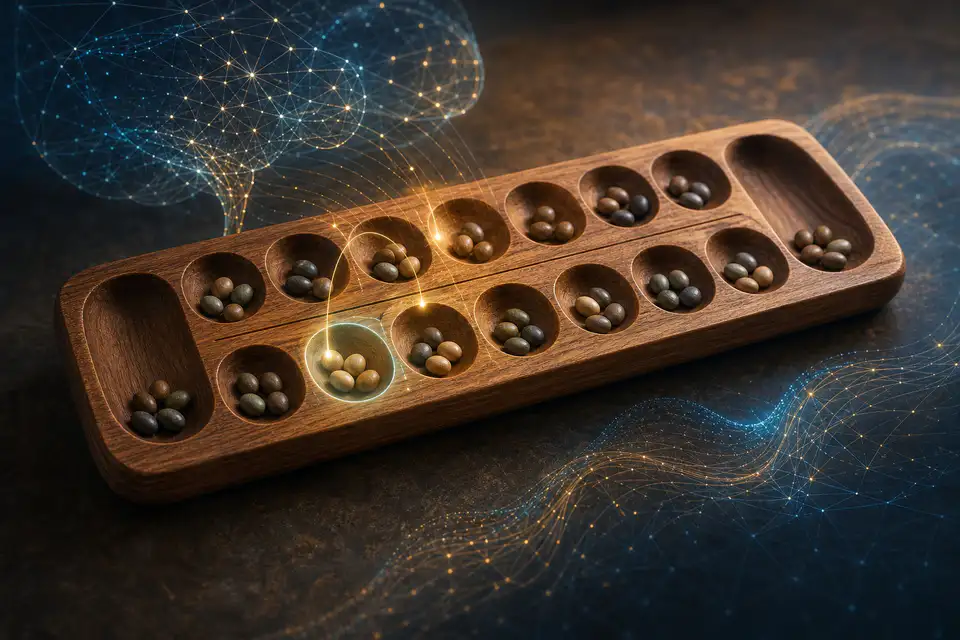
What computers can and cannot prove about Mancala
But an AI article should not turn every technical experiment into a marketing claim. Some Kalah positions and rule sets have been studied very deeply in academic work. Togyz Kumalak has public AI competition coverage. Those are strong facts. They do not prove that every variant is solved, that every engine is public, or that named champions train on a specific private database.
Why computer scientists like sowing games
Mancala games are attractive to programmers for a practical reason: a board can be represented as small arrays of integers. A move takes stones from one pit, distributes them around the board, and updates captures or stores. That makes the game easier to model than many sports or card games, while still leaving enough branching and endgame tension to be interesting.
Classic game-playing programs usually combine search with evaluation. The program explores candidate moves, estimates future positions, and chooses the line that looks strongest under the rules it knows. In Kalah, this can mean counting bonus turns and captures. In Togyz Kumalak, it can mean tracking parity, final-stone landing squares, tuzdik pressure and late-game stone conversion.
The important reader-facing point is this: "computer-playable" is not the same as "fully solved." A simple board representation only opens the door. A reliable claim still needs a specific rule set, a source, a date, and a clear statement about what was actually proven.
Kalah and the meaning of a solved game
Academic Kalah work is a good example of how precise these claims must be. Geoffrey Irving, Jeroen Donkers and Jos Uiterwijk published a paper on solving Kalah configurations and explained the retrograde-analysis approach: work backward from known terminal positions and classify earlier positions from that database.
That does not mean every casual Kalah sentence should say "Kalah is solved" without context. Kalah has rule variations and different starting stone counts. A source-backed article should say which configuration is being discussed, whether the result is a theoretical first-player result or a practical playing engine, and which paper or solver note supports the statement.
| Claim type | Safe wording | Unsafe wording |
|---|---|---|
| Academic search | Kalah configurations have been studied with retrograde analysis. | All mancala is solved. |
| Human play | A solver can prove a result under a fixed rule set, but humans still make practical mistakes. | A computer always makes the game pointless. |
| Public comparison | Kalah is a useful AI testbed because its state can be encoded cleanly. | Kalah search later powered every famous chess and Go engine. |
Oware, Awari and endgame databases
Oware and Awari are often discussed in computer-game literature because the endgame can be represented and searched with databases. Endgame databases are especially useful in sowing games: when few stones remain, the program can often calculate exact results rather than rely on a rough evaluation.
For readers, the practical lesson is not "memorize every database line." The lesson is that late-game counting matters. A player who understands feeding rules, capture timing and stone conservation will make fewer mistakes even without a machine.
For Toguz Arena content, this is the bridge from technical history to product value: an AI trainer is useful when it explains the type of mistake. A user should learn whether the error was counting, parity, tempo, capture timing or endgame conversion.
Togyz Kumalak and public AI competition evidence
The strongest public AI fact for Togyz Kumalak is not a hidden training database. The Astana Times reported that an AI-powered Togyzkumalak competition was held in Kyzylorda in March 2026 as part of the Champion tournament context. The article identified the system as an AI opponent developed by Abylai Nurske and described it as a public competition milestone.
That is enough to show that AI has entered the public Togyz Kumalak conversation. It is not enough to claim that entrants trained on private federation archives, that a particular champion uses a private engine workflow, or that a championship contained a specific unsolved engine disagreement. Those claims need direct sources before publication.
A safe article can still be compelling. It can explain how a Togyz Kumalak AI might evaluate a position: last-stone routes, odd/even holes, tuzdik ownership, opponent replies, and the number of stones that can realistically be converted before the board empties.
How players should use AI analysis
The best use of AI is not blind obedience. A player improves when the machine points to a moment where human evaluation became unreliable, then the player rewrites that moment in plain language.
- Find the first move where the position changed sharply.
- Describe the mistake without engine jargon: counting, parity, tuzdik, tempo or endgame.
- Replay two candidate alternatives and compare the final-stone landing square.
- Save one position as a training pattern instead of trying to memorize the whole game.
This makes AI a coach-like review layer rather than a fake authority signal. It also keeps product copy honest: the value is visible workflow, not secret datasets, invented champion endorsements or unverifiable model strength.
Frequently Asked Questions
Can a computer always beat a human at mancala?
Only under specific rule sets and configurations can a solver make exact claims. It is safer to say that computers can be very strong at some mancala variants, while practical human play still depends on counting, time pressure and mistakes.
Why was mancala useful for AI research?
Mancala-family games have perfect information, deterministic moves, compact board states and clear scoring. Those features make them useful for search, evaluation and endgame database experiments.
Sources and fact-check notes
- Irving, Donkers and Uiterwijk: Solving Kalah - source for Kalah retrograde-analysis and solved-configuration discussion.
- The Astana Times: Kazakhstan hosts first AI-powered Togyzkumalak competition - public source for the Kyzylorda 2026 AI competition context.
- Toguz Arena: AI vs Champion - related source-backed article about the 2026 AI competition milestone.
- Mancala vs Chess - related comparison article with source notes and trust constraints.
- Federation and UNESCO source hub - general entity/source map for Togyz Kumalak, Toguz Korgool and related traditional games.