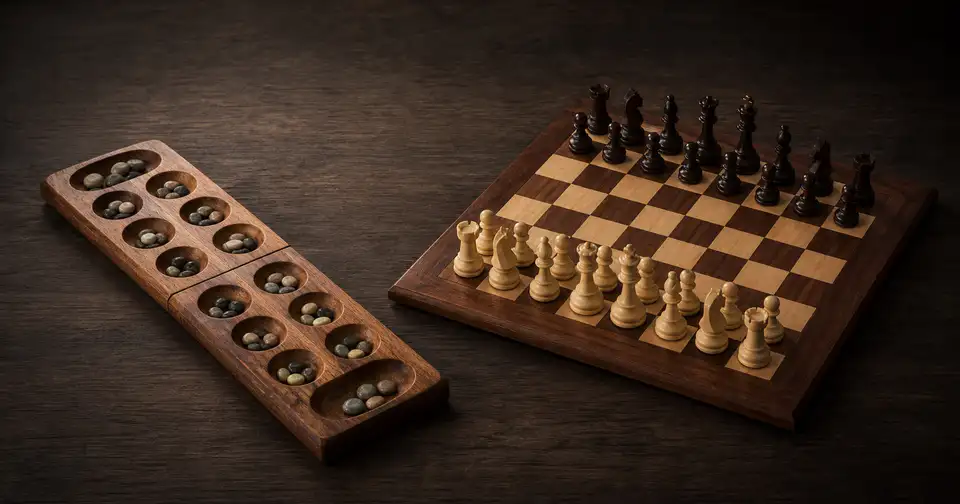
Mancala vs Chess: two calculation games, different skills
If you already play chess and are curious about Mancala, the useful question is not "which game is better?" The useful question is: which thinking habit are you trying to train? Chess emphasizes pattern libraries and tactical coordination. Mancala emphasizes arithmetic routes, tempo and board-economy decisions.
At a glance: Chess vs Mancala
| Question | Chess | Kalah-style Mancala | Togyz Kumalak |
|---|---|---|---|
| Main skill pressure | Pattern recognition, calculation and king safety | Counting, store timing and capture setup | Long sowing routes, parity, tuzdyk and endgame conversion |
| Pieces | Different pieces with different movement | Identical seeds | Identical stones plus permanent tuzdyk state |
| Opening study | Large named-opening tradition | Mostly practical counting patterns | Opening ideas exist, but counting remains central |
| Endgame | Material, king activity and technique | Store count, remaining seeds and move availability | Stone race, atsyz kalu, tuzdyk impact and final score |
| Computer status | Not solved as a full game | Some Kalah sizes have published solution work | No widely cited public full-game solution |
What transfers from chess to Mancala
Counting ahead
Chess players already ask, "If I move here, what can the opponent do?" That habit transfers to Mancala sowing routes. Before moving, predict the landing pit, the capture condition and the opponent's best reply.
Position evaluation
Chess teaches players to evaluate more than material. Mancala has a similar meta-skill: do not look only at the current store count. Look at pit distribution, threats, tempo, empty pits, future captures and whether your side is close to running out of legal moves.
Endgame discipline
Chess endgames punish careless tempo. Mancala endgames do the same. In Kalah, emptying a side too early can lose remaining seeds. In Togyz Kumalak, a player must track stone count, tuzdyk consequences and whether the opponent can be forced into atsyz kalu.
What does not transfer cleanly
Opening memorization
Chess players can rely heavily on prepared openings. In Mancala, the board changes after every sowing route, and a memorized first move is weak if the player cannot count the final stone. Start with calculation before memorized lines.
Piece identity
Chess has queens, rooks, bishops, knights and pawns. Mancala has identical stones or seeds. The depth comes from distribution and landing points rather than piece powers.
Direct attack
Chess ends with checkmate or a draw agreement. Mancala usually ends through count, exhaustion or a variant-specific condition. The pressure is economic and positional, not a direct king hunt.
The solved-game question
It is accurate to say that some Kalah configurations have been studied deeply by computer scientists, and published work exists for solving standard Kalah positions. It is not accurate to use that fact to dismiss the whole Mancala family. Oware, Togyz Kumalak, Mangala, Bao and other variants have different rules and state changes.
The safer comparison is this: solved status depends on the exact ruleset and board size. A proof about one Kalah setup is not a proof about Togyz Kumalak or every Mancala-family game.
Which is harder?
They are hard in different ways. Chess is harder if the challenge is piece coordination, opening theory and tactical motifs. Mancala is harder if the challenge is continuous arithmetic, long sowing routes and keeping the whole board count in working memory.
For beginners, Kalah is usually easier to start than chess. For experienced strategy players, Togyz Kumalak creates a deeper calculation challenge than casual Kalah because the 9x2 board, 162 stones and tuzdyk rule produce longer strategic consequences.
Can playing Mancala help a chess player?
Mancala should not be sold as a guaranteed chess-improvement method. The honest claim is narrower: Mancala can train calculation habits that chess players also need.
- Route calculation: count where the final stone lands before moving.
- Consequence thinking: evaluate the position after your move, not only the immediate gain.
- Tempo awareness: notice when a move gives or removes another turn.
- Endgame patience: convert a small advantage without rushing.
For classroom or training use, connect this comparison with the Toguz Kumalak classroom kit and the educator guide instead of relying on broad cognitive-benefit claims.
Sources and fact-check notes
- Donkers, Uiterwijk and de Voogt: solving Kalah - useful for Kalah-specific solved-game context.
- Complete Mancala rules family guide - rules differences across supported Mancala-family games.
- Togyz Kumalak rules - details for tuzdyk, captures and atsyz kalu.
- Mancala strategy guide - cautious calculation and tempo training without win guarantees.
- Federation and UNESCO source hub - official-source context for Togyz Kumalak and related traditions.
Frequently Asked Questions
Is Mancala harder than chess?
It depends on the variant and skill being tested. Chess is harder for piece coordination and opening theory. Togyz Kumalak and other deep Mancala variants are harder for continuous counting, parity and long sowing-route calculation.
Do chess skills transfer to Mancala?
Some do. Calculation, consequence thinking and endgame patience transfer well. Opening memorization and piece-specific tactics do not transfer directly.
Has Mancala been solved by computers?
Some Kalah configurations have published solution work. That does not solve the whole Mancala family, because variants such as Togyz Kumalak, Oware and Mangala use different rules and board states.
Which Mancala variant is closest to chess in depth?
Togyz Kumalak is the strongest comparison on Toguz Arena because the 9x2 board, 162 stones and tuzdyk rule create long-term strategic consequences. It is still a different kind of game than chess.
Want to test the comparison yourself? Learn the rules, then open a supported board on Toguz Arena and compare which mental muscles engage.