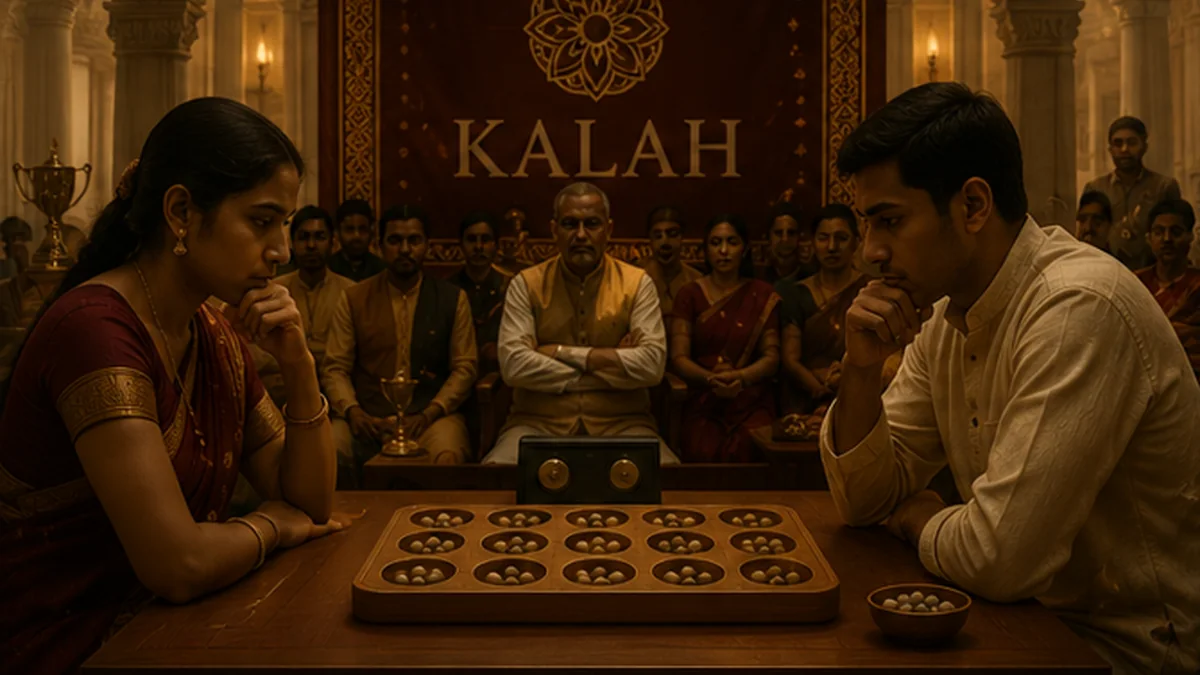
Why playing against the computer helps
A computer opponent is useful because it lets you repeat ideas without pressure. You can return to the same position, try another move, play ten training games and then switch to a human opponent. For the query "play Kalah against computer", that is the clean path: train first, then play online.
Good play against the computer should do more than let you make legal moves. In Kalah, the useful part is seeing why the bot chooses tempo, where a capture is being prepared and when it is time to move from training into a human game.
What matters in the rules
Kalah belongs to the mancala family: a player takes seeds from one pit and sows them around the board. The family resemblance is obvious, but each variant changes the psychology of the game. Kalah is a modern 6x2 version created by William Julius Champion Jr. in the twentieth century, which is why many players treat it as the default play mancala online game.
That is why we do not reduce Kalah to generic "mancala". Good training has to preserve the rhythm of the exact variant: where the sowing ends, when a long move is profitable, when to give up tempo and when to stop the opponent's threat.
How Toguz Arena trains this game
On Toguz Arena you can play Kalah in the browser with no installation. The platform supports games against bots, friend invitations and live online matches against other players. It is not just a rule page: you can read an idea, start a game and test it immediately.
Practicing Kalah against a bot on an interactive board helps you internalize the rules faster than reading alone. Start with the AI, understand the rhythm, then invite a friend or play a live opponent.
Our bots are built around game AI models. Early levels help you learn legal moves, middle levels punish tempo mistakes, and stronger levels search deeper. After a few games, Kalah stops looking like a simple counting exercise and starts feeling like memory, calculation and positional pressure.
Open Kalah online, choose a bot or invite a friend, and play the first game in the browser.
How it compares with other mancala games
All variants share sowing, but player intent differs. Kalah is often the entry point for the broad play mancala online query, Oware is a classic African strategy game, Mangala represents the Turkish branch, Togyz Kumalak and Toguz Korgool offer the deeper 9-pit game with tuzdyk, and Bestemshe works as a compact learning board.
| Game | Board | Training focus |
|---|---|---|
| Kalah | 6x2 pits, two stores and 48 seeds | a bonus move into your own store and fast capture from an empty pit |
| Oware | 6x2 pits without stores and 48 seeds | capturing two or three seeds and the rule against starving the opponent |
| Mangala | 6x2 pits, two stores and 48 stones | the last stone into the store, even captures and the special tempo of Turkish mancala |
| Bestemshe | a compact 5x2 board | short games, fast counting practice and a bridge toward the deeper Togyz Kumalak |
| Togyz Kumalak | 9x2 pits and 162 stones | even captures, long counting and the tuzdyk, which changes the map of the board |
Context: This page uses reference material on the mancala family and the rule set of the specific game.
FAQ
Can I play Kalah against the computer for free?
Yes. You can open Kalah in the browser on Toguz Arena and train with a bot. An account helps save progress and invite friends.
Can I switch from bot games to friends?
Yes. You can invite a friend by link or play live online games against other players.
Can I play Kalah online against a bot?
Yes. Open Kalah online on Toguz Arena, choose the Kalah bot, play Kalah online against computer, then switch to a friend or live opponent.