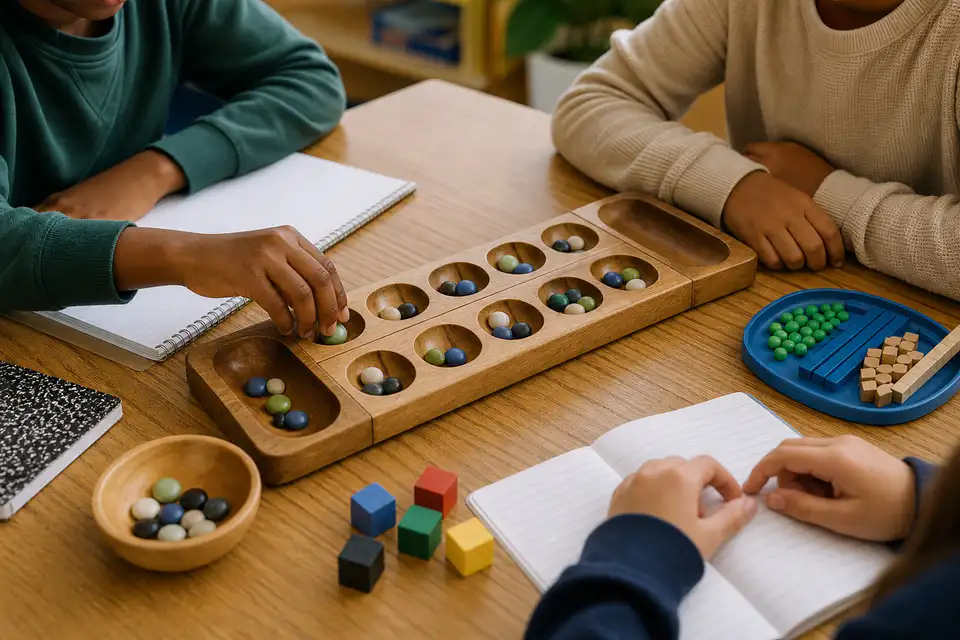
Why teachers can use mancala boards in classrooms
Mancala is not just a game. For educators, it can be a practical teaching tool: it requires no electricity, very little equipment, and a clear sequence of counting actions. A board, some seeds, and a short demonstration are enough for children to start tracing sowing routes, predicting the last seed, and discussing why a move worked.
The safe claim is narrower than "mancala improves math by itself." Different variants can support different classroom goals: Bestemshe and Kalah are useful for early counting practice, Oware makes the feeding rule and fairness visible, and Togyz Kumalak introduces deeper planning for older students. Local curriculum or ministry claims should be cited from official sources before they are presented as facts.
What makes mancala useful in classrooms is its combination of simplicity and depth. The rules are simple enough to teach in a single lesson, while repeated positions can support later lessons on planning, fairness, and explaining a move. The materials can also be cheap: an egg carton and 48 dried beans are enough for a starter Kalah board.
For source checking, route teachers to the printable classroom kit, the rules knowledge base, the source hub, and the events hub. For practice after a lesson, use the AI trainer or supported online boards as a supplement to teacher-led instruction, not as a replacement for classroom guidance.
Which mancala variant should you teach first?
The answer depends on the age group and the learning goals. Treat the ranges below as practical classroom guidance, not as medical, developmental, or curriculum certification.
- Ages 5-7 (Kindergarten-Grade 1): Bestemshe. The 5x2 board with 50 stones creates short games. No complex rules (no tuzdyks, no bonus turns). It isolates the fundamental classroom skill: predicting where the last stone will land.
- Ages 7-10 (Grades 2-4): Kalah. The bonus-turn mechanic adds strategic depth without overwhelming complexity. The capture rule (empty pit on your side → take opponent's opposite pit) teaches cause-and-effect thinking. Once the class knows the rules, Kalah can fit a short classroom session.
- Ages 10-14 (Grades 5-8): Oware. The feeding rule (you cannot leave your opponent with no legal moves) makes fairness visible inside the rules: you must keep the game alive while still trying to win.
- Ages 14+ (Grades 9-12): Togyz Kumalak. The 9x2 board, 162 stones, long sowing routes and tuzdyk rule make it appropriate for advanced students. Use it to discuss search trees, route prediction and why larger games need structured calculation rather than guessing.
| Classroom goal | Useful variant | Safe wording | Limit |
|---|---|---|---|
| One-to-one counting | Kalah or Bestemshe | Students physically count and sow counters one by one. | Do not claim automatic arithmetic improvement. |
| Fair-play discussion | Oware | The feeding rule makes "keep the game alive" part of strategy. | Use a clear rules source before teaching formal Oware. |
| Planning and explanation | Togyz Kumalak | Larger sowing routes make move explanation and final-pit prediction visible. | Advanced rules need teacher preparation. |
| First lesson logistics | Kalah | A 6x2 setup can be made with cheap materials. | Physical setup still needs supervision and classroom norms. |
Lesson plan: your first mancala class (45 minutes)
Minutes 0-5: Distribute boards (egg cartons work perfectly — 12 cups, plus two small bowls for stores). Each student pair gets one board and 48 dried beans. Explain the basic concept: pick up all beans from one cup, drop them one by one going counter-clockwise. Demonstrate once. Let them practice just the sowing motion for 2-3 minutes — no rules, just sowing.
Minutes 5-15: Introduce the rules one at a time. Rule 1: Sowing (practice). Rule 2: If your last bean lands in your store, you get another turn (practice with a simple position). Rule 3: If your last bean lands in an empty cup on your side, you capture the beans from the opponent's opposite cup. This is the hardest rule to grasp — demonstrate 3-4 times before moving on.
Minutes 15-30: First game. Students play a complete game of Kalah against their partner. Walk around and answer questions. The most common confusion: "Where does the last bean land?" Teach them to trace the path with their finger before picking up the beans. This keeps the counting work visible instead of turning the lesson into guesswork.
Minutes 30-40: Discussion. Write these questions on the board: "What was the hardest rule to remember? What would you do differently in your next game? Did you notice any patterns?" Let students share. The patterns they notice (bonus turns create chains, greedy captures backfire) are exactly the strategic insights that make mancala deep.
Minutes 40-45: For students who finish early, give them a puzzle: "Can you find a move that guarantees you get another turn?" This is the bonus-turn hunt — a simple exercise that turns the sowing mechanic into a strategic tool.
Evidence, source routes and safe limits
Do not present mancala as a guaranteed math intervention. The stronger, defensible claim is practical: sowing games force visible counting, route prediction, working-memory load, and post-game explanation. Those are useful classroom behaviors, but the result depends on lesson design, teacher guidance, repetition, and the age of the students.
Adjacent research on number board games can support cautious discussion about early numerical learning, but it does not automatically prove the same effect for every mancala variant or every classroom. When a page makes a country-specific curriculum claim, it should link to the official curriculum, federation, or school-program source that supports that exact claim.
Public education material does support a narrower classroom claim. The NSW Department of Education presents Mancala as a thinking-mathematically resource for one-to-one correspondence, counting sequences, and reasoning with strategies. ERIC also records a 2018 Mathematics Teacher article on using Mancala for combinatorial game theory, discrete mathematics, and search algorithms in upper grades. Those sources justify a teacher-resource page; they do not justify guaranteed test-score language.
For Toguz Arena, the classroom value is operational: teachers can demonstrate positions on a projector, let students practice against bots at home, and use the review flow to discuss a move after the game. The platform is a teaching aid, not a substitute for a lesson plan.
On Toguz Arena, supported mancala variants are available in the browser with no app download required. Teachers can use the platform to demonstrate positions on a projector, let students practice against bots at home, and encourage students to save progress with an account when that fits the class policy.
Sources and teacher limits
- NSW Department of Education: Mancala — classroom resource for counting, one-to-one correspondence, and strategy reasoning.
- ERIC EJ1190134: Using Mancala in the Mathematics Classroom — peer-reviewed record for using Mancala in secondary mathematics topics.
- ERIC ED528430: linear number board games and mathematical knowledge — adjacent number-board-game evidence; useful context, not proof for every mancala classroom.
- Toguz Arena classroom kit — printable 45-minute lesson plan with source notes and no official-curriculum claim.
- Toguz Arena source hub — federation and UNESCO links for cultural/rules context, without claiming endorsement.
Frequently Asked Questions
What age can children start playing mancala?
Children as young as 5 can learn Bestemshe, which uses a simple 5x2 board with no complex rules. By age 7, most children can play Kalah with full rules. The key is to teach sowing first, then add capture rules gradually.
Is there research showing mancala helps with math skills?
There is adjacent research on number board games and early numerical learning, but it should not be overstated as proof for every mancala variant. In class, mancala is best used as structured counting practice with discussion after each game.
Can I use Toguz Arena in my classroom?
Yes. Supported mancala variants are available in the browser with no app download required. Teachers can project the board for demonstrations, let students practice against bots, and use the platform as a homework supplement to physical board play.