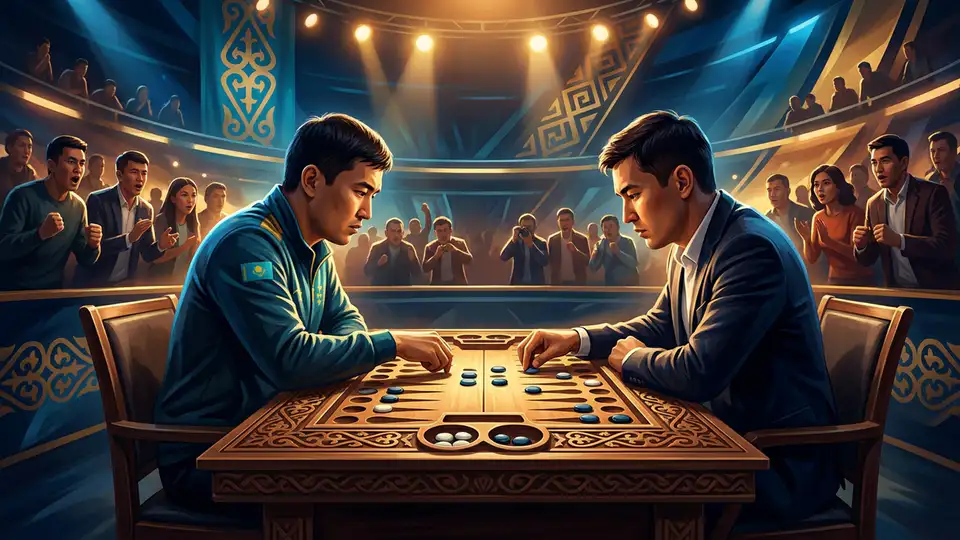
The current map has several centers of gravity: Kazakhstan and the World Togyzkumalak Federation, Kyrgyzstan and its Toguz Korgool school, Czechia as a European tournament hub, Latin America as a young expansion region, and digital platforms where players meet between physical events.
Use this article as a source map, not as an endorsement claim. For internal verification, compare the federation and source hub, the events hub, the rules wiki, and the English rules guide. After reading, move from institutions to practice through browser play or the AI Trainer.
Kazakhstan: a federation-led export model
Kazakhstan has the strongest institutional structure around the game. The national federation, the World Togyzkumalak Federation, and state-linked partners support international travel, junior competitions, world events, and training infrastructure. That combination turns heritage into a discipline with calendars, coaches, arbiters, and recognizable competitive pathways.
By 2026, the official World Togyzqumalaq Federation site presents the body as a global hub for laws, rankings, calendars, member federations, and championships. Its homepage claims 40+ member nations, five continents, 100K+ registered players, and seven world championships. Those figures should be read as the federation's own public statement rather than an independent audit, but the directory and event list still show a real institutional scale.
The 2024 event in Cali, Colombia, shows how far that model now reaches. Kazpetrol Group reported that about 50 athletes from Colombia, Brazil, Mexico, Ecuador, Argentina, Chile, Guatemala, Panama, Venezuela, and Kazakhstan competed there from November 22 to 30. On November 24, the Federation of Toguzkumalak for Latin America was established in Cali, with Oscar Fajardo elected president and German Gonzalez general secretary.
Kyrgyzstan: Toguz Korgool as a national school
The Kyrgyz line is just as important. The Toguz Korgool site notes that the Kyrgyz federation was founded in 1993, soon after independence, and that the game is treated as a national sport. It also describes a formal hierarchy of player degrees, including Master of Sports of the Kyrgyz Republic and Master of Sports of International Class.
Kyrgyzstan brings a strong cultural argument too. The game is tied to the epic Manas in public explanations, and its digital history includes a 1999 computer version by Kubat Kartanbaev with support from the Toktom information center. For a mind sport, that was not cosmetic: software helped move learning beyond a small circle of clubs.
Czechia: the European festival hub
Mankala.cz, the Czech federation of mancala games, plays a different role. It is not a historical owner of Togyz Kumalak, but it has become a neutral European meeting point for several mancala disciplines. Through events around Czech Open in Pardubice, players can encounter Togyz Kumalak, Oware, Mangala, and Bestemshe in the same environment.
That festival model matters. A player from Poland, Germany, or Czechia may come for one game and discover the neighboring games of the same family. Togyz Kumalak then stops being only a national cultural marker and becomes part of a wider abstract-games scene.
UNESCO and the digital layer
In 2020, UNESCO inscribed Togyzqumalaq, Toguz Korgool, and Mangala/Göçürme on the Representative List of the Intangible Cultural Heritage of Humanity. The UNESCO description highlights informal and formal education, cognitive and motor skills, and mobile applications as a new way to transmit the practice among younger players.
That blend of culture and technology is visible on PlayStrategy. The platform added Togyzkumalak in February 2023 and later expanded the mancala group with Bestemshe. A player can read the complete Togyz Kumalak rules, play online, and compare how different schools approach the same sowing logic.
The Mind Sports Olympiad layer on PlayStrategy is another useful signal. The MSO GP 2026 schedule includes a rated Swiss Togyzqumalaq event with a 7+2 time control. It is a small but telling detail: the game appears not only in ethnosport festivals, but also in the wider mind-sports calendar beside Oware, go, draughts, and chess variants.
Organizations active around the game
| Organization | Role | What it gives the game |
|---|---|---|
| World Togyzkumalak Federation | International governance | World events, rule continuity, geographic expansion |
| Kyrgyz Toguz Korgool Federation | National school | Player titles, events, cultural legitimacy |
| Mankala.cz | European tournament hub | Czech Open presence and cross-mancala exposure |
| Latin American federation project | New regional network | Cali as a starting point outside Eurasia |
| PlayStrategy and PlayOK | Digital practice | Online games, ratings, tournaments, analysis |
What should not be exaggerated
The institutional picture is strong, but uneven. Kazakhstan and Kyrgyzstan have established schools, coaches, and official recognition; Latin America is promising but still young. It would be premature to describe every listed country as having a full league system.
The same caution applies to the World Mancala Games Federation. Its site describes an umbrella platform for mancala games, federations, players, and cultures, but public evidence currently supports treating WMGF as a new object to watch rather than as a body with the proven weight of the WTF or The Oware Society.
The strength of the game today lies in the mix: epic tradition, wooden boards, sports federations, online play, and analysis engines are no longer separate worlds. Together they form a modern survival system for an old intelligence game.
Sources
- UNESCO ICH: Togyzqumalaq, Toguz Korgool, Mangala/Göçürme
- World Togyzqumalaq Federation: official website
- Kazpetrol Group: International tournament of Toguzkumalak in Cali
- Toguz Korgool: Game Guide
- Mankala.cz: Czech federation of mancala games
- PlayStrategy changelog
- PlayStrategy: Mind Sports Olympiad tournaments
- World Mancala Games Federation