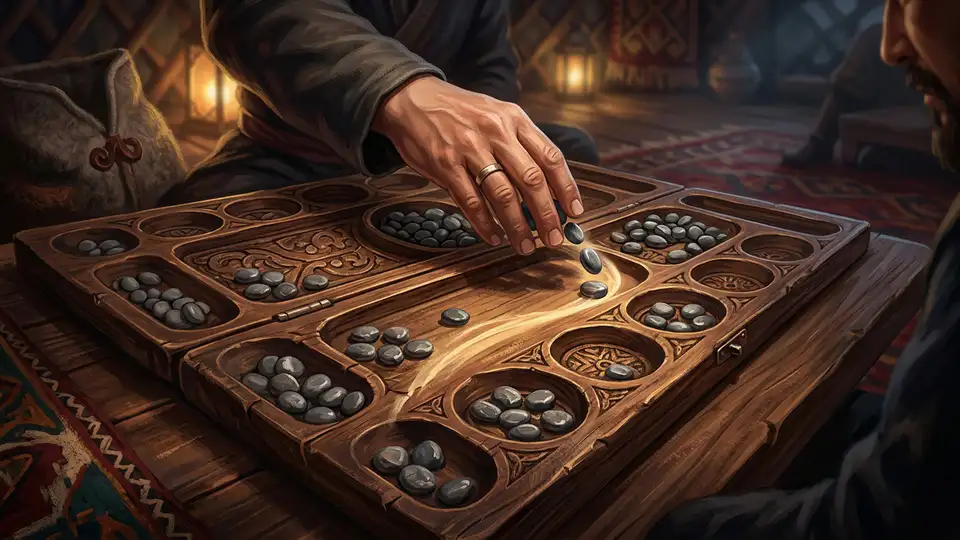
For players, this is the practical question: if you already know Oware, Mangala, Kalah, Bao or another mancala game, what must you relearn before playing Togyz Kumalak well? The answer is mostly counting depth, parity, and the tuzdik rule.
Use this article as a comparison map, not a single-origin or single-rules claim. For rule checking, keep the knowledge base, source hub and event pages close; for practice, move from the comparison to online play or the AI Trainer only after you know which rule set you are studying.
Comparison table: what changes from game to game
| Feature | Togyz Kumalak | Oware | Mangala | Bao |
|---|---|---|---|---|
| Family | Mancala-family Central Asian strategy game. | Mancala-family game widely played in West Africa and the Caribbean. | Turkish intellectual-strategy game in the same UNESCO heritage file as Togyz/Toguz. | East African four-row mancala tradition. |
| Common board shape | 2 rows x 9 holes. | 2 rows x 6 houses. | 2 rows x 6 small pits plus storage pits. | 4 rows x 8 pits in common descriptions. |
| Starting material | 162 stones, 9 in each hole. | 48 seeds, 4 in each house. | 48 stones, 4 in each small pit. | Often 64 counters, with staged setup in Bao la Kiswahili. |
| Core capture idea | Last stone lands on opponent side and makes the hole even. | Last seed makes an opponent house contain exactly 2 or 3 seeds. | Players race to collect more stones in storage. | Relay sowing and captures can continue inside a turn. |
| Signature feature | Tuzdik: one claimed opponent hole, with strict limits. | Feeding rule: if possible, give seeds to an empty opponent side. | Smaller board and store scoring make the game more immediately readable. | Named special pits and phase structure create a steep learning curve. |
Togyz Kumalak: the long-counting member of the family
PlayStrategy describes the modern Kazakh rules clearly: the game starts with nine stones in each hole, there are 162 stones total, and 82 captured stones are enough to win. The game can also end 81-81. This large starting count changes the rhythm. A player cannot evaluate only the next capture. They must estimate how stones will circulate after several moves and how a future tuzdik might redirect the whole position.
The sowing rule also forces precision. On a turn, a player takes stones from one of their holes and distributes them anticlockwise. If the hole had one stone, that stone goes into the next hole; otherwise, the first stone is dropped into the hole just emptied. Captures happen only if the last stone lands in an opponent hole and makes the count even. That is why a one-stone miscount is not small. It can turn a winning capture into a quiet move or hand the opponent a target.
The tuzdik difference
Many mancala games have captures. Togyz Kumalak adds something more durable: the tuzdik. If the last stone lands in an opponent hole and makes exactly three stones, the player may be able to mark that hole as a tuzdik. But there are limits. Each player may create only one tuzdik, the opponent's ninth hole cannot be used, and the symmetrical hole to the opponent's tuzdik is forbidden.
This creates a positional layer that Oware and Mangala players must consciously learn. A tuzdik is not just a single capture. Every later stone that falls there belongs to the tuzdik owner. That affects route choice, hole protection, endgame counting and tempo. Strong Togyz players often evaluate a move by asking: does this capture improve my future routes, or does it help the opponent build a stronger tuzdik plan?
Oware vs Togyz Kumalak
Oware and Togyz Kumalak are both calculation games, but they reward different targets. In Oware, PlayStrategy describes captures based on making an opponent house contain exactly two or three seeds. The board starts with 48 seeds, and 25 captured seeds are enough to win. If a player's side is empty, the opponent must feed seeds back when possible.
For a Togyz player, Oware feels compact. The board is shorter, and the capture target is exact rather than even. For an Oware player entering Togyz, the biggest adjustment is scale. With nine holes per side and 162 stones, the end of a sowing route often lands much farther than intuition expects. The second adjustment is that even-count capture creates a parity game: odd and even counts become tactical signals on almost every move.
Mangala vs Togyz Kumalak
World Nomad Games describes Mangala as a Turkish intellectual-strategy game for two players, with two rows of six small pits and storage pits. It starts with 48 stones, four in each small pit, and the goal is to collect more stones in the player's storage pit. UNESCO links Mangala/Gocurme with Togyzqumalaq and Toguz Korgool as a shared intangible-heritage element across Turkiye, Kazakhstan and Kyrgyzstan.
That shared heritage does not mean identical play. Mangala is shorter and more store-focused. Togyz Kumalak is longer and more positional. A Mangala player may already understand sowing rhythm, but Togyz adds a larger board, longer tactical routes, the 82-stone winning target and tuzdik restrictions. In practice, Mangala gives a good entry point, while Togyz demands more endgame patience.
Bao and Kalah: useful reference points, not direct substitutes
Bao and Kalah often appear in English-language mancala searches, so they are useful for reader orientation. Bao is usually associated with East African four-row boards, relay sowing, named special pits and a staged learning curve. Kalah is a widely taught store-based two-row game in many English-speaking contexts. Both help show the range of the mancala family.
Still, they are not direct substitutes for Togyz Kumalak. Bao's depth comes from relay sowing and multi-stage local rules. Kalah's familiarity often comes from simplified store mechanics. Togyz depth comes from long anticlockwise routes, even-count capture, high stone count and tuzdik pressure. A comparison should help readers transfer skills, not imply the games are interchangeable.
What skills transfer between mancala games
Several skills transfer well. First, count the final landing point before judging a move. Second, think about what the opponent can do after your sowing changes the board. Third, avoid moves that win small material while exposing a larger target. Fourth, compare tempo with structure: sometimes the best move is not the largest immediate capture, but the one that leaves the opponent without a clean reply.
Several skills do not transfer automatically. In Togyz Kumalak, parity is central because even-count capture defines the tactics. Tuzdik planning also has no simple equivalent in many other mancala games. A player coming from Oware or Mangala should build a new habit: before every capture, check whether the move creates, prevents or loses a tuzdik possibility.
Where to go next
If you want the broad family route first, start with the Mancala rules family guide and the online mancala guide. If you want one variant at a time, compare Oware, Mangala, Bestemshe, Bao and Kalah before returning to Toguz Korgool and Togyz Kumalak.
How to study the comparison on Toguz Arena
The fastest practical method is to review your own games by category. In the AI Trainer, mark mistakes as counting errors, parity errors, tuzdik errors or endgame errors. Counting errors mean the last stone did not land where you expected. Parity errors mean you left an even-capture route for the opponent. Tuzdik errors mean you treated a permanent pit as a short-term trick. Endgame errors mean the score target and remaining stones were misjudged.
This is where Togyz Kumalak separates itself from a casual "mancala" label. The family explains the movement. The game itself rewards the player who understands how that movement becomes long-term position.
Sources and comparison limits
This comparison uses public rules sources and related Toguz Arena explainers as orientation. It does not claim that the mancala family has one official authority, one origin story or interchangeable rules across variants.
- PlayStrategy Togyzqumalaq rules for board size, stone count, captures and tuzdik restrictions.
- PlayStrategy Oware rules for Oware board size, capture targets and feeding context.
- UNESCO Intangible Cultural Heritage listing for the Togyzqumalaq/Toguz Korgool/Mangala heritage context.
- World Nomad Games: Mangala and World Nomad Games: Toguz Korgool for event-facing variant descriptions.