Congklak: Indonesian and Malay-World Mancala Rules
Congklak is associated with Indonesia, Malaysia, Singapore, Brunei and nearby island cultures. Names vary by region: Dakon or Dhakon in Java, Congkak in Malaysia and Singapore, and Sungka in the Philippines. Public summaries and museum-style descriptions often agree on the broad idea - pick up seeds or shells, sow them around the board, and collect pieces in a store - but local rules can differ.
Board and setup
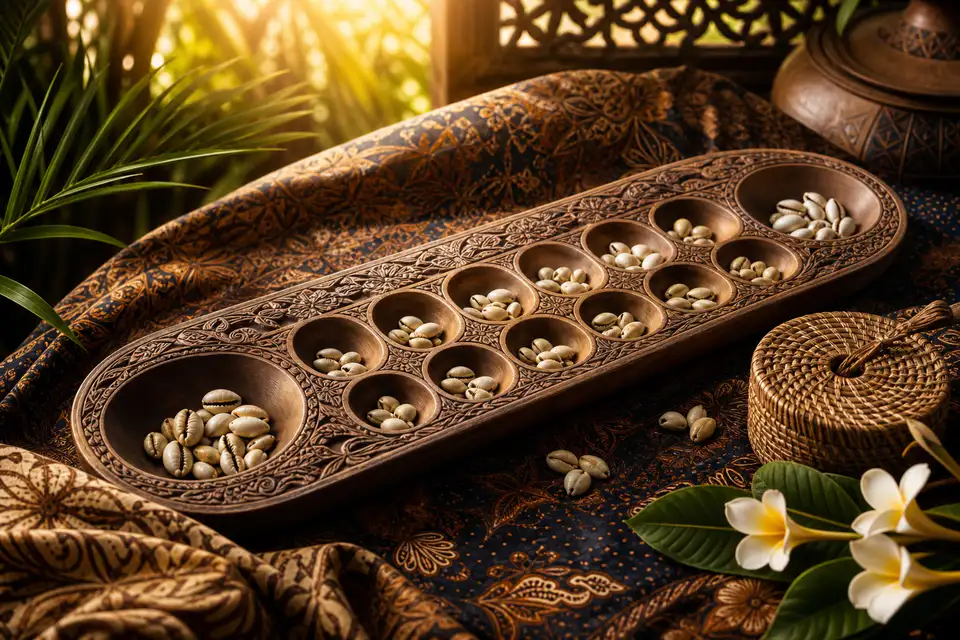
The common modern description uses two rows of seven pits and one store for each player, with seven seeds or shells in every small pit. That gives a 2x7 board and 98 playing pieces. Some related regional games use different pit counts, so a player should always confirm the local rules before comparing a position to Kalah, Oware or Togyz Kumalak.
How to play
A player picks up all pieces from one pit and sows them one by one around the board. Many Congklak/Congkak descriptions sow clockwise and include a store-turn rule: landing the final piece in your own store grants another move. Captures usually involve ending in an empty pit on your own side and taking pieces from the opposite pit, but exact conditions can vary by local rule set.
Congklak vs Kalah
- Board shape: Congklak is often associated with long carved boards; Kalah is commonly sold as a simpler mancala board.
- Starting count: Congklak summaries often use seven pieces per pit; Kalah commonly uses four or six, depending on house rules.
- Sowing direction: Congklak/Congkak is often described as clockwise; Kalah descriptions often use the opposite direction.
- Strategy transfer: counting, store timing and capture awareness transfer; exact opening patterns do not.
Cultural context without overclaiming
Congklak matters because it shows how widely the mancala idea adapted across Southeast Asia. The safest claims are modest: it is a well-known traditional game in the Malay world; it has regional names and rule variants; boards and pieces can carry local craft traditions; and related games such as Sungka are discussed in scholarship on cultural contact in Southeast Asia.
Stronger statements need direct local evidence. For example, a page should not turn regional school use, population size, festival anecdotes or one ritual explanation into a universal fact unless the page cites a current primary or scholarly source for that exact claim.
Regional names and variations
Useful comparison names include Congklak, Congkak, Dakon, Dhakon, Sungka and Pallanguzhi. Those names are not interchangeable in every context. A rules page should tell readers which local rules it is using, because pit count, capture details and opening setup may differ.
For a broader variant map, see our Sungka, Congklak and Pallanguzhi comparison and the complete Mancala rules family guide.
Why Congklak matters for Mancala players
Congklak is useful for players because it changes the counting environment. A familiar Kalah player must re-check direction, pit count, store timing and capture conditions. That makes Congklak a good comparison game for understanding what is universal in mancala strategy and what is only true inside one variant.
For Toguz Arena, the product takeaway is honest: Congklak itself is not currently listed as a playable variant on the platform. The closest practice path is to train the broader mancala skills on supported variants, then compare those habits against Congklak rules from a dedicated local source.
Sources and fact-check notes
- Philippine Sungka and cultural contact in Southeast Asia - useful scholarly context for the regional Sungka/Congklak family.
- Congkak overview - a general orientation source; verify local details before using it as authority.
- Toguz Arena: Sungka, Congklak and Pallanguzhi - internal variant comparison.
- Toguz Arena source hub - broader official-source links for Togyz Kumalak, Toguz Korgool and UNESCO-listed mancala traditions.
Frequently Asked Questions
Is Congklak the same as Mancala?
Congklak is a Southeast Asian member of the mancala family. It shares the sowing idea with Kalah, Oware and Togyz Kumalak, but local board size, direction and capture rules can differ.
How many pieces are used for Congklak?
A common description uses seven pits per side with seven pieces in each pit, for 98 pieces total. Regional variants may use different pit counts.
What is the difference between Congklak and Sungka?
Sungka is the Philippine name for a related Southeast Asian mancala game. It is close enough for comparison, but a careful rules page should still specify the local rule set.
Can I play Congklak on Toguz Arena?
Not as a dedicated variant today. You can practice related mancala skills on supported Toguz Arena variants such as Kalah, Oware, Mangala, Bestemshe and Togyz Kumalak.