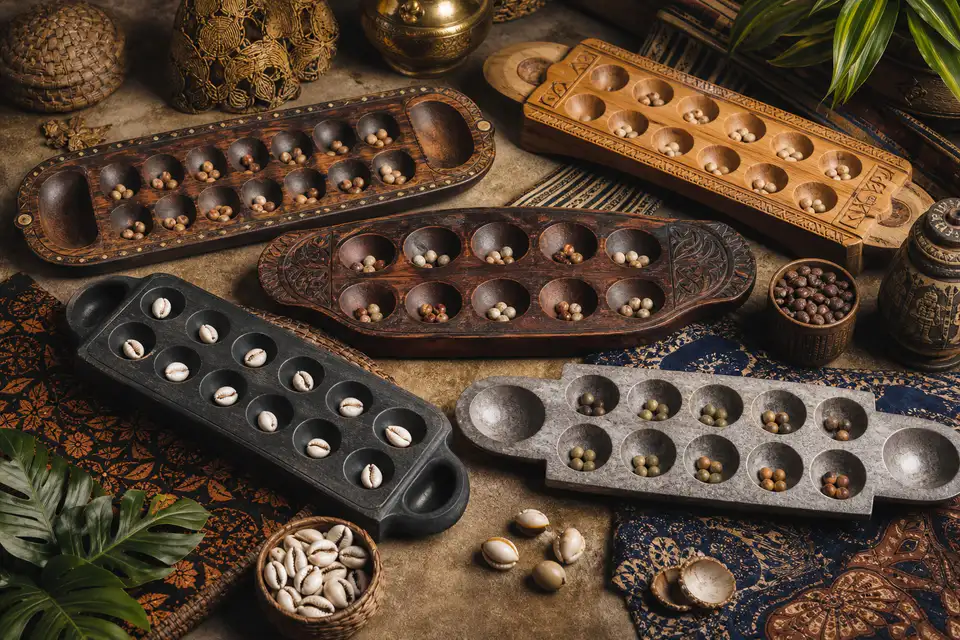
You know Kalah and Oware. Now meet related games from across the globe.
English-language mancala searches often collapse the whole family into Kalah, Oware and a few Central Asian variants. That is useful for beginners, but it hides how different the family can be. A 7x2 store game from the Philippines does not teach the same habits as a four-row East African relay-sowing game.
Variant taxonomy: what changes from game to game
Use this table as a first-pass map, not as a final rulebook. The same name can hide local rule differences, and the same board shape can produce very different tactics.
| Variant | Region / naming context | Common board pattern | What changes strategically | Toguz Arena support |
|---|---|---|---|---|
| Sungka | Philippines; related to Southeast Asian store games | Often 7x2 with stores | Store position, sowing direction and capture logic can differ from Kalah | Study-only context; use supported variants for practice |
| Congklak / Congkak / Dakon | Indonesia, Malaysia, Singapore and nearby traditions | Often 7x2 with stores, but local variants differ | Counting transfers; exact openings and capture timing do not | Study-only context; compare with Kalah and Oware |
| Pallanguzhi / Pallanguli | South India, especially Tamil and Kerala contexts | Usually 2x7 with seeds or shells | Local store/capture customs need exact sourcing before deeper claims | Study-only context; cite local sources before publishing a full guide |
| Bao | East Africa and the Swahili coast | Four-row board in public Bao summaries | Relay sowing, staged play and named pits create a different learning load | Study-only context; Bao guide explains source limits |
Sungka (Philippines): the variant that reverses everything
Sungka is played on a 7x2 board (14 pits + 2 stores) with 98 shells or seeds — usually cowrie shells, which are traditional in Filipino culture. The defining difference from Kalah: stores are called "ulo" (head) and placed at the left end for each player, not the right. Sowing direction varies by region — some play clockwise, others counter-clockwise. The capture rule is also inverted: you capture when your last seed lands in your OWN empty pit, taking the contents from the opponent's opposite pit.
Sungka is strongly associated with Filipino family and community play, but local customs should be cited carefully. For Western Kalah players, the important rule lesson is simpler: store position, sowing direction and capture logic can change enough that a familiar-looking board becomes a new game.
Congklak (Indonesia/Malaysia): the boat-shaped board with dragon heads
Congklak boards are unmistakable: carved from a single piece of mahogany or teak into the shape of a boat, often with dragon-head finials at each end. The board typically has 7 pits per side (sometimes 5, 9, or more). The game uses cowrie shells, tamarind seeds, or small stones. Like Sungka, Congklak sows clockwise, opposite to the Western Kalah convention.
Congklak, Congkak, Dakon and related names can refer to overlapping but locally distinct traditions. Some cultural descriptions connect the game with family gatherings and regional ceremonies, but a rules guide should not flatten Indonesia, Malaysia and Java into one universal custom. Treat this section as a map of names and boards, then verify local detail before publishing deeper history.
Pallanguzhi (South India): social and educational play
Pallanguzhi (also spelled Pallanguli) is played primarily by women in Tamil Nadu and Kerala on a 2x7 board with tamarind seeds or cowrie shells. The name means "many holes" in Tamil (pallam = many, kuzhi = hole). Unlike most mancala games, Pallanguzhi uses a "prize seed" system: each player starts with a set number of seeds in their store, and captured seeds are added to this prize pool rather than returned to the board.
Pallanguzhi is often described as a social and educational game in South India. Stronger claims about medicine, ritual transmission or encoded knowledge need direct scholarly sources before they appear as fact. For a player comparing rules, the safest practical takeaway is board shape, materials, sowing rhythm and how captures or stores differ from Kalah-like play.
Bao (East Africa): the four-row relay-sowing branch
Bao is the variant in this list where a Kalah player usually feels the biggest rules shock. Public summaries describe four rows, a special nyumba pit, namua and mtaji phases, and relay sowing. That is enough to explain why Bao is demanding without turning the page into an unsupported "hardest game" ranking.
Bao is associated with Tanzania, Zanzibar, Kenya and the Swahili coast in public summaries. Local terms and competition scenes deserve their own cited article, because they can differ by place and source. For this overview, the key comparison is rule architecture: four rows, staged play and multilap sowing demand a different kind of memory than the two-row variants.
On Toguz Arena, use supported variants such as Kalah, Oware, Mangala, Bestemshe and Togyz Kumalak for practical browser play. Sungka, Congklak, Pallanguzhi and Bao are not currently platform variants; this page exists to help readers understand the wider family without implying product availability.
Sources and fact-check notes
This overview intentionally avoids exact variant counts, popularity numbers and superlative difficulty claims unless a source is attached. Use the links below to verify the rule family before turning a short overview into a deeper cultural article.
- Philippine Sungka and Cultural Contact in Southeast Asia - scholarly source for Sungka history and dispersal.
- Bao overview and references - general Bao context and bibliography.
- The Game Cabinet: Bao rules summary - practical rule outline for the Zanzibar version.
- Bao rules and context guide - the dedicated Toguz Arena overview with source notes.
- Complete Mancala family rules guide - safe comparison across supported Toguz Arena variants.
Frequently Asked Questions
How many mancala variants exist worldwide?
There are many mancala variants across Africa, Asia, the Middle East and diaspora communities. Exact counts differ by source because researchers may count local names, rule families and related games differently. Use sourced numbers only when the source and counting method are clear.
Which mancala variant is the hardest to learn?
Bao is often difficult for Kalah players because of the four-row board, staged play and relay sowing. Togyz Kumalak is difficult in a different way: a 9x2 board, 162 stones, parity captures and tuzdyk pressure. Ranking one as the hardest is less useful than explaining what skill each game tests.