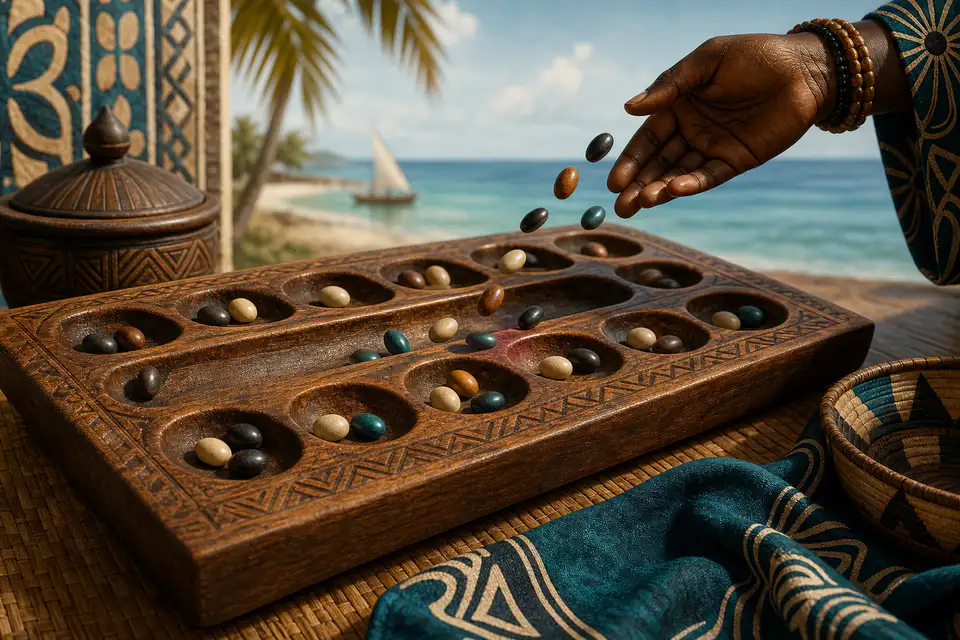
Bao: East Africa's Four-Row Mancala Tradition
Bao is usually discussed through its structure rather than through a single dramatic label. The important facts for a player are the 4x8 board, seeds held in hand during Bao la Kiswahili, the namua and mtaji phases, relay sowing, captures from the inner row and the special nyumba pit.
If you have mastered Kalah and Oware and are looking for a different kind of challenge, Bao is a useful next comparison point. It teaches a player that "mancala" is not one ruleset: a four-row relay-sowing game asks for a different memory habit than store-based Kalah or 9-pit Togyz Kumalak. For the closest playable comparison on this site, read Oware vs Bao before opening the Oware board.
Board and setup
Bao uses a 4×8 board — four rows of eight pits. Each player controls the two rows closest to them (a front row and a back row). Each pit starts with 2 seeds. The board also has two square "houses" at the center of each player's front row that function differently depending on the game phase.
Many summaries describe a 64-seed board, but setup depends on the version. In Bao la Kiswahili, some seeds begin in reserve and enter the board during the opening phase. In beginner versions, the board may start with seeds already placed. Always check the exact rule set before copying a setup diagram.
Two-phase game: Namua and Mtaji
Bao is played in two distinct phases:
Phase 1 — Namua (opening): In Bao la Kiswahili, players introduce seeds from their reserve into the board. The exact legal choices depend on the rule summary being used, so this guide treats namua as the setup-and-entry phase rather than a full tournament manual.
Phase 2 — Mtaji (main game): Once reserve seeds are exhausted, Bao enters the main phase. Relay sowing can continue through several pickups, and captures depend on where the last seed lands. This is the part that makes Bao feel very different from single-sow games such as Kalah.
Captures occur when the last seed lands in a front-row pit opposite an occupied opponent's front-row pit. The captured seeds are removed from play.
Why Bao feels different from other mancala games
- Sowing chains: A single turn can involve dozens of individual sow-and-pickup actions. Counting these chains mentally is a significant cognitive load.
- Two phases: The namua placement phase has no equivalent in Kalah or Oware. You must plan your endgame arrangement while still placing seeds.
- 4-row board: Front and back rows interact. Seeds in the back row are safe from capture but must be moved forward to become useful.
- Local rule precision: Terms such as nyumba, namua, mtaji and takata matter. A casual rules summary can miss details that change legal play.
Cultural significance
Bao is strongly associated with the Swahili coast and wider East African mancala traditions. Public summaries often mention Tanzania, Zanzibar and Kenya, and some describe experienced players with terms such as fundi or master. These details are useful for context, but they should not be turned into unsupported claims about every community or every tournament.
The safer way to explain Bao's cultural weight is to separate three layers: rule structure, regional play culture and historical scholarship. Rules can be checked against rule summaries. Regional play culture should be tied to local sources. Historical claims need more caution because traditional wooden boards and oral transmission leave uneven records.
That source discipline matters for Toguz Arena because readers arrive from many game traditions. A player looking for Bao should not be handed folklore as if it were a rulebook. A player looking for Togyz Kumalak should not assume that Bao, Kalah, Oware and Mangala are interchangeable just because all belong to the mancala family.
Bao vs other mancala variants
| Feature | Bao | Kalah | Togyz Kumalak |
|---|---|---|---|
| Board | 4×8 (32 pits) | 6×2 + stores | 9×2 + kazans |
| Seeds | 64 | 48 | 162 |
| Sowing style | Chain (relay sowing) | Single sow per turn | Single sow per turn |
| Game phases | 2 (namua + mtaji) | 1 | 1 |
| Main learning load | Relay sowing, phases, local terms | Stores, bonus turns | Parity, tuzdyk, long routes |
| Region | East Africa | Global (invented USA) | Central Asia |
Sources and fact-check notes
This page is a player orientation guide, not an official Bao rulebook. For exact play, verify the version being used: Bao la Kiswahili, Bao la kujifunza, Zanzibar rules and other local summaries can differ.
- Bao overview and references - general context, terminology and bibliography.
- The Game Cabinet: Bao rules summary - practical rule outline for the Zanzibar version.
- Mancala family rules guide - safe comparison across Kalah, Oware, Mangala, Togyz Kumalak and Bestemshe.
- Togyz Kumalak vs other mancala games - transfer and non-transfer notes between variants.
- Toguz Arena source hub - federation and UNESCO context for the Central Asian/Turkish branch, without claiming Bao endorsement.
Frequently Asked Questions
Is Bao the hardest mancala game?
Bao is often described as a demanding mancala game because it uses a four-row board, staged play and relay sowing. Calling it the single hardest variant is an opinion unless the article defines the metric and cites a source.
Where is Bao played?
Public summaries most often associate Bao with Tanzania, Zanzibar, Kenya and the Swahili coast, with related games across East Africa. Local names, rules and tournament structures can vary by community.
How long does a Bao game take?
Bao can take longer than simple Kalah-style games because relay sowing and staged play increase the number of decisions in a turn. Exact duration depends on rule version, time control and player strength.
Is Bao available on Toguz Arena?
Not yet. Toguz Arena currently focuses on supported mancala-family variants such as Kalah, Oware, Mangala, Togyz Kumalak and Bestemshe. Bao should be studied as its own four-row ruleset.
What does "Bao" mean?
"Bao" is commonly translated as Swahili for "board" or "board game." The name Bao la Kiswahili is usually explained as the Swahili board game.
Explore the mancala family one ruleset at a time: start with Kalah, compare it with Oware, study Togyz Kumalak, and keep Bao separate until you are ready for its own four-row logic.