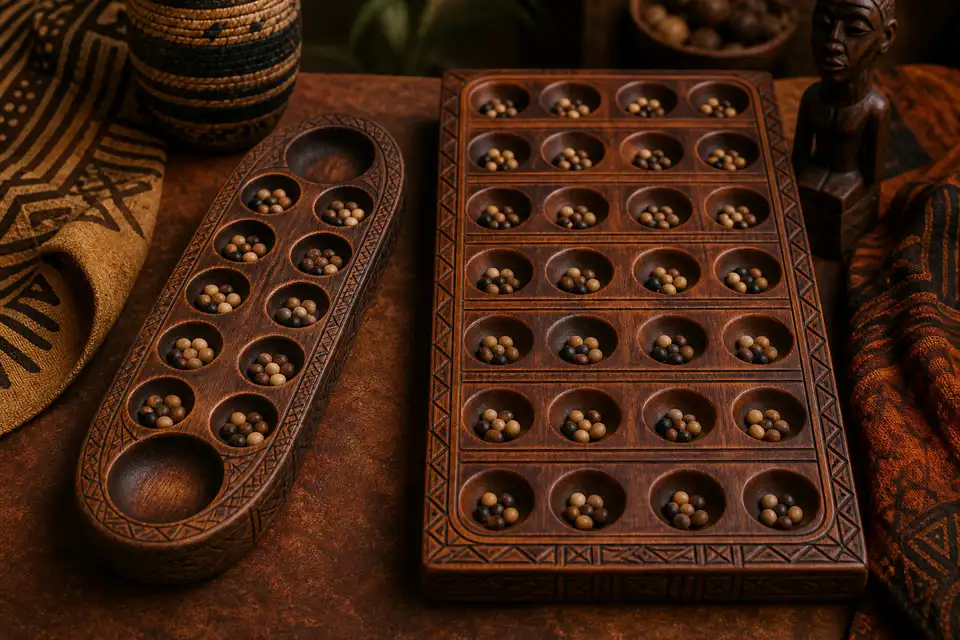
Oware vs Bao: same family, different mental rhythm
That difference matters for a reader who arrives from Kalah or Togyz Kumalak and sees the word "mancala" everywhere. A family name is not a rulebook. Oware can be learned through short practice games on the Oware board on Toguz Arena; Bao is better treated as a study comparison until you are ready for a dedicated four-row rule source.
Reader shortcut: choose Oware if you want a playable capture-and-feeding game now. Study Bao if you want to understand how far the mancala family can stretch into relay sowing, front/back rows and multi-phase planning.
Board shape: two rows versus four rows
The first visible difference is the board. Oware Abapa is usually presented as two rows of six playing houses with four seeds in each house, for forty-eight seeds total. Side stores may exist on physical boards, but they are only scoring places; Oware sowing moves through the playing houses, not through a Kalah-style store.
Bao la Kiswahili is structurally larger. K.I.B.A.'s rules describe a board with thirty-two holes arranged in four rows: two rows belong to one player and two rows to the other. The two middle rows are front rows, the two outer rows are back rows, and detailed rule sets name special holes such as nyumba, kichwa and kimbi.
This changes how a position is read. In Oware, you usually scan twelve houses and ask where the last seed will land. In Bao, you read a front/back-row system where captures, continuation sowing and special holes can create a longer memory load before the turn is finished.
| Feature | Oware / Awale | Bao / Bao la Kiswahili |
|---|---|---|
| Typical board | 2 rows x 6 houses | 4 rows x 8 holes |
| Typical seed count | 48 seeds, four per house at start | 64 seeds in detailed Bao la Kiswahili sources |
| Main scoring idea | Capture opponent houses that become exactly two or three seeds | Capture from front-row relationships, then continue sowing captured seeds |
| Signature constraint | Feed the opponent when possible | Manage staged play, relay sowing and named special holes |
| Toguz Arena status | Playable practice variant | Study-only comparison topic for now |
Capture philosophy: restraint versus continuation
Oware's capture rule is clean enough to teach in one sentence: if your final seed lands in an opponent house and makes that house contain exactly two or three seeds, you capture it. Then you continue backward through adjacent opponent houses that also contain two or three seeds. The difficulty is not the wording; it is predicting the landing and respecting the feeding rule.
Bao's capture logic is more positional. K.I.B.A. describes capture as possible when sowing ends in a non-empty front-row hole that faces a non-empty opponent front-row hole. Captured seeds are then sown immediately on the player's side, and continuation can create a longer move. The player is not only asking, "what do I take?" but also, "what happens after the captured seeds are sown?"
For practical learning, this means Oware rewards clean target counting. Bao rewards chain memory. A beginner can make progress in Oware by counting the last seed aloud and checking twos/threes. A Bao learner must also track direction, front-row relations, special pits and whether the turn continues.
Feeding and starvation: the Oware moral pressure
The feeding rule is what makes Oware feel less greedy than it first appears. PlayStrategy states that if the opponent's houses are empty, the current player must make a move that gives the opponent seeds when possible. Auale makes the same idea practical: a move that would leave all opponent holes empty is not legal.
So the strongest-looking Oware capture can be the wrong move if it kills the board. The game keeps asking the player to leave the opponent with life. That is why Oware is useful training for restraint: you are not just collecting seeds; you are managing legal replies.
Bao has its own restrictions, but not the same beginner-facing feeding lesson. Its pressure comes from whether the move begins with capture, whether continuation is allowed or required, and how the front row, back row and nyumba interact. The moral shape is different: Oware asks whether the opponent can still play; Bao asks whether you still understand the turn you started.
Rule complexity: a ladder for learners
It is tempting to rank games by saying one is "harder." That is usually a bad shortcut. Harder by what metric: rules memory, tactical calculation, cultural variation, tournament depth, or beginner error rate? A safer comparison is a learning ladder.
Oware is not trivial, but its first playable rule set is compact. Learn sowing direction, final-seed capture, backward chains and feeding. Bao has more vocabulary and a larger state space at the rules level: front rows, back rows, nyumba, namua or kunamua, mtaji, compulsory captures and relay continuation.
| Learning rung | Oware task | Bao task |
|---|---|---|
| 1. Board scan | Count twelve playing houses | Identify four rows, player halves and front/back rows |
| 2. Legal move | Choose a non-empty house and sow counter-clockwise | Check phase, legal start hole and whether capture is compulsory |
| 3. Capture | Final seed creates opponent two or three | Front-row opposition and captured-seed sowing can extend the turn |
| 4. Special constraint | Feed the opponent if required | Track nyumba, kichwa/kimbi and continuation rules |
| 5. Practice goal | Predict the final landing pit before every move | Predict whether a capture or continuation sequence changes the whole row |
Cultural context without turning culture into folklore
Oware is associated with West Africa and the Caribbean under names such as Awale, Wari and Warri. Bao is associated with East Africa and the Swahili coast, especially in discussions of Bao la Kiswahili. Those statements are useful, but they should stay tied to sources and not become decorative folklore.
The editorial rule for Toguz Arena is simple: explain culture where it clarifies the game, but do not invent authority. A player comparing Oware and Bao needs to know that the two games come from different regional traditions and rule histories. They do not need fake tournament numbers, decorative prestige labels, or a promise that one page represents every local rule.
That restraint also helps search quality. A comparison page can be authoritative because it says what it knows, what it does not know, and where the reader should go next. Bao especially deserves that treatment because public summaries warn that local versions and transcriptions can differ.
Where Toguz Arena fits
Toguz Arena supports Oware practice. That means you can read the Oware rules, open a board, play against a bot or another player, and return to the article with a real position in mind. For Oware, the comparison can move directly from reading to practice.
Bao is different. Bao is not currently a Toguz Arena playable variant, so this page must not send readers to a fake Bao product route. The useful role of Bao here is semantic and educational: it shows that the mancala family includes four-row relay-sowing games, not only two-row store or capture games.
If you want the closest playable next step on Toguz Arena, use Oware for feeding and capture restraint, Kalah for store and bonus-turn tempo, Mangala for Turkish treasury/capture timing, and Bestemshe for compact classroom-style counting. Keep Bao as a separate study article until the product actually supports it.
How to practice the comparison
Do not try to learn both games by memorizing every rule term at once. Start with the decision that changes the player's hand. In Oware, the hand changes because the final seed may capture twos and threes, but only if the opponent can still continue. In Bao, the hand changes because a capture or continuation can turn one move into a sequence.
- Play three slow Oware games. Before each move, say the final landing house and whether it creates two or three seeds.
- Read the Bao board section once. Do not play from memory yet; identify front rows, back rows and nyumba first.
- Compare one position habit. Oware asks "can I feed after capture?" Bao asks "does this sowing continue?"
- Return to the family guide. Use the Mancala family rules guide to prevent rule leakage between variants.
- Pick one playable training path. If you want board reps today, use Oware rather than looking for a Bao route that does not exist on Toguz Arena.
Experienced players will notice the deeper point: both games punish lazy counting, but they punish it differently. In Oware, lazy counting misses a capture or starves the opponent. In Bao, lazy counting loses the thread of a relay turn. That difference is the whole reason the comparison is worth reading.
Sources and fact-check notes
This article uses public rules references and existing Toguz Arena source-backed pages. Oware facts are checked against PlayStrategy's Oware rules, Auale's Oware guide, the existing Oware rules page, and the older Oware Society Abapa rules.
Bao facts are checked against K.I.B.A.'s Bao rules, the Bao overview and bibliography, The Game Cabinet's Bao summary, and Toguz Arena's Bao orientation page. When these sources differ in detail, the article keeps the claim broad instead of pretending every Bao version uses one universal rulebook.
For broader context, use Kalah vs Oware, Kalah vs Mangala, the complete Mancala rules guide, and the Toguz Arena source hub. Toguz Arena is a playable training platform and source router, not a Bao governing body.
Frequently asked questions
Is Bao harder than Oware?
Bao usually has a heavier rules load because of its four-row board, staged play, special holes and relay sowing. Oware is easier to start, but its feeding and capture timing still create deep strategy. Calling Bao the hardest mancala game requires a defined metric and source.
Can I play Bao on Toguz Arena?
No. Toguz Arena supports Oware practice and other playable mancala-family games, but Bao is currently an informational comparison topic on the site. Use the Bao article for study and the Oware board for actual online practice.
What is the biggest rules difference between Oware and Bao?
Oware is built around last-seed capture on opponent twos and threes, plus feeding the opponent. Bao is built around a four-row board, named special pits, phases such as namua and mtaji, and relay sowing that can make a turn continue.
Which should a beginner learn first?
Most beginners should learn Oware first if they want a playable online game with a compact rule set. Study Bao after you are comfortable with sowing, capture timing and the idea that mancala variants can have very different rule structures.