Why Kalah endings feel different from the opening
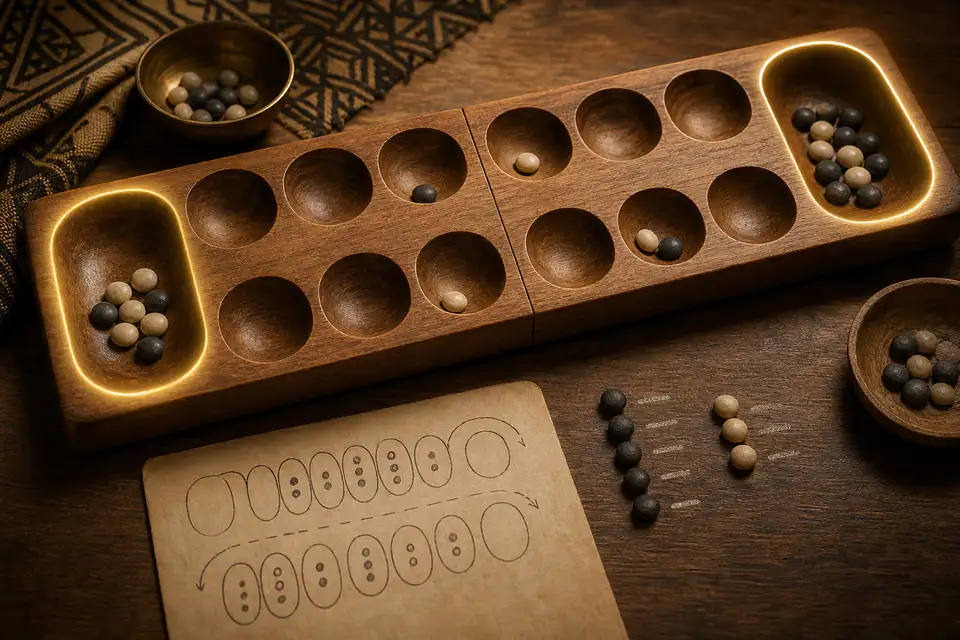
In the opening, a Kalah board looks generous. Every pit has seeds, bonus turns are visible, and capture threats take most of the attention. Near the end, the board becomes stricter. One move can remove the last seed from a side and trigger the final cleanup.
That is why late Kalah is less about decoration and more about arithmetic. Count your store, count the opponent's store, count the seeds left on both sides, and ask what the score becomes if the game ends now.
This page is not a solver and it does not promise a perfect move. It teaches the counting habit that keeps casual endgames honest. For the full move sequence, read the complete Kalah rules first.
The one rule that creates the endgame race
Under the common Kalah ending rule, the game ends when a move leaves one player's six small pits empty. The other player then moves the seeds remaining on their own side into their store. The larger store total wins.
That cleanup rule means a player can lose by ending the game too early. A move may score one seed now but hand the opponent six or seven leftover seeds. In another position, ending the game immediately is correct because the opponent's side has almost nothing to collect.
Use this mental formula before any late move: current stores, plus seeds scored by the move, plus the cleanup seeds for the side that still has material. If you cannot estimate that score, you are moving blind.
Notation for the worked states
The examples below use a simple training notation. Your six pits are `A1` to `A6`; the opponent's six pits are `B1` to `B6`. The exact physical direction is less important than the discipline: name the pit, count the seeds, then calculate the final score if a side empties.
Each worked state is an arithmetic scenario, not a claim that the named move is always the best legal move in every possible board orientation. The point is to show what you should count before committing to a race or a delay.
If the layout still feels abstract, keep the Kalah board-game rules open next to this page and set the seeds on a real or digital board.
When to race
Race when the cleanup helps you. If your store lead is already large and the opponent has only a few seeds left on their side, finishing the game can be the cleanest move. You do not need a dramatic capture if the arithmetic is already enough.
The danger is emotional play. Many players delay the finish because they want one more bonus turn or one more capture. If the score already wins after cleanup, the quiet finish is usually the professional-looking decision.
For club players, the practical question is simple: if my move ends the game, do I still win after the opponent collects their leftovers? If yes, racing is a candidate. If no, racing is probably a trap unless you have a stronger tactical reason.
When to starve the board, not the opponent
Kalah does not use the same feeding rule as Oware, so be careful with the word "starve." Here it means reducing useful late moves and avoiding unnecessary seeds on the opponent's side. It is a practical board-control idea, not a separate official rule.
Sometimes the best late move is not the fastest finish. You may need to keep your side from emptying until a capture square is safe, or avoid sowing one extra seed that gives the opponent a useful reply. The board can be low on seeds and still contain a tactical problem.
Do not turn this into a slogan. A permanent starving plan is just as weak as a permanent racing plan. Kalah endings are counted, not guessed. The correct plan is the one whose final store arithmetic survives the reply.
Three worked board states
Use these as practice positions. Put the numbers into the formula and say the final store score out loud. The habit matters more than memorizing the exact positions.
| State | Snapshot | Arithmetic | Lesson |
|---|---|---|---|
| Race is safe | Your store 26, opponent store 21. After your legal finishing move, your side is empty and the opponent has 3 seeds left on `B` pits. | Final score: you 26, opponent 21 + 3 = 24. | Ending now wins by 2. Do not delay just to look for a prettier capture. |
| Race is too early | Your store 23, opponent store 20. Your candidate move empties your side, but the opponent has 7 seeds left on their side. | Final score: you 23, opponent 20 + 7 = 27. | The move scores activity but loses the cleanup. Look for a delay, capture setup or bonus-turn alternative. |
| Low-board control | Your store 24, opponent store 24. Your side has 5 seeds total, opponent side has 1 seed total, and your move can avoid sowing extra seeds to `B` pits. | If the opponent side empties next and you collect your 5 remaining seeds, final score can become you 29, opponent 24. | Do not feed useful material to the opponent when their side is already nearly exhausted. |
The examples are intentionally small. Big endgames are just these same calculations repeated with more noise. If you can count three seeds correctly, you can count seven; you just need to slow down.
Common endgame mistakes
The first mistake is counting only your own store. A store lead feels safe until you remember that the opponent may collect all remaining seeds on their side. Always count cleanup seeds before celebrating.
The second mistake is chasing a capture after the race has already been decided. If a simple ending wins, the capture is optional. If the capture fails and gives the opponent a better finish, the "active" move was really a delay mistake.
The third mistake is importing Oware language too literally. Kalah has its own store race. If you switch between variants, use the universal mancala strategy guide for broad ideas, then return to Kalah-specific rules before making a final decision.
A slow endgame drill
Play one Kalah game and stop when either side has six or fewer seeds left outside the stores. Do not move immediately. Write down three numbers: your store, opponent store and total seeds on each side.
- Find one move that could finish the game soon.
- Calculate the final score if that move empties a side.
- Find one move that delays the finish.
- Ask whether the delay creates a real capture, bonus turn or defensive improvement.
- Choose the move only after the arithmetic and the reply both make sense.
After the game, review only the first endgame decision. Label it as race, delay, capture or counting error. One precise label is more useful than a long review that never changes your next game.
Where this fits in your Kalah learning path
If you are new, start with rules, then strategy, then endgame arithmetic. The Kalah strategy for beginners page covers bonus-turn tempo and capture setup. This article narrows the final phase.
If you want practice, use a normal link to the Kalah board on Toguz Arena and play slowly. This page does not embed a board because the goal is to keep the article crawlable and focused on the counting lesson.
Once the arithmetic feels natural, make the task harder. Try to predict not only the final cleanup, but also which player can force the board to that cleanup first.
Sources and fact-check notes
- Toguz Arena: Kalah rules complete - internal source-backed rules page for setup, move sequence, bonus turn, capture rule, ending rule and scoring caveats.
- Toguz Arena: Kalah strategy for beginners - companion strategy page for last-seed counting, bonus turns, capture setup and review habits.
- Toguz Arena: Kalah board-game rules - board-orientation companion for pits, stores and beginner practice context.
- Irving, Donkers and Uiterwijk: Solving Kalah - formal source already used by the Kalah rules page for rules notation and solved-game caveats.
Limit: the worked states above teach counting under the common Kalah ending rule. They are not engine lines, tournament rulings, or proof that one move is universally optimal.