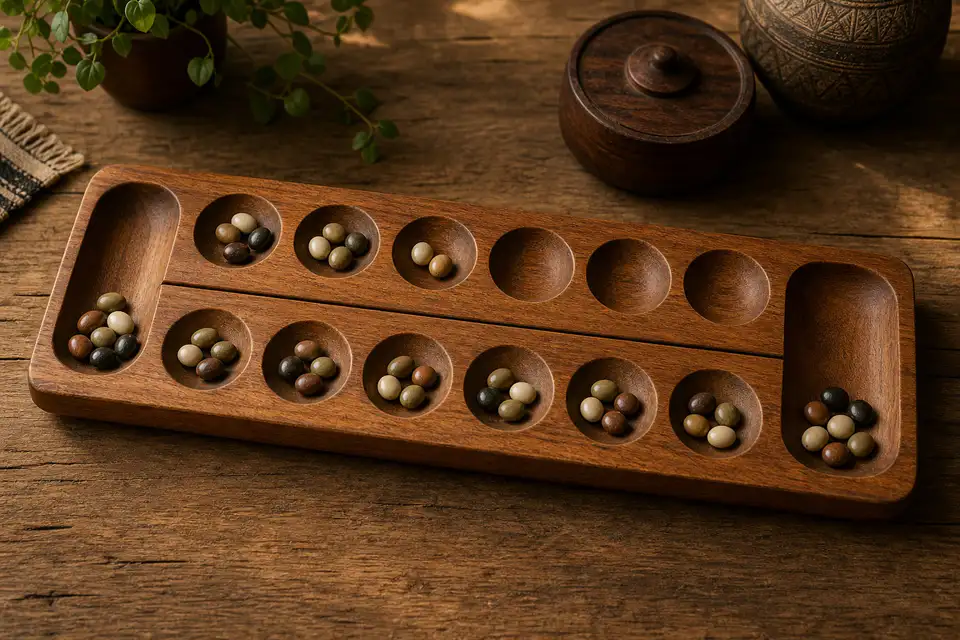
The board changes when the last seed falls
A quiet Kalah board can look like a row of identical pits. Then one move lands in the store, the same player moves again, and the position suddenly has a story. That is the first thing a beginner should learn: Kalah is not about moving the biggest pile. It is about predicting the final seed.
Before every move, count the route aloud or silently. Include your own store, skip the opponent's store, and name the landing pit before you lift the seeds. This small habit prevents most beginner errors because it turns a guess into a calculation.
Experienced players do not ask only, "How many seeds do I score now?" They ask, "What board do I leave after this move?" A capture that gives the opponent an easier capture can be worse than a quiet move that keeps your side flexible.
Beginner rule: if you cannot name the landing pit, you are not choosing a move yet; you are only hoping.
Principle 1: Treat bonus turns as tempo, not decoration
In Kalah, a move that lands its last seed in your store gives you another turn. That extra turn is the cleanest form of tempo in the game. It lets you score, change the board again, or stop an opponent's threat before they can use it.
But not every bonus turn is automatically best. A weak extra move can simply postpone a bad position. A strong extra move changes the position: it prepares a capture, empties a dangerous pit, or keeps your opponent from using a loaded pit on their next turn.
Look for bonus chains only after you know the follow-up. If the second move in the chain has no useful purpose, the first bonus may be smaller than a defensive move that blocks a large capture.
Principle 2: Build captures before chasing captures
The empty-pit capture rule makes Kalah feel tactical. If your last seed lands in an empty pit on your side and the opposite opponent pit contains seeds, you collect both your last seed and the opposite seeds into your store.
Beginners often wait until this capture is already visible. Stronger play is more patient. You can create an empty pit on your side, watch the opposite pit, and choose sowing routes that make the capture square matter on a later move.
Be careful with trap language. A capture setup is not a guaranteed combination. The opponent may empty the opposite pit, take tempo, or force an ending before your plan arrives. The practical skill is to build threats that also leave your board safe if the first idea is stopped.
| Kalah motif | What to check | Good beginner habit | Common mistake |
|---|---|---|---|
| Bonus turn | Does the last seed land in your store? | Check the follow-up move before choosing the bonus. | Taking an extra turn that has no useful second move. |
| Empty-pit capture | Does your last seed land in an empty pit on your side? | Watch the opposite pit and the opponent's next reply. | Capturing now while leaving a larger counter-capture. |
| Store race | Who benefits if one side empties soon? | Count stores and remaining seeds before the last moves. | Emptying your side without checking who collects leftovers. |
| Mobility | How many useful pits remain after your move? | Prefer positions with several playable threats. | Scoring a few seeds but leaving only one obvious move. |
Principle 3: Do not empty your side by accident
Kalah ends when a move leaves one player's side with no seeds. The other player then collects the remaining seeds on their side into their store. That rule makes the endgame a race, not just a clean-up phase.
Near the end, count three things: your store, the opponent's store, and the seeds that are likely to be collected when a side empties. A move that looks active can be bad if it ends the game at the wrong moment.
Pay special attention when your side has only two or three loaded pits. This is where automatic play fails. Slow down, count the landing pit, then ask whether the game is likely to finish before your capture plan matters.
A six-move practice drill for one slow game
Do not try to learn all Kalah strategy at once. One slow game with a written checklist teaches more than ten fast games where every mistake feels random. Use the first six serious decisions as a training drill.
- Move 1: name the landing pit before moving.
- Move 2: check whether a bonus turn has a useful follow-up.
- Move 3: mark one empty pit on your side as a possible future capture square.
- Move 4: ask what capture the opponent threatens next.
- Move 5: count whether your side can empty too soon.
- Move 6: write down the first mistake category: counting, tempo, capture or endgame.
Notice that this drill does not promise a win. It gives you a review language. If every lost game becomes "I miscounted the landing pit" or "I took a weak bonus turn", your next practice game has a clear focus.
On Toguz Arena, play Kalah slowly against the bot first, then replay the same habits against a human. Bot practice is useful for quiet counting; human games are useful because speed and pressure reveal which habits are not stable yet.
Opening habits that are safer than memorized first moves
Many players search for the best Kalah opening. That is understandable, but it can become a shortcut that hides the real lesson. A first move only matters because of the position it creates and the replies it allows.
For beginners, safer opening habits are more useful than a memorized line. Count store landings, avoid giving the opponent a clean empty-pit capture, and keep more than one playable pit on your side. If a move scores now but leaves only one useful reply later, it may be too narrow.
Formal Kalah research matters here, but it must be handled honestly. The paper Solving Kalah discusses solved configurations and reports a first-player result for the studied standard setup. That does not turn beginner play into a one-line recipe. Human games are still full of counting mistakes and timing errors.
How to review a lost Kalah game
The most useful review is short. Do not annotate every move unless you enjoy that work. Find the first moment where the board changed against you, then classify the error.
- Counting error: you misnamed the landing pit or forgot to skip the opponent's store.
- Tempo error: you took a bonus turn without a useful follow-up, or missed one that changed the board.
- Capture error: you created an empty pit but ignored the opposite pit or the reply.
- Endgame error: you emptied a side at the wrong time or missed who would collect the remaining seeds.
Once you have the label, stop. The goal is not to feel clever after the game. The goal is to carry one correction into the next game.
Look at one rule article and one strategy article, then return to the board. Read the complete Kalah rules if the move sequence is still unclear, or the Kalah board guide if the store and pit layout still feels awkward.
Where Kalah strategy stops being universal
Kalah belongs to the mancala family, but its strategy does not transfer perfectly to Oware, Mangala, Bestemshe or Togyz Kumalak. Kalah rewards store tempo and empty-pit captures. Oware rewards feeding-rule discipline. Turkish Mangala has its own treasury and capture rhythm.
That is why a good Kalah player should stay curious when switching games. If you carry Kalah habits into Oware, you may over-capture and forget feeding. If you carry them into Mangala, you may misread even-capture timing. If you carry them into Togyz Kumalak, you will need parity and tuzdyk counting, not store landings.
Use comparison pages as guardrails, not as excuses to avoid playing. Start with Kalah vs Oware and Kalah vs Mangala when the games start to blur together.
Practice Kalah on a real board, then make the game harder
Open the Kalah board on Toguz Arena when you can explain the four questions: where does the last seed land, is the bonus turn useful, is the capture safe, and who benefits if the side empties?
After five slow games, make the task narrower. Play one game where you care only about bonus turns. Play one game where you care only about empty-pit captures. Play one game where every move is checked against the ending rule. That kind of practice is less dramatic than a shortcut, but it builds skill you can actually keep.
Kalah rewards the player who sees one move beyond the shiny score. Count the landing seed, respect the reply, and let each finished game leave one clear lesson behind.
Sources and fact-check notes
- Toguz Arena: Kalah rules complete - source-backed internal rules page for board setup, move sequence, bonus turn, capture and endgame basics.
- Toguz Arena: Kalah board-game rules - companion board-orientation page for stores, pits and beginner practice context.
- Irving, Donkers and Uiterwijk: Solving Kalah - formal source for Kalah(m,n), studied configurations and solved-game caveats.
- US Patent 2,720,362 - William J. Champion patent record for the Kalah or Mop-up board/scoring apparatus.