Why the short board helps
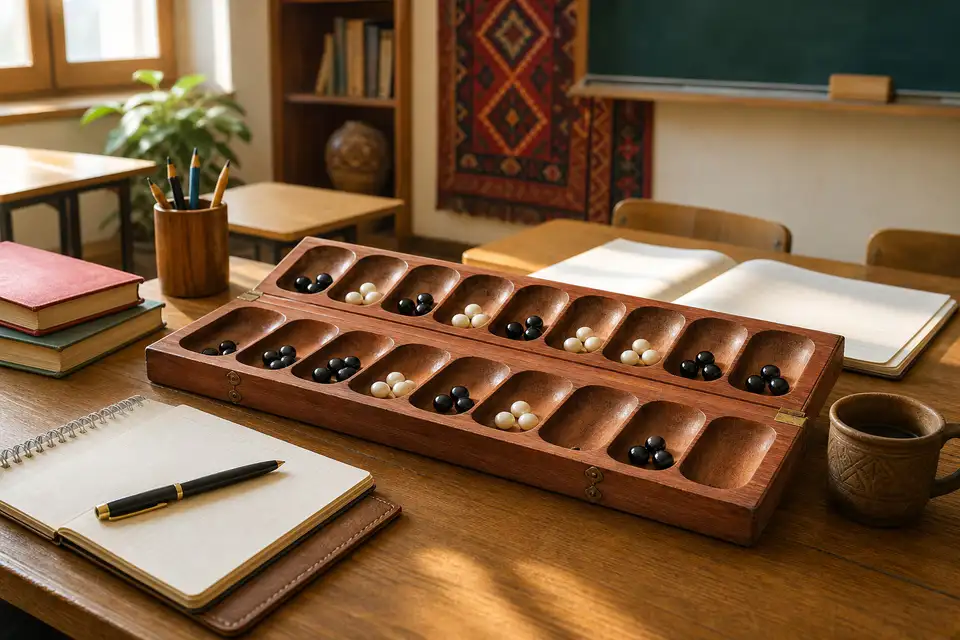
Bestemshe is useful in a classroom because the board is small enough for a teacher to hold the whole position in a single discussion. A full Togyz Kumalak lesson can become a memory exercise before students understand why a move matters. Bestemshe keeps the first task visible: pick a hole, sow the stones, and identify where the last stone lands.
PlayStrategy describes Bestemshe as a simplified Togyzqumalaq variant with five stones in each otau, 50 stones total, 26 stones needed to win, Togyzqumalaq-style movement and capture, and no tuzdiks. That is the core reason it fits a first classroom tactics lesson: the strategic idea is still real, but the board does not overload the room.
For teachers and parents, the safe claim is practical, not magical. Bestemshe can create counting practice, route prediction and move explanation. It should not be presented as a guaranteed math intervention. The result depends on how the lesson is run, how often students repeat the drill and how carefully the teacher slows down the first few moves.
For a first Bestemshe lesson, teach only four facts first: the board is 5x2, each hole starts with five stones, a move sows anti-clockwise, and a capture happens when the last stone makes an opponent hole even. Keep the no-tuzdik rule visible so learners do not import full Togyz Kumalak habits too early.
| Rule point | Bestemshe classroom version | What not to mix it with |
|---|---|---|
| Board size | Five otau / holes per player, ten playing holes total. | Full Togyz Kumalak uses a larger nine-hole-per-side map. |
| Starting material | Five stones in each hole, fifty stones total. | Oware commonly starts with four seeds per house and forty-eight total. |
| Capture trigger | The last stone must land on the opponent side and create an even count. | Kalah-style store captures and Oware two-or-three captures use different logic. |
| Special rule to suppress | No tuzdiks in this beginner classroom slice. | Do not teach full Togyz Kumalak tuzdik planning in the first Bestemshe drill. |
| Win target | Twenty-six captured stones is enough to win. | Do not present the lesson as a full tournament-rule certification. |
The first tactic: count the last stone before moving
The simplest Bestemshe tactic is also the one beginners skip. Before touching stones, point to the starting otau and trace the sowing route with a finger. Ask: where will the last stone land? That question turns the game from random seed movement into calculation.
Bestemshe rewards the player who can see the final landing hole before the move starts. If the last stone lands on the opponent's side and creates an even number of stones, the move can capture. If it lands elsewhere, the same move may simply change the next position. This is why a quiet counting question is tactical, not just arithmetic.
Classroom line: "Do not move yet. Show me the last stone with your finger first."
Use that sentence every time during the first lesson. It slows the strongest students just enough to explain their thinking, and it gives hesitant students a concrete action before they guess. The visible finger route is the bridge between counting and strategy.
Counting exercise for a 15-minute lesson
A short Bestemshe lesson should not try to teach every detail at once. The goal is to make one tactical habit automatic: count the landing hole before moving. The table below keeps the lesson tight enough for a classroom starter, after-school club or parent-child session.
| Time | Teacher action | Student task | Success signal |
|---|---|---|---|
| 0-3 min | Show the 5x2 board and explain that each move starts by emptying one own hole. | Point to their own side and name the hole they would move. | Students can identify legal starting holes. |
| 3-7 min | Demonstrate anti-clockwise sowing with five stones. | Trace the route with a finger before moving any stones. | Students can predict the final landing hole. |
| 7-11 min | Set up a position where the last stone can create an even opponent count. | Say whether the move captures before the stones are collected. | Students connect landing count with capture. |
| 11-15 min | Let pairs play two slow turns each. | Pause before every move and explain the last-stone prediction. | Students explain one legal move without guessing. |
The trap pattern: a tempting move with the wrong landing
The first common trap is choosing the biggest-looking hole without checking where the last stone lands. A loaded hole feels powerful, but in a sowing game the value is in the final square. A smaller move can be stronger if it creates the even count on the opponent's side.
Set up a simple classroom position with two candidate moves. One move moves more stones but lands harmlessly. The other moves fewer stones but lands on an opponent hole and changes the count to even. Ask students to vote before anyone moves the stones. Then play both lines and compare the result.
Experienced players ask a different question from beginners. A beginner asks, "Which hole has the most stones?" An improving player asks, "Which move changes the count I need?" That shift is the whole point of the exercise.
Pair work: make students explain one move, not win fast
Bestemshe can become noisy if the lesson rewards speed. For the first session, do not reward the student who finishes the board first. Reward the pair that can explain one move cleanly: starting hole, route, final hole, capture or no capture.
Use a simple pair-work rule: one student moves, the other narrates. On the next turn, they switch roles. The narrator is not allowed to say "good move" or "bad move" until they have named the final landing hole. That keeps the discussion anchored to the board.
- Choose: the mover points to a legal own hole.
- Predict: the narrator traces the last-stone route.
- Move: the mover sows slowly, one stone at a time.
- Check: both students decide whether the final count captures.
- Explain: one sentence records what changed on the board.
This structure also helps parents at home. You do not need to solve the whole game. You only need to make the next move explainable. Once a child can explain a move, the board becomes less like a toy and more like a small argument they can test.
What to avoid in a first Bestemshe lesson
The main mistake is trying to turn the first lesson into a complete rules lecture. Bestemshe is short, but students still need time to feel the sowing route. If you add scoring, tactics, history, online accounts and every comparison with Togyz Kumalak in one pass, the useful habit disappears.
- Do not promise learning outcomes. Say "counting practice" and "move explanation", not guaranteed arithmetic improvement.
- Do not start with tournament language. Start with one board, one route and one capture question.
- Do not translate native terminology casually. If a Kazakh classroom page is published, it needs native review.
- Do not embed a live board into every teaching article. Keep the lesson readable, then send students to practice after they understand the task.
- Do not let fast students dominate the room. Make them narrate the route; explanation is the skill.
If the class is ready for a wider lesson, use the Toguz Arena classroom kit and the broader mancala for schools guide. This page is the narrow Bestemshe tactics starter, not the whole curriculum.
Practice on Toguz Arena after the lesson
This article does not embed a game board. It is designed as a classroom explanation first. After the counting drill, open the Bestemshe board on Toguz Arena and ask the same question in live play: where will the last stone land?
For individual repetition, use Bestemshe against the computer. For source and institution context, read Bestemshe organizations and education. For the broader family map, keep the Mancala rules family guide nearby so learners do not mix Bestemshe, Kalah, Oware and Togyz Kumalak rules.
One good homework task is enough: play one slow game and write down three final landing holes before moving. The written answers matter more than the score. You are training the eye to see the route before the hand moves the stones.
Sources and teacher limits
- PlayStrategy: Bestemshe rules - used for the 5x2 setup, 50-stone count, 26-stone win target, sowing, even capture and no-tuzdik rule facts.
- NSW Department of Education: Mancala - used as classroom support for one-to-one correspondence, counting sequences and reasoning with strategies.
- ERIC EJ1190134: Using Mancala in the Mathematics Classroom - used as education context for upper-grade mathematical extensions.
- ERIC ED528430: Playing Linear Number Board Games Improves Children's Mathematical Knowledge - adjacent number-board-game evidence; useful context, not direct proof for Bestemshe outcomes.
Limit: this article is a practical teaching aid. It does not certify a curriculum, does not claim official Bestemshe education status for Toguz Arena, and does not replace native review for Kazakh-language rules or terminology.