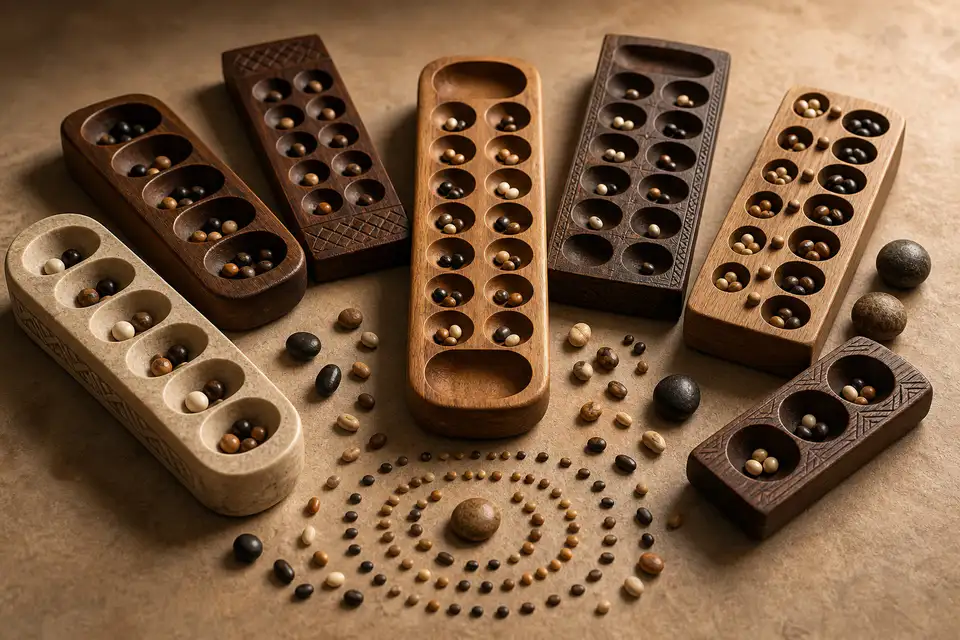
After Mancala: 10 games that use similar skills
What makes a game "like Mancala" is not just the sowing mechanic. It is a combination of traits: deterministic play or low-luck structure, tactile satisfaction, counting as a core skill, and repeatable sessions where a player can improve by reviewing one decision at a time.
Games that share Mancala's sowing mechanic
Five Tribes is the closest modern board game in physical action: you pick up a group of meeples and drop them one by one across adjacent tiles. The last meeple determines the action, so Mancala players immediately recognize the "count the landing point" habit even though the game is not a traditional mancala variant.
Trajan uses a mancala-style action-selection rondel. You pick up colored pieces from one bowl and distribute them around the ring; the final bowl controls which action you take. The mechanism rewards planning several turns ahead, which feels familiar to players who enjoy long sowing counts in Togyz Kumalak or Oware.
Gold West applies a sowing-like track to resource management. It is not a direct Mancala relative, but it gives the same satisfaction of moving resources through a sequence and deciding where the final value lands.
Abstract strategy for Mancala minds
Mancala players who like counting, territory and clear board states often enjoy abstract strategy games. The rules are different, but the learning loop is similar: count, forecast, make a move, and review whether your timing was right.
Go is a territory game with complete information. It does not use sowing, but it rewards counting liberties, territory and captures. A Togyz Kumalak player will not automatically become strong at Go, but the habit of counting future consequences transfers well.
Hive has no fixed board. Pieces connect to each other and the position grows during play. Like Mancala, it rewards players who see how one move changes the future shape of the board.
Santorini is a compact 3D abstract game. The core loop - move, build, block - is simple, but the vertical board adds spatial calculation that many Mancala players enjoy.
Azul is not an abstract duel in the same way, but it matches Mancala's tactile appeal. Drafting tiles and placing them into patterns gives the same physical clarity as moving seeds into pits.
Patchwork is a two-player spatial puzzle with visible information. It is a quieter game than Oware or Kalah, but it keeps the same short-session and "one decision changed everything" feeling.
Ancient strategy and race games
Chess is the obvious comparison because it is another complete-information strategy game. The transfer is partial: Mancala trains counting and sequencing, while chess trains pattern recognition, piece coordination and king safety. The shared value is disciplined calculation.
Xiangqi is a faster tactical chess-family game. It is useful for Mancala players who want more direct contact and shorter tactical sequences than Western chess usually provides.
Senet is an ancient Egyptian race game documented from archaeological contexts. It is an interesting historical companion, but it should not be described as a direct Mancala sibling without careful sourcing. Unlike Mancala-family games, Senet includes chance elements through casting sticks or similar randomizers.
What partners of Mancala players often enjoy
When players ask for alternatives to Kalah or Mancala in board-game communities, the useful pattern is practical rather than historical. The best recommendations usually have clear rules, visible information, pleasing components, short sessions, and no early player elimination.
- Clear rules: learnable quickly, without a long rules lecture.
- Tactile pieces: stones, tiles, meeples or chunky pieces matter.
- Visible information: the player can review why a move worked.
- Short sessions: a rematch is easy.
- No early elimination: both players stay involved.
Top candidates from that pattern are Five Tribes for the sowing mechanism, Azul for tactile drafting, Patchwork for a calm two-player puzzle, Santorini for compact spatial tactics, and Hive for chess-like pressure without a full board setup.
Rare Mancala variants worth discovering
Beyond Kalah and Oware, the mancala family contains many regional games. Some are well documented; others appear mostly in local descriptions or academic notes. Keep the distinction clear: a game can be culturally important even when public English-language sources are limited.
Pallanguzhi is a South Indian mancala-family game often described with a two-row board and small seeds or shells. Cultural and educational claims should be tied to local sources rather than repeated as universal facts.
Enohoy or related East African names appear in discussions of regional mancala traditions. Before using exact initiation, tournament or age-grade claims, cite a local ethnographic or rules source for the specific community and period.
Congkak/Congklak is the Malay-world family connected to Indonesian, Malaysian, Singaporean and Philippine names such as Congklak, Congkak, Dakon and Sungka. It is useful to compare against Kalah because pit counts, direction and captures can change the whole strategy.
Regional names: what Mancala is called around the world
| Region | Name | Careful note |
|---|---|---|
| Ghana and neighboring regions | Oware / Awale | Well-known two-row Mancala family; rules differ by local tradition. |
| South India | Pallanguzhi / Pallanguli | Commonly described as a two-row seed game; cultural claims need local sourcing. |
| Malaysia and Singapore | Congkak | Malay-world related game; compare rules before assuming Kalah tactics. |
| East Africa | Bao | Four-row Swahili-board tradition with specialized rules and vocabulary. |
| Philippines | Sungka | Related Southeast Asian game discussed in cultural-contact scholarship. |
| Kazakhstan | Togyz Kumalak | Nine-pit Central Asian game with tuzdyk and even-count capture logic. |
Practice Supported Mancala Variants
On Toguz Arena, you can practice supported Mancala-family games in the browser: Kalah, Oware, Mangala, Bestemshe and Togyz Kumalak. Use them to train counting and tempo, then use source-backed local rules when you study a regional game that is not yet playable on the platform.
Sources and fact-check notes
- Complete Mancala rules family guide - internal rules hub for supported variants and careful comparisons.
- Sungka, Congklak and Pallanguzhi comparison - related Southeast Asian and South Asian variant notes.
- Congklak / Congkak rules and context - focused regional comparison page.
- Senet overview - general orientation for the ancient Egyptian race game.
- Philippine Sungka and cultural contact in Southeast Asia - scholarly context for the regional Sungka/Congklak family.
Frequently Asked Questions
What board game is mechanically closest to Mancala?
Five Tribes is the closest modern board game by hand action because players pick up pieces and drop them one by one. Trajan uses a mancala-style rondel for action selection.
What games do Mancala players usually like?
Good matches include Five Tribes, Trajan, Azul, Patchwork, Santorini, Hive and Go. They preserve some mix of counting, tactile play, visible information or short repeatable sessions.
Is Senet a Mancala game?
No. Senet is an ancient Egyptian race game and an interesting historical comparison, but it is not a sowing game in the Mancala family.