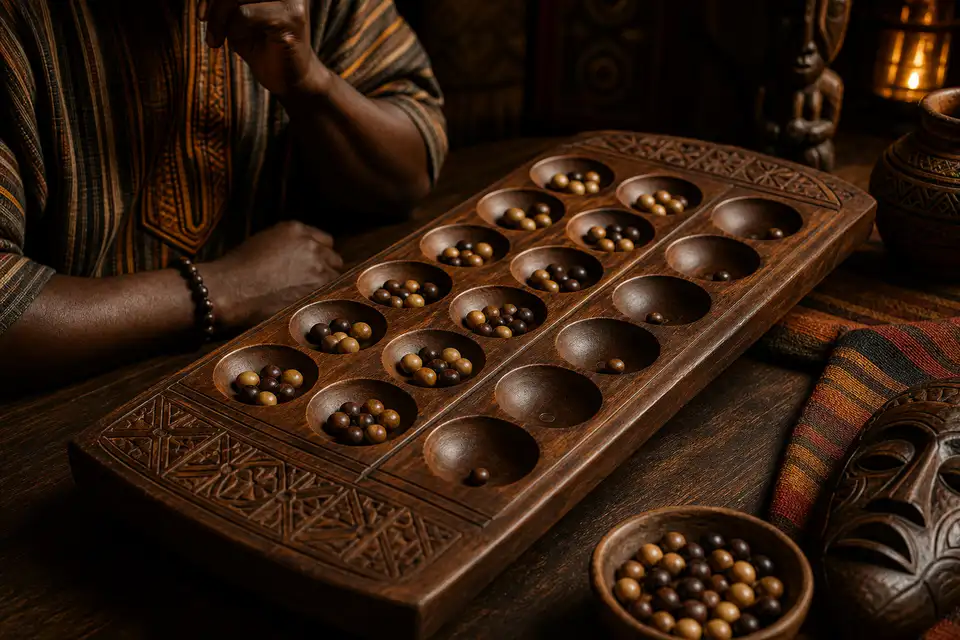
Why this rule confuses good beginners
Most beginners learn Oware as a clean capture game: sow seeds, land on the opponent's side, make two or three, and collect. That basic rule is true, but it is not the whole rule. The game also protects the ability of both sides to keep moving.
The confusion appears when a large chain capture looks beautiful on the board. You may see three or four opponent houses ready to fall, then notice that taking them would leave the opponent with no seeds. In Kalah, a big capture is usually just a big capture. In Oware, it can become a rules question.
This is why the topic deserves its own page. The general Oware / Awale rules guide explains the full game. This article narrows the lens to starvation, feeding, and grand slam so you know what to check before treating a dramatic capture as a point swing.
What starvation means in Oware
Starvation means one player has no seeds on their side and cannot make a move unless the opponent gives them seeds. Oware does not normally reward killing the board. If you can feed the opponent, common Abapa-style rules require you to do it.
In practical terms, the feeding rule changes the order of calculation. Do not start by asking how many seeds you can take. Start by asking whether the opponent will have a legal move after your candidate move. If they do not, ask whether you had another move that would feed them.
This does not make Oware soft. It makes the tactics stricter. A strong player uses the feeding rule to control timing, not to avoid competition. The best move may score less now because it forces the opponent to return seeds into a better capture shape later.
What a grand slam means
A grand slam is a move that would capture every seed from the opponent's side. It usually happens through a backward capture chain: the final seed lands on an opponent house that becomes two or three, then the houses behind it also contain two or three and can be captured in sequence.
The important point is that the term describes the shape of the move, not a universal scoring result. A grand-slam-looking move may be legal, illegal, allowed without capture, or treated as forfeited capture depending on the rule set being used.
For online play, this matters because platforms may implement a specific variant. For club or tournament play, the arbiter or published rule sheet matters more than a slogan remembered from another board. Treat a grand slam as a prompt to check the rules, not as an automatic payday.
Rule-variant caveat box
The safest way to write about this rule is to name the source and the treatment. The table below is not a federation ruling. It is a reader-facing map of the public sources used for this article.
| Rule situation | Source-backed treatment | Reader action |
|---|---|---|
| Opponent has no seeds before your move | If a feeding move exists, you must choose a move that lets the opponent play. | Find the feeding move before calculating captures. |
| Grand slam on PlayStrategy | Allowed but no capture: PlayStrategy's Oware page says grand slam moves are allowed, but they do not capture any seeds. | Do not count the whole opponent side as captured on that platform. |
| Grand-slam-style capture under Oware Society Abapa wording | Capture forfeited: the Abapa page describes forfeiting a capture that would leave the opponent unable to play. | Check whether the large capture is cancelled by the rule sheet. |
| Casual board or tournament | Variant-sensitive: clubs and platforms may state their own handling. | Check the platform rule before a serious game. |
Three safe examples to count
Example 1: the ordinary feed. Your opponent has no seeds. One of your houses can sow far enough to place at least one seed on their side. In that case, the first task is not finding a capture. The first task is selecting a move that keeps the opponent able to play.
Example 2: the tempting chain. Your final seed would land on an opponent house and create a two. The previous opponent houses also show two or three. That looks like a chain capture, but before collecting the seeds, check the board after the capture. If the opponent's side would be empty, you are in the starvation/grand-slam zone.
Example 3: the platform check. You see a move that would remove every seed from the opponent's side. On one site this may be allowed but score nothing. Under another published Abapa wording, the capture can be forfeited. If the rule text is not visible, test the behavior in a casual bot game before relying on it in serious play.
How to ask the right question before a capture
A reliable Oware capture check has four questions: the landing house, the backward chain, the opponent's remaining row, and the rule set for that board. Ask them in order so that a tempting chain does not become an assumed score before you have checked the resulting board.
- Where does the last seed land? A capture starts only when it lands on an opponent house with two or three seeds.
- Which earlier opponent houses continue the chain? Count backward only while adjacent houses in the capture path also hold two or three seeds.
- What remains on the opponent's side after the chain? Do not score an imagined grand slam until you can see whether that row is empty.
- What does this board's rule set do then? Read the platform, club, or tournament rule before treating an empty opponent row as a capture result.
Most beginner mistakes happen because the fourth question is skipped. The player sees the first capture, follows the chain backward, and only notices the empty opponent side after the score has already been imagined. Good Oware calculation keeps the legal board state in view until the end.
Practical habit: say "capture shape, then feeding check" before you move. If that sentence feels slow, it is doing its job.
For strategy practice beyond this rule edge case, use the Oware beginner strategy guide. It covers tempo without stores, twos and threes, and a short practice drill that turns rules into board habits.
Practice drill on Toguz Arena
This page does not embed a board. It keeps the rule explanation crawlable and sends you to the live product only when you are ready to test the idea. Open Oware on Toguz Arena, play slowly, and pause whenever a capture would leave the opponent with very few seeds.
Use a three-game drill. In game one, ignore winning and call every final landing house before moving. In game two, call every backward chain before collecting. In game three, add the feeding question before every large capture. That sequence is enough to make grand-slam confusion visible.
If you want a guided practice entry point, start with Oware against the computer. If you want the trust layer around public Oware institutions, read Oware organizations and tournaments. If you are comparing games, the Kalah vs Oware page explains why Kalah's store race creates different instincts.
Sources and fact-check notes
- PlayStrategy: Oware rules - used for platform wording on feeding and grand slam treatment.
- Auale / Joan Sala Soler: how to play Oware - used for Oware setup, sowing, capture and endgame context.
- Oware Society: Abapa rules - used for Abapa wording around feeding and forfeited captures; the HTTP URL was the reachable source in the earlier source packet.
Limit: this article teaches how to recognize the rule question. It is not a tournament ruling and does not claim that every Oware platform handles grand slam the same way. Before serious play, use the rule sheet attached to that board, club, event, or platform.